


Acarospora glaucocarpa

Cave Dale, Derbyshire
The scattered, wavy-edged thallus of this lichen makes it generally easy to recognised in its calcareous habitat. The thallus areoles often have distinctive pruinose margins, as shown here.
The similar A. cervina has a pruinose covering on much of the areole surface, areoles which are rounded and lobed and apothecia which are red when wet.
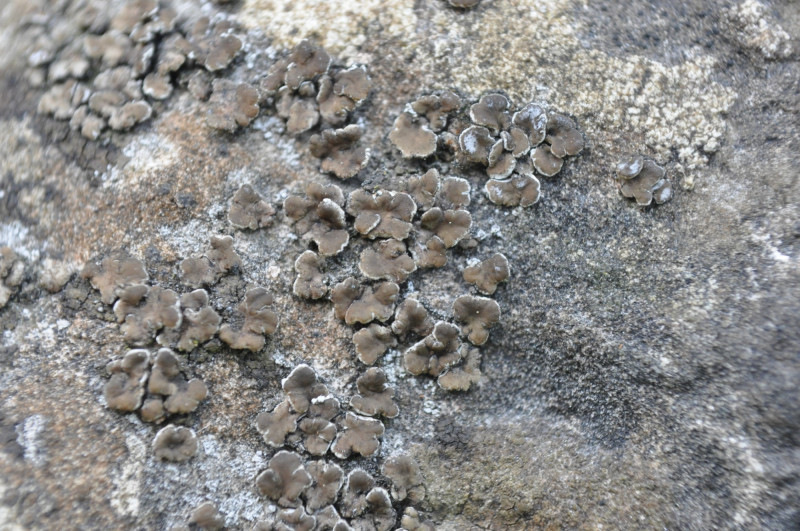
The similar A. cervina has a pruinose covering on much of the areole surface, areoles which are rounded and lobed and apothecia which are red when wet.
Acrocordia conoidea
image coming soon!
Monks Dale NNR, Derbyshire
Monks Dale NNR, Derbyshire
A common lichen of hard, shaded limestone, A. conoidea is one of four rock-dwelling members of the genus in Britain. Its most distinctive field character is the black, conical perithecium - these are dispersed evenly across the pale, immersed thallus. A. salweyi is similar and also occurs widely on limestone - it lacks flattened apices on the perithecia and has smaller ascospores.
Anaptychia runcinata

Valley of Stones NNR, Dorset
This conspicuous brown lichen with strap-shaped lobes is a common species around much of coastal Britain.
Two Anaptychia species occur here - the other, A.ciliaris, is epiphytic and also coastal (two subspecies occur), but is greyish, with tomentose upper surfaces.
Two Anaptychia species occur here - the other, A.ciliaris, is epiphytic and also coastal (two subspecies occur), but is greyish, with tomentose upper surfaces.
Arthrorhaphis citrinella

Ben Lawers NNR, Perthshire
This montane lichen is widespread at higher altitudes in Britain. It lacks a distinctive thallus shape, being made of small squamules with an eyecatching yellow-green colour. The surface is sorediate.
This species resembles the rarer A.alpina, but that species lacks soredia and has smaller ascospores.
This species resembles the rarer A.alpina, but that species lacks soredia and has smaller ascospores.
Aspicilia contorta ssp.contorta

Coombs Dale SSSI, Derbyshire
This species is a common member of the limestone lichen community often seen here in Derbyshire. It has a thallus composed of scattered, convex, white areolae and a very indistinct greyish-white prothallus in between them.
This species is similar to A.calcarea, which occurs in the same habitats but has a much more obvious, thickened thallus and areoles gathered at the margins.
Thanks to Synan for the identification.
This species is similar to A.calcarea, which occurs in the same habitats but has a much more obvious, thickened thallus and areoles gathered at the margins.
Thanks to Synan for the identification.
Aspicilia contorta ssp. hoffmanniana

Tideslow Rake SSSI, Derbyshire
The prominent apothecia above a grey, indistinct thallus help to identify this common lichen of calcareous rocks.
Thanks to Steve Price for the identification.
Thanks to Steve Price for the identification.
Bagliettoa baldensis (syn. Verrucaria baldensis) (probably)

Coombs Dale SSSI, Derbyshire
Another of the typical pale lichens which grow as patches on hard limestone, this species is common throughout Britain, and much of the northern hemisphere.
Key identifying features of this species are the white thallus with immersed perithecia which are rather densely gathered together. Other features can only been determined my microscopical measurements, hence the identity of the specimen photographed here cannot be fully resolved.
Thanks to Synan for the identification.
Key identifying features of this species are the white thallus with immersed perithecia which are rather densely gathered together. Other features can only been determined my microscopical measurements, hence the identity of the specimen photographed here cannot be fully resolved.
Thanks to Synan for the identification.
Bacidia bagliettoana

Tideslow Rake SSSI, Derbyshire
Bacidia is a very diverse genus of crustose lichens and they can be difficult to identify without microscopical analysis. B. bagliettoana is a species found on decaying plant material or living mosses on open, calcareous ground. The pale, slightly granular, uneven thallus and scattered black apothecia help to identify it. Bilimbia sabuletorum is a similar species which sometimes has black apothecia - in these situations, the ascospores need to be measured to confidently distinguish between the two.
Thanks to Steve Price for the identification.

Thanks to Steve Price for the identification.
Belonia nidarosiensis

Monks Dale NNR, Derbyshire
A common lichen of dry limestone rocks, this species can often be spotted from a distance, as it is such a different colour to other typical limestone species. Patches of this lichen can cover extensive areas, especially under overhangs on crags.
The orange-pink colour is highly distinctive. Apothecia are not recorded for this species, which is often present as a sterile crust.
The orange-pink colour is highly distinctive. Apothecia are not recorded for this species, which is often present as a sterile crust.
Bryobilimbia ahlesii (syn. Lecidea ahlesii)

Birks of Aberfeldy, Perthshire
Text coming soon!
Bryoria fuscescens


Morrone Birkwood SSSI, Braemar
Britain's commonest Bryoria can be seen in a variety of habitats, from exposed siliceous rocks to tree bark in acidic woodlands.
Although other Bryoria species are superficially similar, this variable species can be recognised by the pale base to the branches, overall smoky-brown colour with a matt surface and the soralia being present as both fissural and tuberculate growths.
Although other Bryoria species are superficially similar, this variable species can be recognised by the pale base to the branches, overall smoky-brown colour with a matt surface and the soralia being present as both fissural and tuberculate growths.
Bryoria sp


Morrone Birkwood NNR, Braemar
Text coming soon, pending id.
Caloplaca aurantia

Monks Dale NNR, Derbyshire
Caloplaca is a large genus of crustose/leprose lichens, with over sixty species found in Britain.
C. aurantia is one of the commonest memebrs of the genus, occurring on sunlit, calcareous rocks. It is easily recognised by the flattened tips to the thallus lobes.
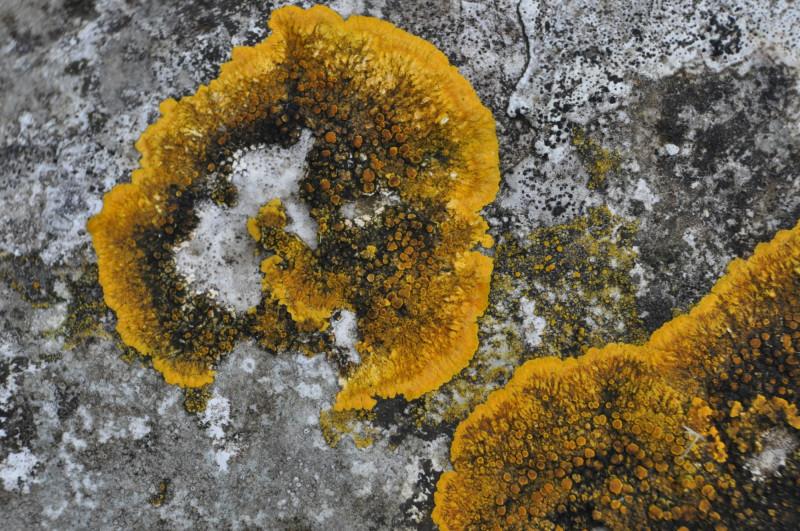
C. aurantia is one of the commonest memebrs of the genus, occurring on sunlit, calcareous rocks. It is easily recognised by the flattened tips to the thallus lobes.
Caloplaca dichroa


Bonsall Leys SSSI, Derbyshire
Text coming soon!
Caloplaca flavescens


Deep Dale, Derbyshire
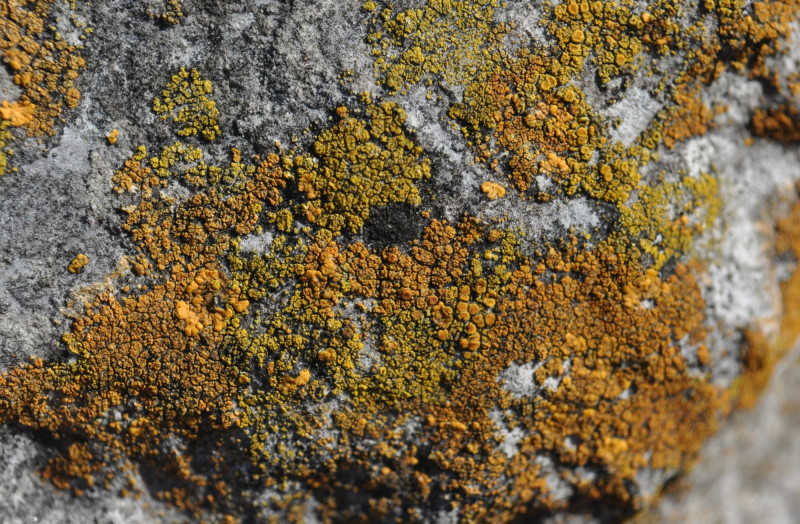
This very common species can be found on almost any sunlit, calcareous rocks in Britain. It resembles some other Caloplaca species, but is usually identifiable by its narrow lobe ends to the thallus, which often have pruina, and the dark orange apothecia.
Caloplaca flavovirescens

Morrone Birkwood SSSI, Cairngorms
C. flavovirescens is a species of calcareous rocks, recognisable by its deep orange apothecia and broken, uneven thallus. It is widely distributed in Britain where suitable rock occurs.
Caloplaca holocarpa

Dirtlow Rake, Peak District, Derbyshire

Conies Dale, Peak District, Derbyshire
Text coming soon!
Caloplaca oasis
image coming soon!
Cunning Dale, Peak District, Derbyshire
Cunning Dale, Peak District, Derbyshire
Text coming soon!
Candelariella coralliza

Ben Lawers NNR, Perthshire
This primarily upland species occurs on well-lit, siliceous outcrops. It can be distinguished from the similar C. vitellina by its golden (not orange) thallus. The colony shown here has a cracked thallus, but it may be smooth in other populations.
Cetraria islandica

Morrone Birkwood SSSI, Braemar
This attractive species is typical of montane heath habitats on mountain summits in northern Britain. The flattened, mostly unbranched lobes help to identify C. islandica.
Cetraria muricata

Cronkley Fell, Teesdale

Artilligan SSSI, Argyll
Text coming soon!

Ben Lawers NNR, Perthshire
Ben Lawers NNR, Perthshire
Cladonia bellidiflora

Craighoyle Wood SSSI, Cowal, Scotland
Text coming soon!
Cladonia furcata ssp. furcata

Morrone Birkwood SSSI, Braemar
One of several Cladonias with very slender podetia, C. furcata can be recognised by the pointed apices to the podetia and dichotomous branching habit. C. gracilis (see below) is similar and equally common in similar habitats. Its podetia have scyphi at the tips and its podetia are mostly unbranched.
Cladonia gracilis ssp. gracilis

with Cladonia ciliata (pale grey), Morrone Birkwood SSSI, Braemar
This species is described above with C. furcata.

The Cairnwell, Cairngorms
The Cairnwell, Cairngorms
Cladonia humilis

Kingston-on-Spey, Moray
Text coming soon!
Cladonia macilenta

Morrone Birkwood SSSI, Braemar
This Cladonia is distinctively greyish-blue in colour in all its parts. The basal squamules are small and the apothecia bright red (not present in the patch shown here). This species lacks scyphi.
Cladonia maxima

Glas Maol, Cairngorms
Text coming soon.

detail of swollen thallus base
detail of swollen thallus base
Cladonia pocillum

Deep Dale NR, Peak District, Derbyshire
One of the few Cladonias typical of calcareous habitats, C. pocillum is recognised by its well-developed basal rosette of overlapping, horizontal squamules. Like many other Cladonias, it bears podetia. These have a granular surface, much like C. pyxidata, to which it is very closely-related.
Cladonia portentosa

Tentsmuir NNR, Fife
This robust, finely-branched Cladonia is a typical species of moorland and coastal dunes, and is common in suitable habitat across Britain.
C. portentosa can be recognised by its randomly-orientated terminal branches, pale greenish-grey colour and rounded (broccoli-like, according to Smith, et al) habit.
C. portentosa can be recognised by its randomly-orientated terminal branches, pale greenish-grey colour and rounded (broccoli-like, according to Smith, et al) habit.
Cladonia rangiferina

Morrone Birkwood NNR, Braemar, Scotland

Tentsmuir NNR, Fife, Scotland
This primarily upland lichen has strikingly white podetia (under magnification, they are seen to have a cottony thallus surface). It is a typical species of montane heaths and northern, acidic woodlands.
C. rangiferina has characteristic branching in fours (see first photo) - the only other species that shares this and the previous character is C. stygia, which has a blackened base to the podetia. It is much rarer species.
C. rangiferina has characteristic branching in fours (see first photo) - the only other species that shares this and the previous character is C. stygia, which has a blackened base to the podetia. It is much rarer species.
Cladonia rangiformis

XXXX

Tentsmuir NNR, Fife

Morrone Birkwood SSSI, Braemar
C. rangiformis is a common lowland Cladonia, favouring neutral and basic habitats. Its most distintive feature is the densely-branched habit, with individual podetia having thin, spiky ends - this is not a Cladonia which bears scyphi ('cups' at the top of the podetia).
C. furcata (see above) is similar but is less branched, darker and has a negative K reaction.

C. furcata (see above) is similar but is less branched, darker and has a negative K reaction.
Cladonia squamosa var. squamosa

Craighoyle Wood SSSI, Cowal, Scotland
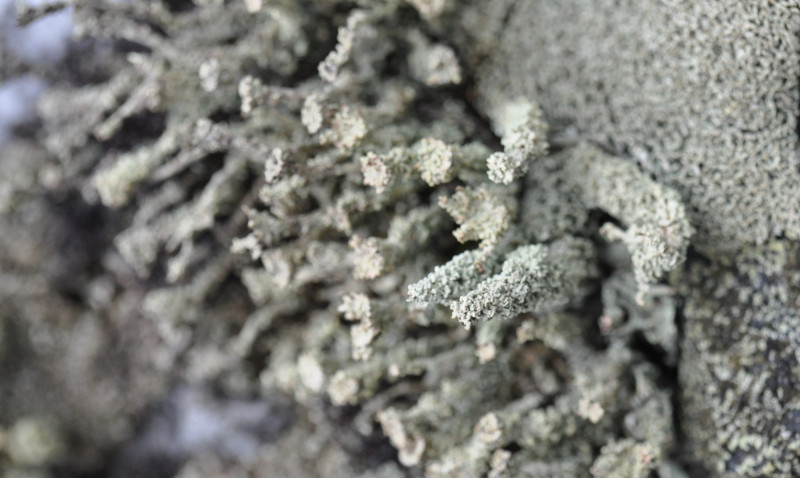
Named for the podetia being densely covered in tiny squamules, this common Cladonia occurs on a wide range of substrates, from sil to wood to damp, mossy rocks.
When present, apothecia are brown in this species but they are rare.
Morrone Birkwood SSSI, Braemar
When present, apothecia are brown in this species but they are rare.
Morrone Birkwood SSSI, Braemar
Cladonia subcervicornis

Craighoyle Wood SSSI, Cowal, Scotland
This unusual-looking Cladonia is largely dominated by its basal squamules, which are fairly large (up to 2cm), elongated, blue-grey and have characteristically blackened bases. The podetia are small in comparison and rather insignificant. Unlike many Cladonias, they are only rarely formed.
This species is typical of coastal and montane sites in the north and west of Britain. The patch shown here was growing on damp humus in an oceanic woodland.
This species is typical of coastal and montane sites in the north and west of Britain. The patch shown here was growing on damp humus in an oceanic woodland.
Cladonia uncialis ssp. biuncialis

Morrone Birkwood SSSI, Braemar
A common and conspicuous Cladonia of moorlands and open, acidic soils, this species is generally very easy to recognise. Its podetia are very pale and slender, with simple, dichotomous branching. The apices are usually tinged brown and have very small, narrow scyphi.
Cladonia sp

Cronkley Fell, Teesdale
Text coming soon!
Cladonia sp

Glen Shee
Text coming soon!
Cladonia sp (poss subcervicornis)

Morrone BIrkwood NNR, Cairngorms
Text coming soon!
Cornicularia normoerica

Ben Lawers NNR, Perthshire

with apothecia, Morrone Birkwood SSSI, Braemar
One of the easier montane lichens to identify, this very dark species forms characteristic cushions on siliceous rocks. Superfically, it resembles a moss but close inspection will reveal the total lack of leaves.
Cornicularia is common in upland areas of northern and western Britain.

Cornicularia is common in upland areas of northern and western Britain.
Collema auriforme


Monks Dale NNR, Derbyshire
This foliose lichen has a distinctively jelly-like consistency. It is a common species of damp crevices in limestone.
The similar C.fuscovirens also occurs in Derbyshire but is smaller, less swollen when wet and more closely-appressed to rocks.
The similar C.fuscovirens also occurs in Derbyshire but is smaller, less swollen when wet and more closely-appressed to rocks.
Degelia atlantica

Ballachuan Hazelwood, Ardnamurchan
Degelia is a small, mainly Southern Hemisphere genus with only three species in Britain. All three are restricted to the humid west where they are characteristic of coastal rocks and woodlands.
D. atlantica can be recognised by its knobbly thallus surface which is covered with abundant isidia. This species is not found on coastal rocks, unlike the other two.
D. atlantica can be recognised by its knobbly thallus surface which is covered with abundant isidia. This species is not found on coastal rocks, unlike the other two.
Degelia plumbea


Ballachuan Hazelwood, Ardnamurchan
This attractive species has a much thicker, plate-like thallus than D. atlantica. Unlike D. atlantica, it commonly has dark brown disc-like apothecia. It favours open woodland (as shown here) and will also grow on damp coastal rocks.
Dermatocarpon luridum

Rumbling Bridge, Strathbraan, Perthshire
This very distinctive species of base-rich river margins is common in the northern half of Britain where suitable rock occurs.
The large, non-pruinose lobes of the thallus which turn bright green when wet are a useful identification feature, as are the scattered holdfasts attaching it to the rock (all other Dermatocarpon species apart from D. intestiniforme have a single, central holdfast). Chemically, this is the only I+ Dermatocarpon species.

The large, non-pruinose lobes of the thallus which turn bright green when wet are a useful identification feature, as are the scattered holdfasts attaching it to the rock (all other Dermatocarpon species apart from D. intestiniforme have a single, central holdfast). Chemically, this is the only I+ Dermatocarpon species.
Dermatocarpon miniatum

Monks Dale NNR, Derbyshire

Taddington Dale, Derbyshire
This greyish-brown Dermatocarpon occupies two distinct habitats in Britain - in upland areas it grows along streams and rivers like other members of the genus, but in the lowlands (as pictured here) it grows on damp, sheltered limestone crags.
D. miniatum can be recognised by its single holdfast and, microscopically, by its short ascospores. In Derbyshire, it is the only member of the genus to occur on limestone crags away from running water.
D. miniatum can be recognised by its single holdfast and, microscopically, by its short ascospores. In Derbyshire, it is the only member of the genus to occur on limestone crags away from running water.
Flavocetraria nivalis


Morrone Birkwood SSSI, Braemar
As its name suggests, this is a lichen of cold, snow-covered habitats and is a speciality of the Cairngorm plateau in Scotland. Here, it can be a common species and a prominent member of the specialised boreal heath plant community found on mountain summits.
F. nivalis is an easy species to recognise, through a combination of habitat and the large, shrubby thallus with its very pale white-grey-yellow colouration.
F. nivalis is an easy species to recognise, through a combination of habitat and the large, shrubby thallus with its very pale white-grey-yellow colouration.
Flavoparmelia caperata

Artilligan SSSI, Argyll, Scotland
Britain's two Flavoparmelia species are quite similar in appearance. They are both lichens of tree bark and well-lit siliceous rocks and most frequent in the south and west of Britain.
F. caperata is distinguished by its often a large species with a yellow thallus (more noticeable when wet) and coarse, granular soredia. F. soredians is similar, but has much finer, flour-like soredia and is often smaller.
F. caperata is distinguished by its often a large species with a yellow thallus (more noticeable when wet) and coarse, granular soredia. F. soredians is similar, but has much finer, flour-like soredia and is often smaller.
Flavoparmelia soredians (probably)

Valley of Stones NNR, Dorset
The lichen shown here could well be F. soredians, but without knowing what to look for in the field, I didn't look at the surface with a hand lens. It does, however, look very finely-dusted with soralia. See the full description of F. soredians, above.
Fuscidea kochiana


Lochnagar, Grampians
Eleven Fuscidea species are present in Britain and fall into two roughly equal groups - those with soralia and those with apothecia. F. kochiana is in the latter group and is a distinctive species with a pale grey, cracked thallus and irregular, rounded, immersed apothecia. The most similar species is F. intercincta, which is a rare species of moist, sloping rocks, mainly in the Scottish Highlands.
F. kochiana is a widespread species in upland Britain, where it grows on exposed, coarse, siliceous rocks. Populations here in Derbyshire represent the south-eastern limit of this species' distribution in England.
F. kochiana is a widespread species in upland Britain, where it grows on exposed, coarse, siliceous rocks. Populations here in Derbyshire represent the south-eastern limit of this species' distribution in England.
Graphis sp

Text coming soon!

Graphis sp

Pin Dale, Castleton, Derbyshire
Text coming soon!
Gyalecta foveolaris

Ben Lawers NNR, Perthshire
Rarer than G. jenensis (see below(, this species occurs in similar damp, calcareous habitats, although it does not grow directly on rock, but rather on accumulated soil and decaying bryophytes.
G.foveolaris has a more granular thallus than G. jenensis (and G. geoica) but shares the distinctive sessile, pink apothecia with concave discs.
G. foveolaris and G. geoica are rather similar. The latter species has smaller apothecia, an unevenly-developed thallus and different ascospore structure. Only the former species is known from Ben Lawers.
G.foveolaris has a more granular thallus than G. jenensis (and G. geoica) but shares the distinctive sessile, pink apothecia with concave discs.
G. foveolaris and G. geoica are rather similar. The latter species has smaller apothecia, an unevenly-developed thallus and different ascospore structure. Only the former species is known from Ben Lawers.
Gyalecta jenensis

Ben Lawers NNR, Perthshire

Via Gellia, Peak District, Derbyshire
A common species of damp, sheltered calcareous rocks, this lichen is very small but very distinctive. The thin pinkish-grey thallus can be easily overlooked on dark limestone (as here) but the round, pink apothecia with thick, white margins make it easy to spot.
G. jenesis is the most common rock-dwelling species of Britain's nine Gyalectas.

below Cow Low, Castleton, Derbyshire
G. jenesis is the most common rock-dwelling species of Britain's nine Gyalectas.
below Cow Low, Castleton, Derbyshire