


Hypotrachyna taylorensis

Craighoyle Wood SSSI, Cowal, Scotland
Hypotrachynas are a group of pale, foliose lichens, typical of tree bark in northern forests. H. taylorensis is an oceanic species of acidic bark and rocks and is thus only found in the west of our country. It can be recognised by the pale thallus, which lacks soredia.
Icmadophila ericetorum

Craig Leek SSSI, Braemar, Scotland
This strikingly-coloured upland lichen is typical of damp, peaty habitats and on rotting wood. The pale pink apothecia and soft, granular thallus make it fairly easy to recognise.
This species can be seen across much of northern Britain and Ireland.
This species can be seen across much of northern Britain and Ireland.
Lecanora albescens
image coming soon!
Cunning Dale, Peak District, Derbyshire
Cunning Dale, Peak District, Derbyshire
A common species of well-lit limestone and other calcareous substrates, this lichen can be recognised by the all-white appearance of its thallus and apothecia, which have pale margins and discs which can be pink, brown or olive-coloured.
Lecanora chlarotera

Deep Dale, Peak District, Derbyshire
Text coming soon!

Lecanora muralis

Rumbling Bridge, Strathbraan, Perthshire
This very common lichen is a large Lecanora which forms characteristic yellow-green circular patches on calcareous rocks and man-made objects. Apothecia are very noticeable in this species, and present as dense groups of flat red-brown discs in the central areas of the thallus.
Lecanora polytropa

Ben Lawers NNR, Perthshire

Lochnagar, Grampians

Bar Brook, Eastern Moors, Derbyshire
L. polytropa is part of a group of similar species, typified by pale yellow, convex apothecia and a pale yellow-green thallus.
L. polytropa itself has pale yellow apothecia and an inconspicuous, immersed thallus. It is a typical species of siliceous rocks throughout Britain. The first of these photos doesn't show this very well. L. stenotropa is a somewhat rarer species that is best identified by measuring its spores, which are wider than those of L. polytropa. Any of these photos could actually be that species.
L. polytropa itself has pale yellow apothecia and an inconspicuous, immersed thallus. It is a typical species of siliceous rocks throughout Britain. The first of these photos doesn't show this very well. L. stenotropa is a somewhat rarer species that is best identified by measuring its spores, which are wider than those of L. polytropa. Any of these photos could actually be that species.
Lecidea lithophila or lapicida

Ben Lawers NNR, Perthshire
Both of these lichens are common species of upland, siliceous rocks and both have a characteristically pale grey thallus with rust-coloured patches. Separating these two species in the field is best done when the lichens are wet: the apothecia of L. lapicida remain black when moist, whereas those of L. lithophila turn dark brown. Microscopically, the two are easily separated by the violet I+ reaction of the medulla in L. lapicida.
Lepraria nivalis

Deep Dale NR, Derbyshire
This distinctive species is a characteristic member of the lichen community found on sheltered limestone crags here in Derbyshire.
Key features of L. nivalis are the rosette-like, granular thalli which are well knitted-together, rather than breaking off in small fragments, and the lack of apothecia (like all Lepraria).
Thanks to synan for the ID.

Monks Dale NNR
Key features of L. nivalis are the rosette-like, granular thalli which are well knitted-together, rather than breaking off in small fragments, and the lack of apothecia (like all Lepraria).
Thanks to synan for the ID.
Monks Dale NNR
Leproplaca xantholyta (syn. Caloplaca xantholyta)
image coming soon!
Deep Dale, Derbyshire
Deep Dale, Derbyshire
Text coming soon!
Leptogium plicatile

Cave Dale, Derbyshire
Text coming soon.

Lobaria pulmonaria


Glen Nant NNR, Argyll
Lobarias are among the most handsome of our native lichens and any ancient woodland containing them will almost certainly prove a rich habitat for all kinds of other species.
L. pulmonaria is the most widespread of Britain's four species and esy to recognise. When wet (as here) the lobes are bright green, turning to a brownish shade when dry. The upper surface is characteristically strongly ridged and wrinkled.
L. pulmonaria is the most widespread of Britain's four species and esy to recognise. When wet (as here) the lobes are bright green, turning to a brownish shade when dry. The upper surface is characteristically strongly ridged and wrinkled.
Lobaria scrobiculata or amplissima

Glen Nant NNR, Argyll
Text coming soon!
Lobaria virens

dry thallus state

wet thallus, Ballachuan Hazelwood, Seil, Argyll (both photos)
This oceanic Lobaria is the only species usually found with apothecia, which are a distinctive orange-brown colour. The thallus is green when wet but more greyish-brown when dry.


Melanelixia fuliginosa ssp. fuliginosa

Valley of Stones NNR, Dorset
This deep brown foliose lichen is characteristic of sunny, siliceous rocks and is common across much of Britain where they occur. It grows as patches over 10cm across with small, characteristically shiny lobes.
The other subspecies (glabratula) is described below.
The other subspecies (glabratula) is described below.
Melanelixia fuliginosa ssp. glabratula

Pollochro Wood SSSI, Loch Lomond, Scotland
At first sight, this lichen looks very different to M. fuliginosa ssp. fuliginosa. It differs in having a greenish-brown thallus and normally growing on bark (although the patch shown here was on a siliceous crag).
Myriolecis semipallida


Dirtlow Rake, Derbyshire
Text coming soon.
Thanks to Synan for the ID.

Thanks to Synan for the ID.
Myriospora smaragdula


Tideswell Dale, Derbyshire
Text coming soon!


Ochrolechia inaequatula


Artilligan SSSI, Argyll, Scotland (all photos)
This crustose lichen resembes a patch of pale grey coral when examined closely. Unlike most Ochrolechias, apothecia are unknown in Britain for this species. It is largley restricted to Scotland, with a handful of sites in north Wales, but is unknown in England.
Both O.androgyna and O.frigida look similar to this O.inaequatula but only the latter species has a Pd+ chemical reaction.

Both O.androgyna and O.frigida look similar to this O.inaequatula but only the latter species has a Pd+ chemical reaction.
Ochrolechia parella

Ardnamurchan Point, Ardnamurchan
This common Ochrolechia is primarily rock-dwelling, occurring on siliceous and slightly base-rich substrates. The apothecia on this species typically group together and are slightly angular, as can be seen in this photo.
Ochrolechia tartarea

Morrone Birkwood SSSI, Braemar

Craighoyle Wood SSSI, Cowal, Scotland
In upland areas, this lichen is often prominent on siliceous boulders, where its warty greyish-white thallus and abundant orange-brown, concave apothecia make it easy to recognise.
As the second photo shows, this species also occurs on acidic bark.
As the second photo shows, this species also occurs on acidic bark.
Ochrolechia sp

Glen Shee, Grampians, Scotland
Currently unidentified.
Opegrapha sp

Monks Dale NNR, Derbyshire
Text coming soon!

Ophioparma ventosa

Ben Lawers NNR, Perthshire

Morrone Birkwood NNR, Cairngorms
One of Britain's most characteristic lichens, this instantly-recognisable species is found on exposed, brightly-lit siliceous rocks, especially in upland areas.
The pale thallus contrasts starkly with the blood-red apothecia.

Ben Lawers NNR, Perthshire

Cronkley Fell, Teesdale
The pale thallus contrasts starkly with the blood-red apothecia.
Ben Lawers NNR, Perthshire
Cronkley Fell, Teesdale
Pannaria conoplea

Craighoyle Wood SSSI, Cowal, Argyll
Britain has only three members of this largely tropical genus of lichens, and all are rather rare. P. conoplea can be recognised by its blue-grey, irregular, foliose thallus with abundant bluish isidia. It is a species of humid woodland, commonest in western Scotland.
Pannaria rubiginosa

Glen Nant NNR, Argyll

Sonachan hazelwood, Ardnamurchan
Pannaria rubiginosa is a typical species of oceanic woodlands in the west, where it usually grows on bark.
P. rubiginosa can be rocgnised by its uniform blue-grey thallus and red-brown apothecia with pale margins. P. conoplea (above) can occur alongside it but lacks the abundant apothecia and has an irregular, incised thallus. Both share a similar distribution in Britain.

Sonachan hazelwood, Ardnamurchan
P. rubiginosa can be rocgnised by its uniform blue-grey thallus and red-brown apothecia with pale margins. P. conoplea (above) can occur alongside it but lacks the abundant apothecia and has an irregular, incised thallus. Both share a similar distribution in Britain.
Sonachan hazelwood, Ardnamurchan
Parmelia omphalodes


Morrone BIrkwood NNR, Braemar
Formerly Parmelia was a very large genus but has now been split up, leaving only five British species as 'true' Parmelias. They are all foliose lichens, typical of exposed, siliceous rocks, although some also occur on acidic bark and the very rare P. submontana only rarely occurs on rock.
P. omphalodes is a fairly common species in upland Britain and can be identified by its brownish upper surface which lacks isidia and soredia - instead it has pseudocyhellae. In this species they are distinct - those of the very similar P. discordans are indistinct.
P. omphalodes is a fairly common species in upland Britain and can be identified by its brownish upper surface which lacks isidia and soredia - instead it has pseudocyhellae. In this species they are distinct - those of the very similar P. discordans are indistinct.
Parmelia saxatilis

Ben Lawers NNR, Perthshire

Morrone Birkwood NNR, Cairngorms
The commonest Parmelia across much of Britain, P. saxatilis is often a conspicuous lichen on exposed boulders on moorland. It is typified by having isidia over its thallus surface - this species can become so densely isidiate that the lobes are obscured. It sometimes has the browned lobe tips we can see here (thanks to Synan from the iSpot community for the id and info).
P. saxatilis lacks the pseudocyphellae of P. ompahlodes and discordans, and the soredia of P. sulcata and submontana.

P. saxatilis lacks the pseudocyphellae of P. ompahlodes and discordans, and the soredia of P. sulcata and submontana.
Peltigera collina

Craighoyle Wood SSSI, Cowal
This medium-sized Peltigera has an oceanic distribution in Britain, with nearly all records from Scotland, Cumbria, western Wales, Devon and Cornwall. There are a few records from along the south coast, but the species is totally absent from central and eastern England.
This species is easy to recognise because its thallus lobes are rimmed by a fine grey 'fuzz' of soralia - no other British Peltigera species has these. It is always found in humid conditions, growing on bryophyte-covered trunks or rocks.
This species is easy to recognise because its thallus lobes are rimmed by a fine grey 'fuzz' of soralia - no other British Peltigera species has these. It is always found in humid conditions, growing on bryophyte-covered trunks or rocks.
Peltigera hymenina


Pollochro Wood SSSI, Loch Lomond

Ben Lawers NNR, Perthshire
Along with P. membranacea, this is the commonest of Britain's twenty or so Peltigera species. Its most noticeable character is the presence of red-brown veins on the underside of the thallus.
This species is common throughout Britain and can grow quite large, with patches covering tens of centimetres in sheltered, permanently damp sites like woodland.

This species is common throughout Britain and can grow quite large, with patches covering tens of centimetres in sheltered, permanently damp sites like woodland.
Peltigera malacea
image coming soon!
Findhorn Dunes, Moray
Findhorn Dunes, Moray
Text coming soon!
Peltigera membranacea


Glen Nant NNR, Argyll

Hob's House, Monsal Dale, Derbyshire

Glencoyne Wood, Lake District, Cumbria
One of the most easily-identified of our foliose lichens, this handsome, large species has a similar grey thallus to P. hymenina but is tomentose and the underside has white veins instead of brown. The rhizines are also a different shape - in this species they have a furry surface, but in hymenina they are simple and smooth in appearance.
P. membranacea is common over most of Britain but is more strongly associated with shaded, damp, mossy habitats than P. hymenina.

in habitat, Hob's House
P. membranacea is common over most of Britain but is more strongly associated with shaded, damp, mossy habitats than P. hymenina.
in habitat, Hob's House
Peltigera sp

Ben A'an SSSI, Trossachs
Text coming soon!

Peltigera praetextata
Image coming soon!
Craighoyle Wood SSSI

Chee Dale SSSI, Derbyshire
Craighoyle Wood SSSI
Chee Dale SSSI, Derbyshire
This large and common Peltigera closely resembles P. membranacea and occurs in the same damp, mossy habitats, but can be recognised by the presence of scale-like schizidia/isidia on the margins of the thallus lobes. The underside also has flattened, rather than raised, veins with dark centres.
Thanks to Synan for the help with ID..
Thanks to Synan for the help with ID..
Peltigera leucophlebia


Ben Lawers NNR, Perthshire
One of the few bright green (when wet) Peltigeras in Britain, P. leucophlebia is a distinctive species with scattered black cephalodia embedded in the thallus surface and very dark veins on the thallus underside.
The similar (and rarer) P. venosa also occurs on Ben Lawers, but is much smaller, lacks the cephalodia and its thallus underside lacks rhizines and has the dark veins extending right to the margins - in P. leucophlebia, these veins are only present in the central, older areas of the thallus.
The similar (and rarer) P. venosa also occurs on Ben Lawers, but is much smaller, lacks the cephalodia and its thallus underside lacks rhizines and has the dark veins extending right to the margins - in P. leucophlebia, these veins are only present in the central, older areas of the thallus.
Peltigera sp
image coming soon!
Ben Lawers NNR, Perthshire
Ben Lawers NNR, Perthshire
Text coming soon!
Peltigera sp

Coire nam Beith, Glencoe
Text coming soon!
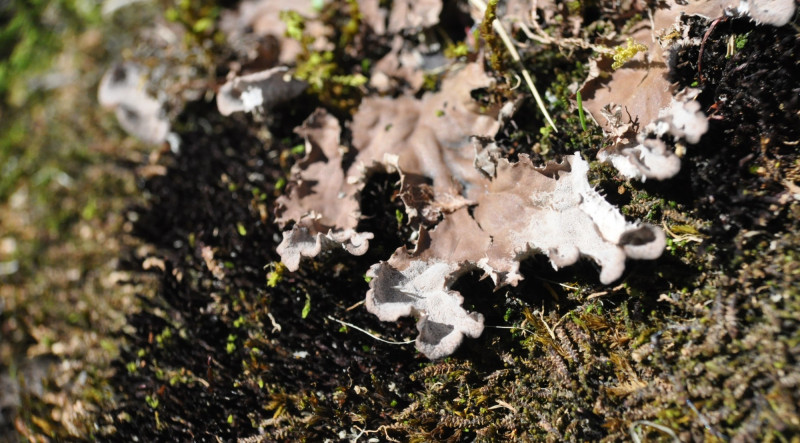
Pertusaria amara

Craighoyle Wood SSSI, Cowal
Pertusaria is a large genus of pale, crustose lichens. P. amara is a bark-dwelling species (usually) distinguished by its very pale thallus covered with small soralia. These are reputed to have a terribly bitter taste but I've not tried it (yet)!
P. amara is widespread in Britain where humid woodland occurs.
P. amara is widespread in Britain where humid woodland occurs.
Pertusaria pertusa

Inversnaid RSPB Reserve, Loch Lomond, Trossachs
Unlike P. amara above, this pale Pertusaria is frequently fertile, with apothecia present in the centre of raised warts which emerge from the central area of the thallus.
This species is most common on tree bark but can also occur on non-calcareous rocks.
This species is most common on tree bark but can also occur on non-calcareous rocks.
Physcia caesia

Dirtlow Rake, Derbyshire
image coming soon!
Conies Dale, Derbyshire
P. caesia is a typical species of exposed calcareous rocks, where it forms spreading, very pale patches, closely-pressed against the substrate. A typical habitat here in Derbyshire is is on the top of old drystone walls.
This species has characteristic blue-grey soralia, which occur in globular masses on the thallus. Apothecia are rare, but are shown in the third photo.
This species has characteristic blue-grey soralia, which occur in globular masses on the thallus. Apothecia are rare, but are shown in the third photo.
Placidium lachneum
image coming soon!
Ben Lawers NNR, Perthshire
Ben Lawers NNR, Perthshire
Text coming soon.
Placidium squamulosum (syn. Catapyrenium squamulosum)

Ben Lawers NNR, Perthshire
This dense lichen somewhat resembles a leafy liverwort at first sight. It is a species of soil patches in rocky habitats, often overgrowing mosses and can be recognised by its squamules not having dark margins and being pale below (although the squamules are usually attached by the entire underside, so this can be difficult to see.
Although the British Lichen Flora states this species as being English and Welsh, the NBN Atlas has scattered records from Scotland as well.
Although the British Lichen Flora states this species as being English and Welsh, the NBN Atlas has scattered records from Scotland as well.
Placopsis gelida

Ben Lawers NNR, Pertshire
This montane lichen is easily-recognised when the distinctive pink-brown cephalodia are present in the centre of the thallus.
The similar P. lambii has a shiny thallus, unlobed cephalodia and more frequent apothecia. It shares similar siliceous habitats and is the more common species in Britain.
The similar P. lambii has a shiny thallus, unlobed cephalodia and more frequent apothecia. It shares similar siliceous habitats and is the more common species in Britain.
Placynthium nigrum

Cave Dale, Derbyshire
A common lichen of calcareous rocks, P. nigrum is found as a black, finely-crustose thallus on slightly moist or damp surfaces. Its most distinctive feature is the blue-black prothallus.
Platismatia glauca


Glen Tilt, Perthshire
Text coming soon!

Porpidia macrocarpa

Wragg's Quarry, Derbyshire
On gritstone boulder.
Thanks to Synan for the ID.

Thanks to Synan for the ID.
Porpidia melinodes

Morrone Birkwood SSSI, Braemar
One of the commoner Porpidias in Britain, is a plant of siliceous rocks, especially those rich in metals. It typically has rust-tinged, cracked thallus with soralia at the margins and occasional, solitary apothecia, as shown here.
Porpidia tuberculosa

Corrie Fee NNR, Angus, Scotland

Morrone Birkwood SSSI, Braemar
This species and P. soredizodes are very similar and generally need chemical test to separate them reliably. Both are characterised by having a pale grey, sorediate thallus. P. soredizodes is smaller, with a thinner, darker thallus and a yellow K+ reaction for the soralia. It is largely a lowland species, unlike the more cosmopolitan P. tuberculosa.
Apothecia are occasional in this species, and shown here.
Thanks to Alan S from the iSpot community for the following id help: "Fertile state, with grouped black apothecia on a blueish crust. More frequently seen in asexual state, with crust covered by dark blue, powdery soredia. Not often I'll name a Porpidia to species, especially not one from a montane site likely to have numerous rare species, but this is quite distinctive."

Ben Lawers NNR, Perthshire
Apothecia are occasional in this species, and shown here.
Thanks to Alan S from the iSpot community for the following id help: "Fertile state, with grouped black apothecia on a blueish crust. More frequently seen in asexual state, with crust covered by dark blue, powdery soredia. Not often I'll name a Porpidia to species, especially not one from a montane site likely to have numerous rare species, but this is quite distinctive."
Ben Lawers NNR, Perthshire