


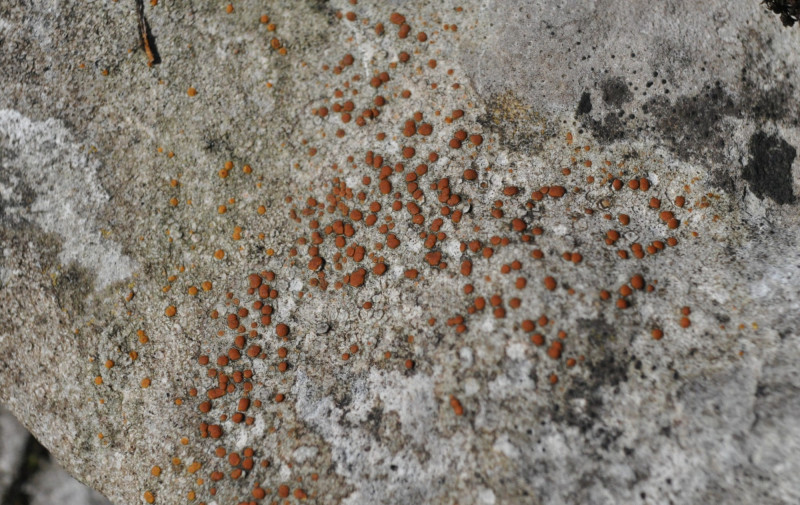
Protoblastenia sp

Conies Dale, Peak District, Derbyshire
Text coming soon!
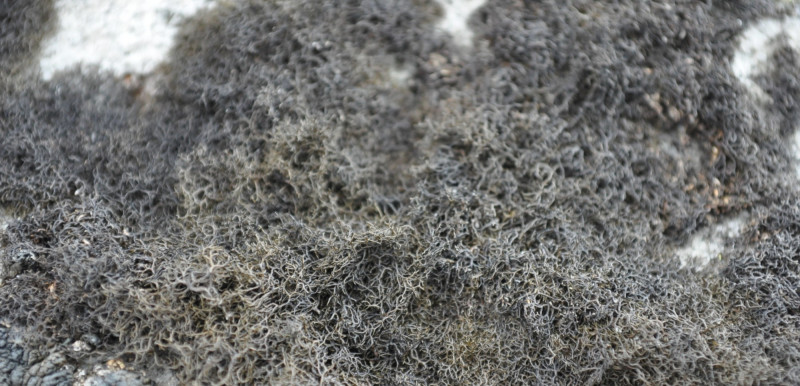
Pseudephebe pubescens

Ben Lawers NNR, Perthshire
This wiry lichen is a distinctive species of upland siliceous rocks in the north of Britain, where it can be locally common. It can be recognised by its richly-branched brown-black thallus and sprawling habit.
Cairnwell SSSI, Cairngorms
Cairnwell SSSI, Cairngorms
Pseudevernia furfuracea


Glen Tilt, Perthshire (this and previous photo)

Morrone Birkwood SSSI, Braemar
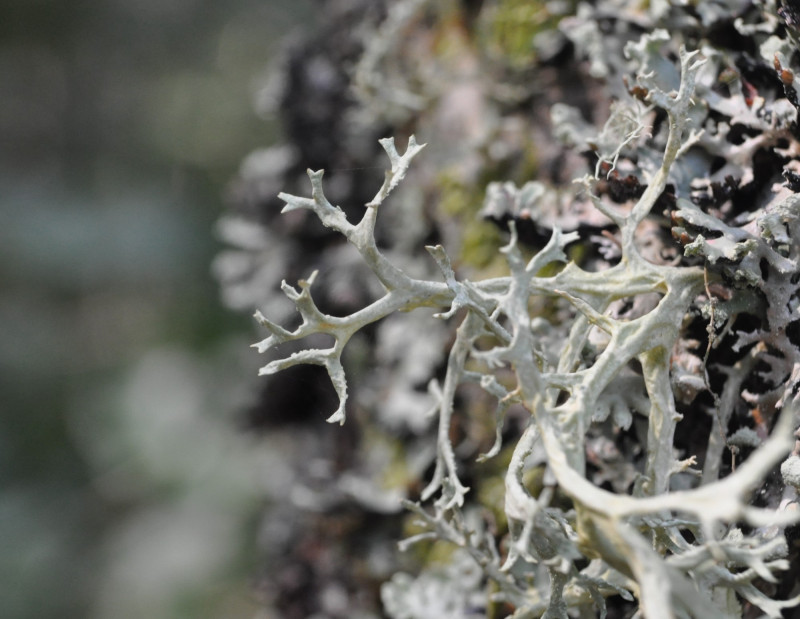
Common in many parts of Britain, P. furfuracea is a typical species of tree bark and old wooden fence posts, stc. It can be recognised by having isidia on the upper surface of thallus, which give it a rough texture.
The similar E. prunastri is more greenish and lacks isidia and a black underside to the thallus.
The similar E. prunastri is more greenish and lacks isidia and a black underside to the thallus.
Pseudocyphellaria crocea


Glen Nant NNR, Argyll
Pseudocyphellarias are a group of beautiful lichens, made more exotic by being confined to some of most pristine, oceanic woodlands.
P. crocea is named for the yellow pseudocyphellae. It can be further recognised by its coarsely-ridged upper thallus (although ths can be smooth) and Pd+ chemical reaction.
P. crocea is named for the yellow pseudocyphellae. It can be further recognised by its coarsely-ridged upper thallus (although ths can be smooth) and Pd+ chemical reaction.
Pseudocyphellaria norvegica

S side of Ardnamurchan Peninsula, Scotland
P. norvegica is the most widespread member of the genus in Britain, although it is still very uncommon anywhere except the wet west coast of Scotland.
This species can be identified by its red-brown upper thallus, which has marginal soralia. In this respect, it is like P. intricata, but the soralia are lilac-tinged when fresh and short thallus lobes. Chemically, it has a KC+ chemical reaction.
This species can be identified by its red-brown upper thallus, which has marginal soralia. In this respect, it is like P. intricata, but the soralia are lilac-tinged when fresh and short thallus lobes. Chemically, it has a KC+ chemical reaction.
Psora decipiens
image coming soon!
Ben Lawers NNR, Perthshire
Ben Lawers NNR, Perthshire
Text coming soon.
Ramalina fraxinea

Salt Lake Quarry, North Yorkshire
Ramalina species tend to have a distinctive appearance, with a thallus made of many flattened, tufted lobes. Typically, they occur on tree branches, but some species also occur on rocks.
R. fraxinea is an exclusively bark-dwelling species of open, exposed habitats, such as scattered trees in upland areas. Unlike many of our lichens, this species is absent from the west, preferring the drier eastern side of the country.
R. fraxinea can be recognised by the crumpled surface of its pale grey, matt thallus, the branches of which are broad (several centimetres at times).
R. fraxinea is an exclusively bark-dwelling species of open, exposed habitats, such as scattered trees in upland areas. Unlike many of our lichens, this species is absent from the west, preferring the drier eastern side of the country.
R. fraxinea can be recognised by the crumpled surface of its pale grey, matt thallus, the branches of which are broad (several centimetres at times).
Ramalina siliquosa

 Valley of Stones NNR, Dorset
A mainly coastal species, this common lichen occurs on siliceous rocks and less often on wooden structures and trees.
R. siliquosa can be recognised by its matt thallus surface, which is uniformly pale with no blackened areas.
R. siliquosa can be recognised by its matt thallus surface, which is uniformly pale with no blackened areas.
Rhizocarpon alpicola

Meall Odhar, Glen Shee, Cairngorms
Text coming soon!
Rhizocarpon geographicum

Ben Laers NNR, Perthshire
Upland siliceous rocks are often home to this very widespread and conspicuous lichen. Recent studies suggest it may be a group of very similar species, rather than one variable taxon.
Generally, R. geographicum can be recognised by its bright yellow-green thallus which has angular cracks and flat, black apothecia. The most similar species is R. lecanorinum but the areoles in that species form a smooth crescent shape around the apothecia. It is rarer species, confined to the north and west. R. eupetraeoides is an extremely rare species, known in Britain only from three mountains summits.
Generally, R. geographicum can be recognised by its bright yellow-green thallus which has angular cracks and flat, black apothecia. The most similar species is R. lecanorinum but the areoles in that species form a smooth crescent shape around the apothecia. It is rarer species, confined to the north and west. R. eupetraeoides is an extremely rare species, known in Britain only from three mountains summits.
Romjularia lurida

Monks Dale NNR, Derbyshire
A fairly common species of limestone crevices, R. lurida can be recognised by its small, rounded squamules which are strongly imbricate (arranged like tiles on a roof).
Romjularia is widespread in calcareous areas of northern and western Britain.
Romjularia is widespread in calcareous areas of northern and western Britain.
Scytinium pulvinatum (syn. Leptogium pulvinatum)

Hob's House, Monsal Dale, Derbyshire
Text coming soon!
Thanks to Synan for the ID.
Thanks to Synan for the ID.
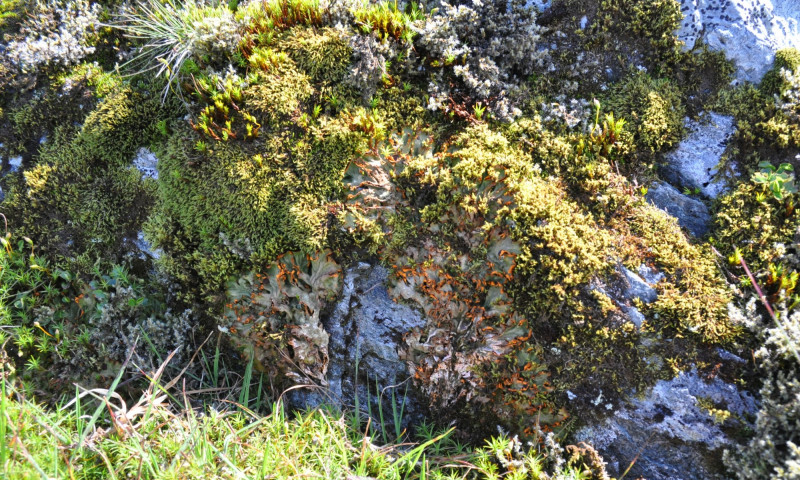
Solorina crocea


Ben Lawers NNR, Perthshire
This instantly-recognisable species is a classic montane lichen in Britain, especially on acidic soil and crags where snow lies later in the year. The bright orange colour is on the underside of the thallus - the upper surface is greyish-green.
In Britain, this species is only found in the Scottish Highlands, where it can be locally common.
In Britain, this species is only found in the Scottish Highlands, where it can be locally common.
Solorina saccata

Ben Lawers NNR, Perthshire
When wet, the thallus of this common calcicolous lichen turns bright green. This, combined with the bowl-like apothecia make it an easy species to identify. When dry, the thallus is white or pale brownish-grey.
Sphaerophorus fragilis

Cronkley Fell, Teesdale
Text coming soon!
Sphaerophorus globosus

Ben Lawers NNR, Perthshire

Morrone Birkwood SSSI, Braemar
The two British Sphaerophorus species are rather similar, shrubby lichens of montane rocks and humid tree trunks.
S. globosus can be recognised by its overall brownish colour and wide main stems on its branches. S. fragilis has more or less equally wide sterile branches and tends to be grey, rather than brown. Both species are most common in Scotland.
S. globosus can be recognised by its overall brownish colour and wide main stems on its branches. S. fragilis has more or less equally wide sterile branches and tends to be grey, rather than brown. Both species are most common in Scotland.
Squamarina cartilaginea


Harborough Rocks, Derbyshire
Text coming soon!
Stereocaulon nanodes (possibly)

Tideslow Rake SSSI, Derbyshire
Text coming soon!
Stereum rugosum
image coming soon!
Text coming soon!
Sticta fuliginosa

Craighoyle Wood SSSI, Cowal
Sticta is a small genus in Britain, with only five species, all typical of oceanic habitats. S.fuliginosa is widespread in Scotland and western England, where it grows in ancient woodland. It can be distinguished from other species by a combination of its brownish-grey thallus with smooth margins which is only slightly lobed, and the margin has clusters of cylindrical isidia.
The most similar species, S.sylvatica (see below) has a noticeably-lobed thallus and the isidia are bunched together in groups. Both species have very similar distributions in Britain.
The most similar species, S.sylvatica (see below) has a noticeably-lobed thallus and the isidia are bunched together in groups. Both species have very similar distributions in Britain.
Sticta sylvatica


Glen Nant NNR, Argyll
This species is described with its close cousin, S.fuliginosa, above.
Scytinium imbricatum
image coming soon!
Ben Lawers NNR, Perthshire
Ben Lawers NNR, Perthshire
Text coming soon.
Tephromela atra
image coming soon!
Ben Lawers NNR, Perthshire
Ben Lawers NNR, Perthshire
Text coming soon.
Thelidium papulare

Conies Dale, Derbyshire
Text coming soon!
Thelotrema lepadinum

Craighoyle Wood SSSI, Cowal, Scotland
Thelotrema species are usually bark-dwelling, crustose lichens, and this one is typical of ancient woodland.
It can be recognised by its raised apothecia and pale thallus.
It can be recognised by its raised apothecia and pale thallus.
Thelotrema petractoides

Craighoyle Wood SSSI, Cowal, Scotland
This terrible photo just about manages to show T. petractoides, a specialised inhabitant of the oceanic west of Britain. Here, it can be an abundant epiphyte in woodland where it favours smooth-barked trees like Hazel and Rowan.
Unlike T. lepadinum (above), the apothecia in this species lie level with the thallus and are hardly raised above it.
Unlike T. lepadinum (above), the apothecia in this species lie level with the thallus and are hardly raised above it.
Toninia aromatica

Tideslow Rake SSSI, Derbyshire
Text coming soon!
Toninia sedifolia

Conies Dale, Peak District, Derbyshire

Ballidon, Peak District, Derbyshire
Text coming soon!

Trapelia coarctata

Tideswell Dale, Derbyshire
A common Trapelia, with a distinctive smooth, pale thallus and contrasting red apothecia, this species can be seen on siliceous rocks across Britain.
Umbilicaria cylindrica


Lochnagar, Cairngorms
Largely montane in Britain, this attractive grey Umbilicaria is often common on exposed, sunlit siliceous rocks.
The often abundant marginal cilia are a characteristic feature of this species, as is the grey thallus with scattered gyrose apothecia.

Morrone Birkwood SSSI, Braemar
The often abundant marginal cilia are a characteristic feature of this species, as is the grey thallus with scattered gyrose apothecia.
Morrone Birkwood SSSI, Braemar
Umbilicaria polyphylla

Ben Lawers NNR, Perthshire
One of Britain's most widespread Umbilicarias, this species can be recognised by its red-brown, smooth thallus which is divided into many small, irregular lobes. The lower surface is smooth and black. Apothecia are very rare in this species.
Usnea cornuta (perhaps)

Artilligan SSSI, Argyll
Text coming soon!
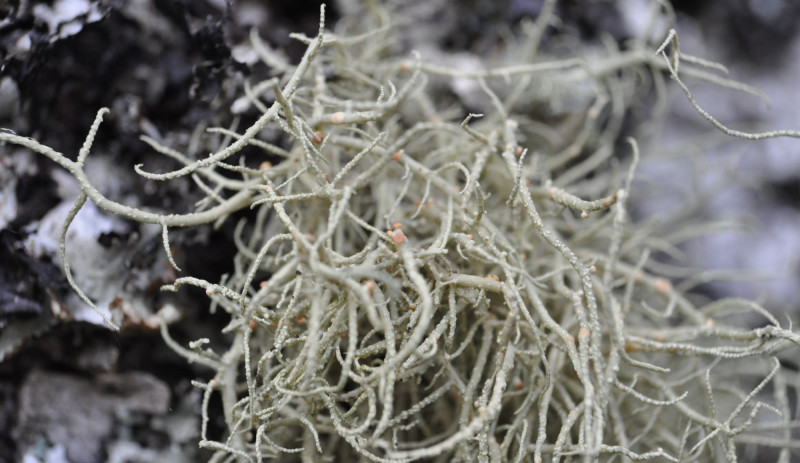
Usnea filipendula (perhaps)

Morrone Birkwood SSSI, Braemar
Usnea species are familiar colonists of tree branches, formy wipsy pale grey beard-like growths, especially in areas of low air pollution. Britain has a dozen or so species, which can be difficult to identify due their variability.
U. filipendula is one of the larger members of the genus in Britain, and can form pendent braches up to 30cm long. It always occurs on tree bark and is a common species in upland, exposed woodland. It is an extremely variable species (the plant shown here is not especially typical) but usually has fibrils sticking out at right angles from the branches and only rarely has soralia.
U. filipendula is one of the larger members of the genus in Britain, and can form pendent braches up to 30cm long. It always occurs on tree bark and is a common species in upland, exposed woodland. It is an extremely variable species (the plant shown here is not especially typical) but usually has fibrils sticking out at right angles from the branches and only rarely has soralia.
Usnea subfloridana (perhaps)

Morrone Birkwood SSSI, Braemar
The commonest Usnea over much of Britain, this species immediately differs from U. filipendula in lacking fibrils and in being shrubby, rather than pendulous in growth.
Key identifying features of this species are the blackened base of the stem and shape of the soralia, as well as various chemical reactions.
Key identifying features of this species are the blackened base of the stem and shape of the soralia, as well as various chemical reactions.
Usnea sp

Birks of Aberfeldy, Perthshire
Text coming soon!
Xanthoparmelia sp (deliseii probably)


Valley of Stones NNR, Dorset
Text coming soon!