


Anthelia juratzkana

path to Refuge de Carro, Vanoise PN

crags by Refuge d'Etendard, Saint-Sorlin-d'Arves
One of the most characteristic liverworts of open ground in late-snow areas, A.juratzkana is widespread in the French Alps.
I've described this species in more detail in the Liverworts of Ben Lawers NNR section of the site.
I've described this species in more detail in the Liverworts of Ben Lawers NNR section of the site.
Lophozia sp.
Image coming soon!
Text coming soon!
Barbilophozia lycopodioides

path to Refuge de Carro, Vanoise PN


Refuge d'Etendard, Saint-Sorlin-d'Arves
This is a widespread liverwort in the French Alps, where it typically grows in moist turf amongst grasses and low vegetation where it can remain partially shaded.
I've described this species in more detail in the Liverworts of Ben Lawers NNR section of the site.

I've described this species in more detail in the Liverworts of Ben Lawers NNR section of the site.
Scapania irrigua
 Terres Vielles, N side of Col du Galibier
S.irrigua is widespread in the French Alps in subalpine and alpine habitats, always where the soil remains damp.
This species is described in more detail in the Liverworts of Derbyshire section of the site.
This species is described in more detail in the Liverworts of Derbyshire section of the site.
Andreaea rupestris

Refuge d'Etendard, Saint-Sorlin-d'Arves
Six Andreaea species are recorded from Savoie, with A.rupestris being the most common.
This species is described in more detail in the Mosses of Cumbria section of the site.

in habitat
This species is described in more detail in the Mosses of Cumbria section of the site.
in habitat
Polytrichastrum sexangulare

path to Refuge de Carro, Vanoise PN
An in its Scottish haunts, this moss is a typical colonist of bare, acidic soil in snow hollows high in the mountains, where it typically occurs with Barbilophozia species and 'weedy' annual vascular species like Gnaphalium.
You can see photos of plants from Scotland here.
You can see photos of plants from Scotland here.
Distichium capillaceum

N side of Col du Galibier
This species is typical of damp fissures and recesses in calcareous rocks in montane areas. It is widespread in the Alps and easily recognised by its long, yellow seta and slender capsules.
D.capillaceum is described in more detail in the Mosses of Ben Lawers NNR section of the site.
D.capillaceum is described in more detail in the Mosses of Ben Lawers NNR section of the site.
Oncophorus integerrimus


path to Refuge de Carro, Vanoise PN

Tortella tortuosa

path to Refuge de Carro, Vanoise PN
This very common species is described in the Mosses of Ben Lawers NNR section of the site.
Schistidium aff.rivulare

Refuge d'Etendard, Saint-Sorlin-d'Arves
Text coming soon!
Schistidium atrichum

path to Refuge de Carro, Vanoise PN


mid-leaf cells
Text coming soon!

basal marginal cells
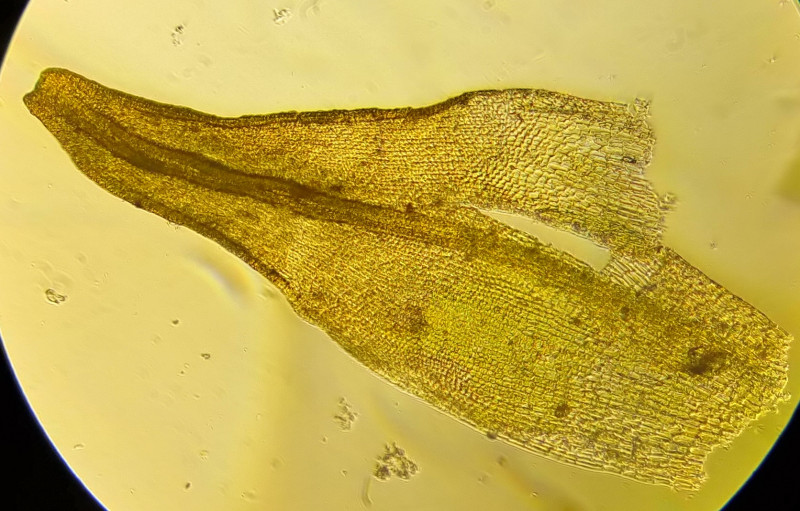
perichaetial leaf
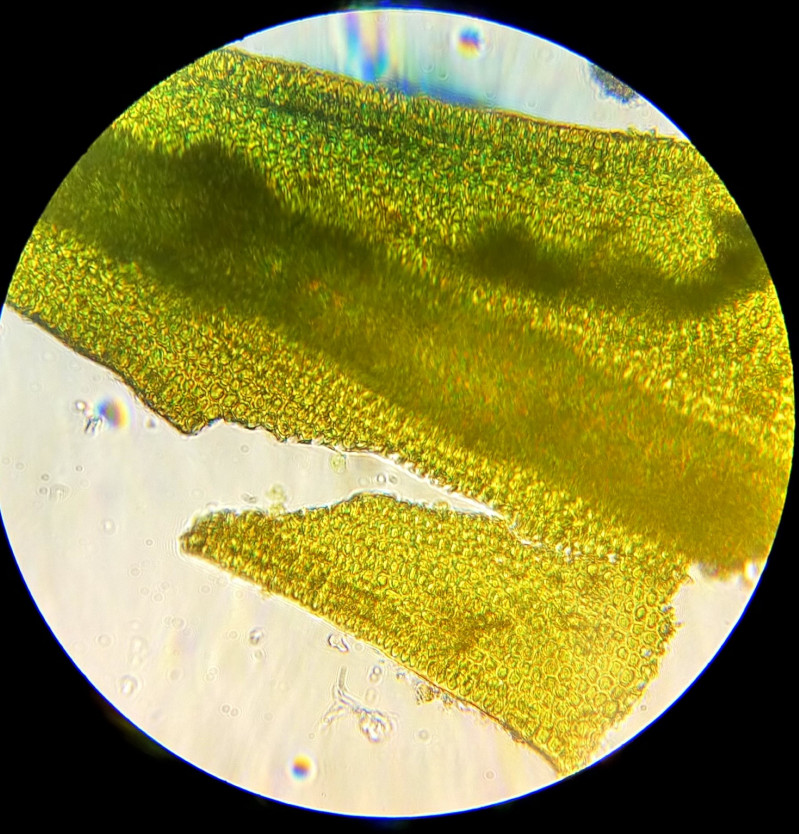
basal marginal cells
perichaetial leaf
Schistidium dupretii

N side of Col du Galibier
This species is described in the Mosses of Ben Lawers NNR section of the site.
Grimmia alpestris

path to Refuge de Carro, Vanoise PN
This common alpine species is described in the Bryophytes of the Maritime Alps section of the site.
Racomitrium canescens

Refuge d'Etendard, Saint-Sorlin-d'Arves

path to Refuge de Carro, Vanoise PN

N side of Col du Galibier
R.canescens is an attractive moss that is widespread in calcareous meadows in many parts of the French Alps. It is especially distinctive when dry, as the hair points become even more prominent.
This species is described in more detail in the Mosses of other areas of Scotland section of the site.
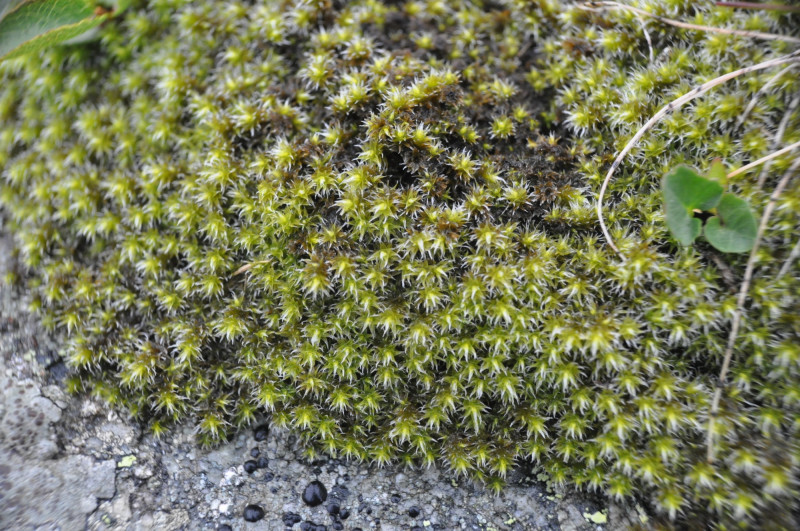
This species is described in more detail in the Mosses of other areas of Scotland section of the site.
Timmia austriaca

N side of Col du Galibier

leaf section, showing nerve (photo courtesy Tom Blockeel)
Timmias are an exotic rarity in Britain but visitors to the French Alps can see them flourishing as fairly widespread plants of calcareous rock ledges and mountain pastures.
T.austriaca is often separated from T.bavarica (below) by the colour of the leaf base: red or brown in austriaca and pale yellow or white in bavarica. This feature isn't always clear-cut - a definitive feature is the structure of the nerve in the leaf-base. A cross-section of T.austriaca (see image) shows it to lack stereids (small, very-thick-walled cells with only a tiny empty central part). That of T.bavarica (see separate account below) does have stereids, which are easily visible.
T.austriaca is often separated from T.bavarica (below) by the colour of the leaf base: red or brown in austriaca and pale yellow or white in bavarica. This feature isn't always clear-cut - a definitive feature is the structure of the nerve in the leaf-base. A cross-section of T.austriaca (see image) shows it to lack stereids (small, very-thick-walled cells with only a tiny empty central part). That of T.bavarica (see separate account below) does have stereids, which are easily visible.
Timmia bavarica


Refuge d'Etendard, Saint-Sorlin-d'Arves

leaf section, showing nerve (photo courtesy of Tom Blockeel)
Timmia bavarica is equally as widespread in the French Alps as T.austriaca and both occupy the same habitat and sometimes the same site. In my (albeit limited) field experience, T.bavarica seems to fruit fairly regularly, whereas I have never seen T.austriaca bearing capsules (although it certainly does).
As mentioned above, T.bavarica is best identified by its distinctive leaf section, although the pale leaf-base is a strong indicator of this species.


As mentioned above, T.bavarica is best identified by its distinctive leaf section, although the pale leaf-base is a strong indicator of this species.
Encalypta alpina

N side of Col du Galibier
E.alpina is widespread at high altitudes on calcareous schist and other base-rich rocks in the French Alps. For characters distinguishing it from other species, see the separate species accounts.
This common montane moss is described in the Mosses of Ben Lawers NNR section of the site.
This common montane moss is described in the Mosses of Ben Lawers NNR section of the site.
Encalypta rhaptocarpa

path to Refuge de Carro, Vanoise PN
This is an admittedly terrible photo, but I've added it for the sake of completeness in my surveys in Savoie! E.rhaptocarpa is widespread in the Alps and well-known from Savoie, albeit at slightly lower elevations than E.alpina and E.vulgaris.
This species is described in more detail in the Mosses of Ben Lawers NNR section of the site - I first saw this species in Scotland.
This species is described in more detail in the Mosses of Ben Lawers NNR section of the site - I first saw this species in Scotland.
Encalypta vulgaris

path to Refuge de Carro, Vanoise PN
In Britain, E.vulgaris is a species that avoids mountains. This can lead to false optimism when one heads to the continent, as high altitude Encalyptas in the French Alps can often prove to be this common (but still very attractive) species.
This species is described in the Mosses of Derbyshire section of the site.

This species is described in the Mosses of Derbyshire section of the site.
Encalypta affinis ssp. affinis

 path to Refuge de Carro, Vanoise PN
E.affinis is one of several Encalypta species not found in Britain but is fairly common in the northern part of French Alps - it may still occur further south in the Queyras but the records are pre-1990. Unusually for Encalyptas, it is not especially base-demanding and can be found on acidic siliceous rocks.
Visually, it is difficult to distinguish this species from others whose capsules bear a peristome such as E.rhaptocarpa. The most conclusive feature is the presence of forked papillae on the back of the cells at the leaf-base. No other Encalypta has this feature, and they are easy to see when present.
Two subspecies of E.affinis occur in the French Alps - the nominate form and a much rarer form, ssp.macounii. This is well-known from the Col du Galibier area and is distinguished by having the nerve ending below the leaf apex, rather than being shortly-excurrent.
Visually, it is difficult to distinguish this species from others whose capsules bear a peristome such as E.rhaptocarpa. The most conclusive feature is the presence of forked papillae on the back of the cells at the leaf-base. No other Encalypta has this feature, and they are easy to see when present.
Two subspecies of E.affinis occur in the French Alps - the nominate form and a much rarer form, ssp.macounii. This is well-known from the Col du Galibier area and is distinguished by having the nerve ending below the leaf apex, rather than being shortly-excurrent.
Encalypta affinis ssp.macounii

N side of Col du Galibier
Text coming soon!
Encalypta brevipes

N side of Col du Galibier
Text coming soon!
Bryum algovicum var. algovicum

Col du Galibier

path to Refuge de Carro, Vanoise PN
Bryum algovicum is a common species at high altitudes in the Alps, where it grows on thin, dry soil on rock ledges and patches of soil in scree. Alpine plants are var.algovicum. Lowland plants (and all those that occur in Britain) are var.rutheanum.
Like other small, green, fertile Bryums, this species cannot be confirmed in the field - the mature capsules must be analysed microscopically. B.algovicum is instantly distinctive in having cross-walls on the outer peristome teeth. Spotting this feature will rule out all other Bryums, which can be much more troublesome and time-consuming to identify!

leaf detail
Like other small, green, fertile Bryums, this species cannot be confirmed in the field - the mature capsules must be analysed microscopically. B.algovicum is instantly distinctive in having cross-walls on the outer peristome teeth. Spotting this feature will rule out all other Bryums, which can be much more troublesome and time-consuming to identify!
leaf detail
Bryum pallens
 N side of Col du Galibier
The pure pink colour of this small Bryum makes it easy to recognise and one of the few that can be identified in the absence of capsules.
It is found on wet or damp soil - the colony shown in this very poor photo was growing on a small soil 'cliff' above a mountain stream with Scapania irrigua.
B.pallens is a common species in the French Alps and occurs at all elevations in suitable habitat.
It is found on wet or damp soil - the colony shown in this very poor photo was growing on a small soil 'cliff' above a mountain stream with Scapania irrigua.
B.pallens is a common species in the French Alps and occurs at all elevations in suitable habitat.
Ptychostomum imbricatulum (syn. Bryum caespiticium)

path to Refuge de Carro, Vanoise PN
Text coming soon!
Mnium thomsonii

path to Refuge de Carro, Vanoise PN
M.thomsonii is the most widespread or the montane Mniums in the French Alps, as is the case in Britain. It occurs from lower elevations up to almost 3000m.
This species is described in more detail in the Mosses of Ben Lawers NNR section of the site.
This species is described in more detail in the Mosses of Ben Lawers NNR section of the site.
Mnium hornum

N side of Col du Galibier
Text coming soon.
Mnium lycopodioides

N side of Col du Galibier
Text coming soon.
Bartramia ithyphylla

path to Refuge de Carro, Vanoise PN
This widespread species is common in the French Alps, where it inhabits dry soil crevices in sunny habitats. Unlike in Britain, where it is often a base-loving species, it appears rather indifferent of soil chemistry in France. B.ithyphylla is happy at high altitudes in the French Alps, whereas its cousin, B.pomiformis, only ascends to subalpine elevations in France
This species is described in the Mosses of Derbyshire section of the site.

This species is described in the Mosses of Derbyshire section of the site.
Philonotis calcarea

N side of Col du Galibier, Savoie
This species is described in the Mosses of Derbyshire section of the site.
Tayloria froelichiana


Refuge d'Etendard, Saint-Sorlin-d'Arves
Six Tayloria species are recorded from Savoie, and this is the most widespread.
T. froelichiana is characterised by having a rounded leaf apex, like T. lingulata, but is smaller, with dark spores and a thick seta.

T. froelichiana is characterised by having a rounded leaf apex, like T. lingulata, but is smaller, with dark spores and a thick seta.
Heterocladiella dimorpha (syn. Heterocladium dimorphum)
image coming soon!
Text coming soon!
Lescuraea incurvata

N side of Col du Galibier
This common alpine species is described in the Bryophytes of the Queyras & Hautes-Alpes section of the site.
Lescuraea radicosa
 Refuge d'Etendard, Saint-Sorlin-d'Arves
This widespread calcicole is described in the Bryophytes of the Queyras section of the site.
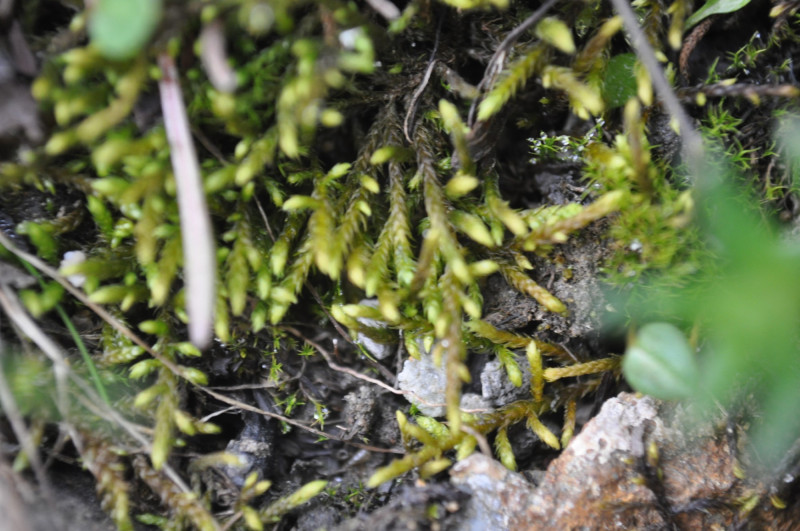
N side of Col du Galibier
N side of Col du Galibier
Lescuraea patens
 Refuge d'Etendard, Saint-Sorlin-d'Arves
This attractive species grows on base-rich siliceous rocks, forming loose patches of pale-tipped stems with a typically spiky appearance when wet.
In Britain, this species is the most widespread of the Lescuraeas, although still very rare. In the French Alps, it is the least widespread (apart from the recently-identified L.saviana and the subalpine, epiphytic L.mutabilis), with most recent records centred on Savoie and the adjacent Hautes-Alpes region.
This species is described in more detail in the Mosses of Ben Lawers NNR section of the site - I first saw this species in Scotland.
In Britain, this species is the most widespread of the Lescuraeas, although still very rare. In the French Alps, it is the least widespread (apart from the recently-identified L.saviana and the subalpine, epiphytic L.mutabilis), with most recent records centred on Savoie and the adjacent Hautes-Alpes region.
This species is described in more detail in the Mosses of Ben Lawers NNR section of the site - I first saw this species in Scotland.
Palustriella decipiens


path to Refuge de Carro, Vanoise PN
Text coming soon!
Campylium stellatum

path to Refuge de Carro, Vanoise PN
One of the most characteristic mosses of calcareous, flushed habitats in the mountains, C.stellatum is common in the French Alps, especially towards the north, where the summer heat is less intense and prevents habitats drying out.
This species is described in the Mosses of Derbyshire section of the site.
This species is described in the Mosses of Derbyshire section of the site.
Scorpidium cossonii
 path to Refuge de Carro, Vanoise PN
Text coming soon!
Pseudocalliergon turgescens

 alar cells, Carro, Vanoise PN (all photos)
Text coming soon!
This species is described in more detail in the Mosses of Ben Lawers NNR section of the site.

leaf profile

mid-leaf cells
This species is described in more detail in the Mosses of Ben Lawers NNR section of the site.
leaf profile
mid-leaf cells
Brachytheciastrum collinum

Refuge d'Etendard, Saint-Sorlin-d'Arves

Text coming soon!
Sciuro-hypnum plumosum

 Refuge d'Etendard, Saint-Sorlin-d'Arves
Text coming soon!
This species is described in more detail in the Mosses of Ben Lawers NNR section of the site.

This species is described in more detail in the Mosses of Ben Lawers NNR section of the site.
Brachythecium salebrosum

N side of Col du Galibier
Text coming soon!
Roaldia revoluta (syn. Hypnum revolutum)

Carro, Vanoise PN
This beautiful and common alpine species is described in the Bryophytes of the Queyras section of the site.
Hylocomiadelphus triquetrus (syn. Rhytidiadelphus triquetrus)

Carro, Vanoise PN
Damp, base-rich pastures are a favourite haunt of this attractive species. This colony was growing not far above the path to the Refuge de Carro, where it grew with a host of other attractive alpine plants.
H.triquetrus is described in the Mosses of Derbyshire section of the site.
H.triquetrus is described in the Mosses of Derbyshire section of the site.
Hylocomiastrum pyrenaicum

Refuge d'Etendard, Saint-Sorlin-d'Arves
Text coming soon!
Sanionia uncinata

Refuge d'Etendard, Saint-Sorlin-d'Arves
Sanionia is one of the commonest pleurocarps in alpine meadows, where it thrives in sunny, short, calcareous turf. It often occurs with Hypnum revolutum and Lescuraea species.
This species is described in the Mosses of Derbyshire section of the site.

N side of Col du Galibier, Savoie
This species is described in the Mosses of Derbyshire section of the site.
N side of Col du Galibier, Savoie
Orthothecium intricatum

Refuge d'Etendard, Saint-Sorlin-d'Arves
Syntrichia norvegica

path to Refuge de Carro, Vanoise PN
Text coming soon!


N side of Col du Galibier, Savoie
N side of Col du Galibier, Savoie
Hymenoloma crispulum (syn. Dicranoweisia crispula)

N side of Col du Galibier
This very common upland species is described in the Mosses of Ben Lawers NNR section of the site.
Pseudostereodon procerrimus (syn. Ctenidium procerrimum)

N side of Col du Galibier
Text coming soon!