


Anthelia juratzkana

below Col Vieux, Queyras
One of the most characteristic liverworts of open ground in late-snow areas, A. juratzkana is widespread in the French Alps.
I've described this species in more detail in the Liverworts of Ben Lawers NNR section of the site.
I've described this species in more detail in the Liverworts of Ben Lawers NNR section of the site.
Barbilophozia hatcheri

Col Vieux

diagnostic marginal cilia with elongate cells, Crete de Gilly (all photos)
Along with B.lycopodioides, this species is the most abundant of the Barbilophozias in the French Alps. This is no surprise, as it is the most continental in terms of its habitat preferences - sunny, dry summers and cold, snow-covered winters. It is mainly a high-altitude species in France, although one or two lower, subalpine records are known.
This species is described in more detail in the Liverworts of other areas of Scotland section of the site.
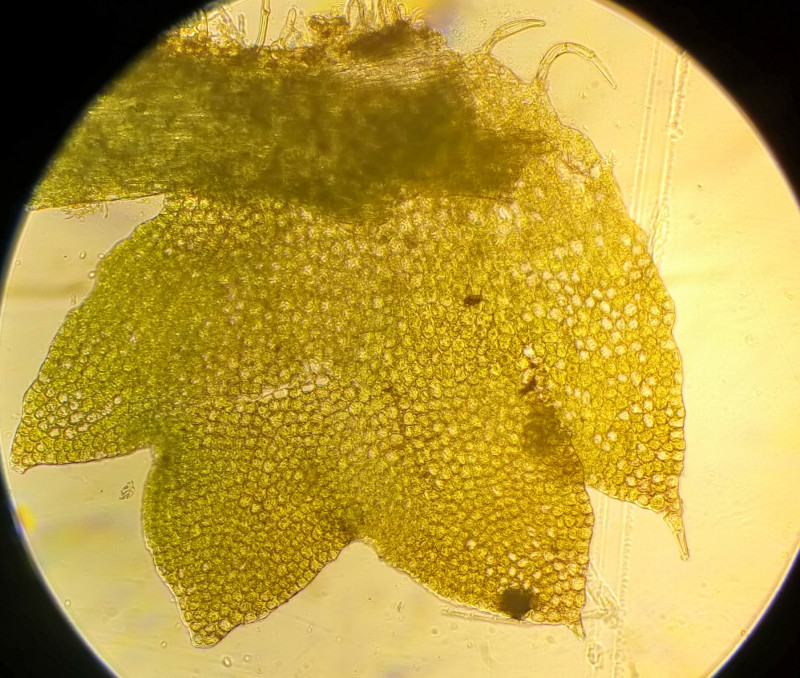
leaf detail, showing elongate apical cells
This species is described in more detail in the Liverworts of other areas of Scotland section of the site.
leaf detail, showing elongate apical cells
Lophozia sp
Image coming soon!
Text coming soon!
Tritomaria scitula

S side of Col du Galibier, Hautes-Alpes
This species is described in the Bryophytes of Queyras & Hautes-Alpes section of the site.
Polytrichastrum alpinum

Col Vieux
This common alpine species is found on fairly dry rock ledges where some soil has accumulated. It is the most common Polytrichum species in rocky habitats at higher altitudes.
This species is described in more detail in the Mosses of Ben Lawers section of the site.

This species is described in more detail in the Mosses of Ben Lawers section of the site.
Ditrichum sp
Image coming soon!
Text coming soon!
Distichium capillaceum

Crete de Gilly

S side of Col du Galibier
Distichium is a common sight on damp, sheltered, calcareous ledges on the Queyras mountains.
This species is described in the Mosses of Ben Lawers section of the site.

Lacs Blanchet, Saint-Veran, Queyras

S side of Col du Galibier, Hautes-Alpes
This species is described in the Mosses of Ben Lawers section of the site.
Lacs Blanchet, Saint-Veran, Queyras
S side of Col du Galibier, Hautes-Alpes
Trichostomum crispulum

above Refuge de Blanchet, Saint-Veran
This calcicolous species is very common in the French Alps, from low altitudes up to high alpine habitats.
I've described T.crispulum in more detail in the Mosses of Derbyshire section of the site.
I've described T.crispulum in more detail in the Mosses of Derbyshire section of the site.
Oncophorus integerimmus


Col Vieux
Text coming soon!

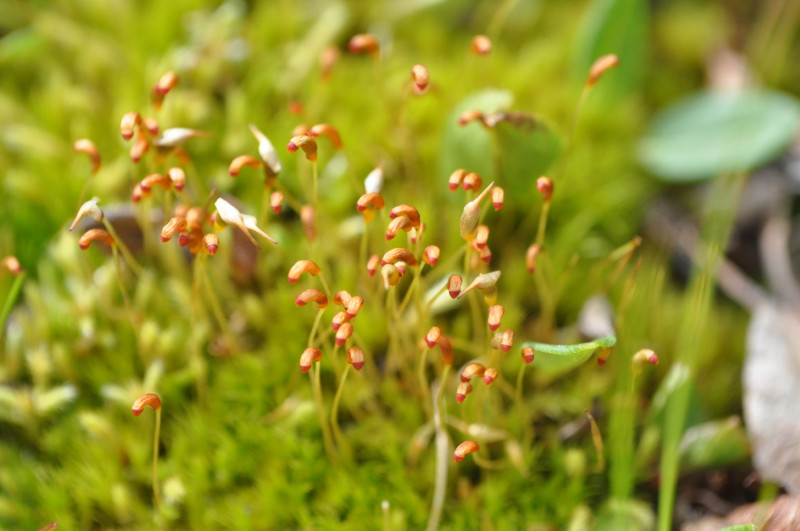
Hymenoloma crispula


Lacs Blanchet area, Saint-Veran
This very common montane species is easy to find almost anywhere in the French Alps. It is worth looking carefully in case the very similar but much rarer H.compactum (see below) is present.
H.crispula is described in more detail in the Mosses of Ben Lawers NNR section of the site.
H.crispula is described in more detail in the Mosses of Ben Lawers NNR section of the site.
Hymenoloma compactum


above Lac Blanchet Superieur, Saint-Veran
This rarity is a characteristic species of cold, calcareous rocks in late snow areas, high in the mountains. Microscopical analysis of the peristome teeth on mature capsules and measurement of spore size is necessary to confirm the species. Those of H.compactum are papillose from the apex to the base, whereas those of H.crispulum are only papillose at the apex. H. compactum has spores over 20 microns in diameter. In the field, the small cushions with erect red-brown mature capsules and setae are a useful indicator.
H.compactum is very rare in the Queyras (or perhaps under-recorded) and this find represents a new locality for the species.

peristome detail
H.compactum is very rare in the Queyras (or perhaps under-recorded) and this find represents a new locality for the species.
peristome detail
Dicranum tauricum

Col Lacroix
This woodland Dicranum is fairly common in the Alps, where it grows as an epiphyte and more commonly as patches and cushions around the base of tree trunks. Its is often abundantly fertile (the opposite is true in Britain) and this feature is often what draws attention to it in the field.
D.tauricum is distinctly dark green, with fragile leaf apices which break easily when collected. It is widespread in the Alps but does not ascend further than subalpine elevations.
D.tauricum is distinctly dark green, with fragile leaf apices which break easily when collected. It is widespread in the Alps but does not ascend further than subalpine elevations.
Dicranum spadiceum

S side of Col du Galibier, Hautes-Alpes
Text coming soon!
Tortella tortuosa

Lacs Blanchet, Saint-Veran
This very common (and variable) montane calcicole is described in the Mosses of Ben Lawers NNR section of the site.

Barbula unguiculata

SW of Col Vieux, Queyras
Text coming soon!
Tortula hoppeana

Col Lacroix
This widespread montane species is described in the Bryophytes of the Maritime Alps section of the site.

Syntrichia ruralis

Col Lacroix

Col du Galibier
This species is widespread in the French Alps, where it invariably occurs in very sunny, dry sites, such as thin soil on mountain ridges and warm rock ledges.
The species is described in more detail in the Mosses of Scotland section of the site.
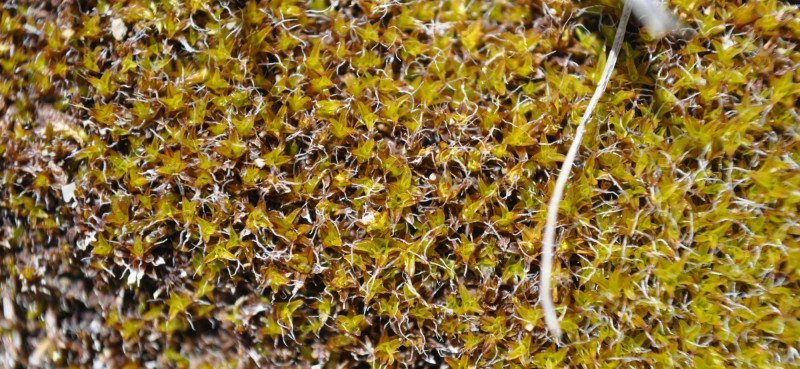
Col du Galibier
The species is described in more detail in the Mosses of Scotland section of the site.
Col du Galibier
Syntrichia norvegica

Lacs Blanchet, Saint-Veran, Queyras

fruiting plants, Crete de Gilly, Queyras

S side of Col du Galibier, Hautes-Alpes
While an extreme rarity in Britain, S.norvegica is a common species at high elevations in the French Alps. The distinctive reddish hair-point makes it easy to identify, as well as the habitat - only S.ruralis var.ruralis ascends to such high elevations but that species grows in dry, acidic habitats and looks rather different.
Plants can fruit abundantly (as in the second photo here), but most tufts I have seen were not fertile (see first photo).
Plants can fruit abundantly (as in the second photo here), but most tufts I have seen were not fertile (see first photo).
Schistidium cf.flaccidum

above Refuge de Blanchet, Saint-Veran
Text coming soon!

Schistidium confertum
Image coming soon!
Text coming soon!
Schistidium crassipilum

below Refuge de la Blanche, Saint-Veran
This species is described in the Mosses of Derbyshire section of the site.
Schistidium sp. nov.

Lacs Blanchet area, Saint-Veran
Text coming soon.
Grimmia reflexidens (syn.Grimmia sessitana)


Lacs Blanchet, Saint-Veran
Text coming soon!

Grimmia tergestina


Route des Astragales, Chateau-Vielle-Ville
Grimmia tergestina is a heat-loving species, common in Mediterranean regions, and is found only at lower elevations in France. It is widely-recorded from the French Alps, but only at lower altitudes in suitable habitat.
Like many Grimmias, G.tergestina needs microscopical analysis to confirm its identity. Key features are its bistratose leaves which lack a prominent keel, and the basal cells, which are much longer than wide. In the field, its immersed capsules and hot, calcareous habitat provide a good clue to its presence.
The most similar species is G.laevigata, which has exserted capsules and grows in acidic habitats. It is also well-known from subalpine elevations in the Alps.
Like many Grimmias, G.tergestina needs microscopical analysis to confirm its identity. Key features are its bistratose leaves which lack a prominent keel, and the basal cells, which are much longer than wide. In the field, its immersed capsules and hot, calcareous habitat provide a good clue to its presence.
The most similar species is G.laevigata, which has exserted capsules and grows in acidic habitats. It is also well-known from subalpine elevations in the Alps.
Timmia austriaca
Image coming soon!
Text coming soon!
Timmia bavarica

Lacs Blanchet, Saint-Veran

Encalypta rhaptocarpa
Image coming soon!
Text coming soon!
Encalypta vulgaris

S side of Col du Galibier
This common species is described in the Mosses of Derbyshire section of the site.
Encalypta alpina

Lacs Blanchet, Saint-Veran
E.alpina is widespread at high altitudes on calcareous schist and other base-rich rocks in the French Alps. For characters distinguishing it from other species, see the separate species accounts.
This common montane moss is described in the Mosses of Ben Lawers NNR section of the site.

This common montane moss is described in the Mosses of Ben Lawers NNR section of the site.
Encalypta affinis ssp. affinis

S side of Col du Galibier
This species is described in the Bryophytes of Savoie section of the site.
Encalypta microstoma

Col Agnel
E.microstoma is a European endemic species. It is known from scattered sites in the French Alps, where it inhabits sites typical of other Encalyptas - crevices and fissures in rocks where a thin layer of soil has accumulated.
E.microstoma is one of the Encalyptas whose capsules lack a peristome - this feature is easily observable in the field by removing the calyptra. It shares this feature with two other common species - E.alpina & E.vulgaris, both of which are common at high altitude in the habitats where E.microstoma grows. E.microstoma has similar leaves to E.vulgaris but has a fringed calyptra like E.ciliata - this combination of features is unique in the genus (E.ciliata has capsules with a peristome).
E.microstoma is one of the Encalyptas whose capsules lack a peristome - this feature is easily observable in the field by removing the calyptra. It shares this feature with two other common species - E.alpina & E.vulgaris, both of which are common at high altitude in the habitats where E.microstoma grows. E.microstoma has similar leaves to E.vulgaris but has a fringed calyptra like E.ciliata - this combination of features is unique in the genus (E.ciliata has capsules with a peristome).