


Carnegia gigantea (Saguaro)

Catalina State Park, N of Tucson

cristate saguaro, Saguaro NP East


flowering saguaros, Sabino Canyon, Santa Catalina Mountains

spine detail, Saguaro NP West
Surely the most emblematic symbol of the Sonoran Desert, the Saguaro needs little introduction. It is the largest cactus in the United States, and unique to the Sonoran Desert.
The tallest Saguaros are ancient plants, well over a century old - it can be seventy years or so until a 'young' plant begins to develop arms.
Saguaros flower in early summer and are pollinated by bats - indeed, they are a vital nectar source for Long-nosed Bats.


Saguaro NP East
The tallest Saguaros are ancient plants, well over a century old - it can be seventy years or so until a 'young' plant begins to develop arms.
Saguaros flower in early summer and are pollinated by bats - indeed, they are a vital nectar source for Long-nosed Bats.
Saguaro NP East
Echinocactus horizonthalonius ssp.nicholii (Nichol Turk's Head)


Silver Bell Mountains, NW of Tucson
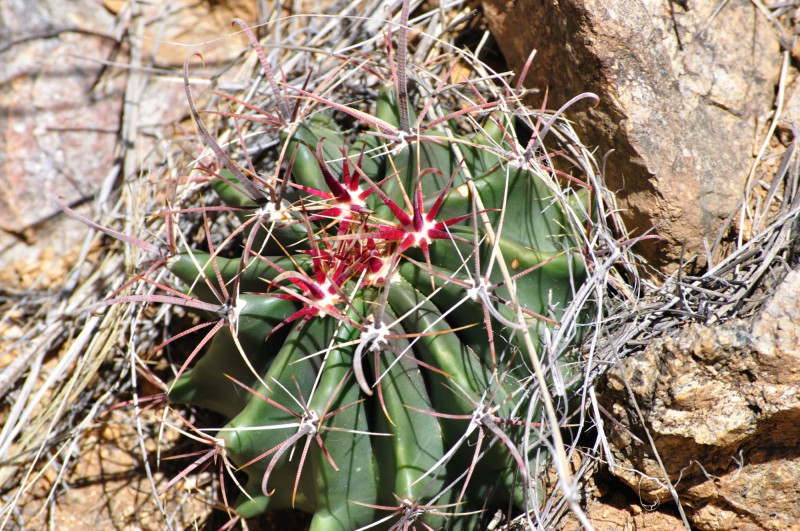
This inconspicuous cactus is a very rare plant indeed, restricted to the Waterman and Vekol Mountains in Arizona, and other limestone mountains in Sonora, Mexico. It is federally listed as an Endangered Species.
No other cactus is likely to be confused with it, given its ashy-grey epidermis and robust, curved spines. Unlike many Arizona cacti, this species is summer-blooming.
No other cactus is likely to be confused with it, given its ashy-grey epidermis and robust, curved spines. Unlike many Arizona cacti, this species is summer-blooming.
Ferocactus wislizenii (Compass Barrel Cactus)


In the Tucson area, this is the most common barrel cactus, and often the only species present.
Echinocereus engelmannii var.acicularis (Engelmann Strawberry Hedgehog)


Waterman Mountains
The commonest hedgehog cactus in the Sonoran Desert in southern Arizona, this attractive species is beautiful in bloom, when it is covered with large, bright pink goblet-shaped flowers. E.engelmannii is a variable species, with several varieties recognised, some of which are regarded as separate species by some authorities (such as the similar E.fasciculatus).
Key feautures to identify this cactus are its long, needle-like spines which obscure much of the stem, clustering habit and arid habitat.


Red Rock, NW of Tucson
Key feautures to identify this cactus are its long, needle-like spines which obscure much of the stem, clustering habit and arid habitat.
Red Rock, NW of Tucson
Echinocereus ledingii (Leding Hedgehog Cactus)


road to Mt Graham, Pinaleno Mountains (all photos)
A speciality of the mountains of south-eastern Arizona, where it grows at moderate elevations in grassland, canyon sides and open woodland habitats. Here, it can be conspicuous and locally abundant.
E.ledingii can be recognised by its quite tall (over 30cm), upright habit, the stout, down-curved, golden central spines and late flowering period. This species has typical magenta flowers but these emerge later than most Echinocereus, in May.
E.ledingii is an Arizona endemic, found only in the Chiricahua, Santa Theresa and Pinaleno Mountains.
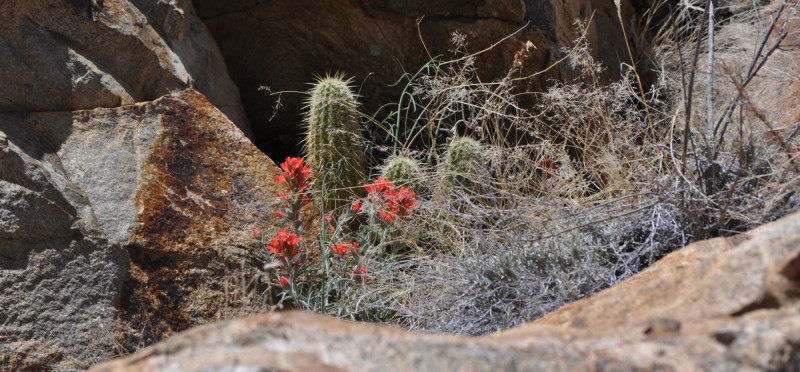
growing with Castilleja sp
E.ledingii can be recognised by its quite tall (over 30cm), upright habit, the stout, down-curved, golden central spines and late flowering period. This species has typical magenta flowers but these emerge later than most Echinocereus, in May.
E.ledingii is an Arizona endemic, found only in the Chiricahua, Santa Theresa and Pinaleno Mountains.
growing with Castilleja sp
Echinocereus nicholii (Nichol Hedgehog)


Silver Bell Mountains, NW of Tucson
Another of the Sonoran Desert's special cacti, Nichol Hedgehog is enitrely restricted to this region. It is easily recognised, thanks to its golden spines, fairly tall stature (up to 60cm) and rather small, pale pink flowers.
E.nicholii is a plant of foothills and rocky areas, rather than desert lowlands. The Tucson area marks it north-eastern limit in Arizona, from where it occurs in a band towards the south-west of the state and into Mexico.
E.nicholii is a plant of foothills and rocky areas, rather than desert lowlands. The Tucson area marks it north-eastern limit in Arizona, from where it occurs in a band towards the south-west of the state and into Mexico.
Mammillaria grahamii (Arizona Fishhook Pincushion Cactus)


Red Rock, NW of Tucson (this and previous photo)
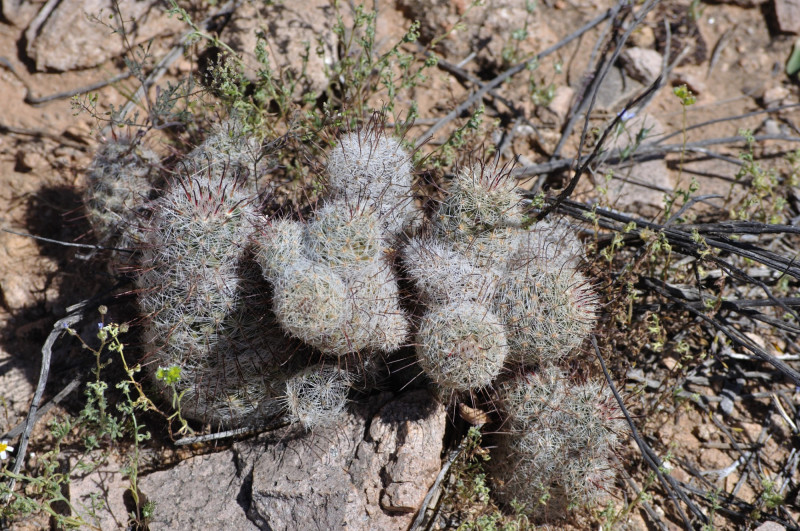
The most widespread and commonly-seen Mammillaria in the Sonoran Desert, this species enjoys the shade of taller shrubs and is often seen in sheltered spots.
It can be identified by its densely-interwoven spines, which almost totally obscure the green, fat stems of the cactus. The bright red elongate fruits persist for a long time (those in the first photo were still looking immaculate the spring after they were formed). Flowering is triggered by heavy rainfall and can occur almost any time from late spring to late summer.
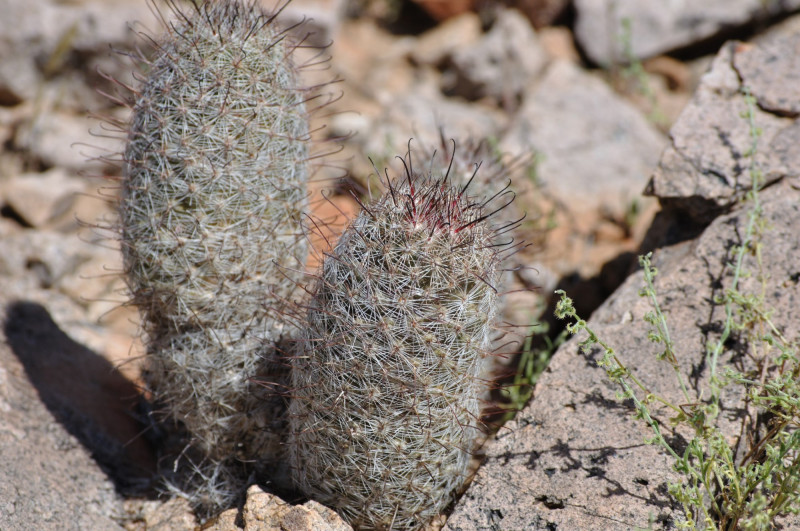


Saguaro NP West
It can be identified by its densely-interwoven spines, which almost totally obscure the green, fat stems of the cactus. The bright red elongate fruits persist for a long time (those in the first photo were still looking immaculate the spring after they were formed). Flowering is triggered by heavy rainfall and can occur almost any time from late spring to late summer.
Saguaro NP West
Mammillaria heyderi var.macdougalii (MacDougal Pincushion)


I was lucky to come across this pancake-like cactus, which has a very restricted distribution in the United States. Here, it is found in rocky habitats at lower elevations in the 'sky island' ranges around Tucson and Nogales, in rather grassy habitats.
When in flower, it is easy to recognise - no other small Arizona cactus has yellow flowers arranged in a broad ring.
Although described as a separate species in may references, the USDA currently regards this as a variety of the widespread M.heyderi.
When in flower, it is easy to recognise - no other small Arizona cactus has yellow flowers arranged in a broad ring.
Although described as a separate species in may references, the USDA currently regards this as a variety of the widespread M.heyderi.
Cylindropuntia bigelovii (Teddy-bear Cholla)


Saguaro NP East
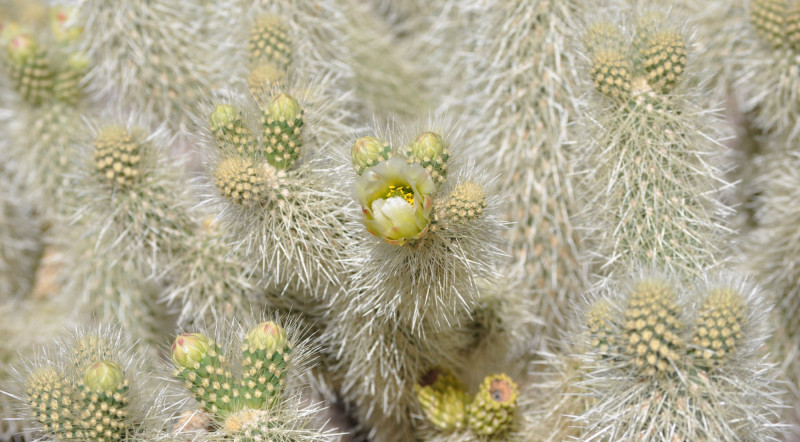
One of the classic plants of the Sonoran Desert, Teddy-bear Cholla is named for the short 'arms' on the stems and furry appearanve from far-off, but there is nothing cuddly about this plant - the golden-spined joints break off very easily and attach themselves to any passer-by with vicious persistence, thanks to the spear-shaped tips on the spines. This habit is actually an evolutionary adaptation, helping the plant to reproduce - the detached joints root in the desert soil to produce clonal colonies of the parent plant. Even fertilised flowers rarely produce viable seed, so successful is its vegetative method of reproduction.
This plant enjoys the hottest, driest portions of the Sonoran Desert, and is equally common in the Mojave Desert further north and west.
This plant enjoys the hottest, driest portions of the Sonoran Desert, and is equally common in the Mojave Desert further north and west.
Cylindropuntia arbuscula (Pencil Cholla)


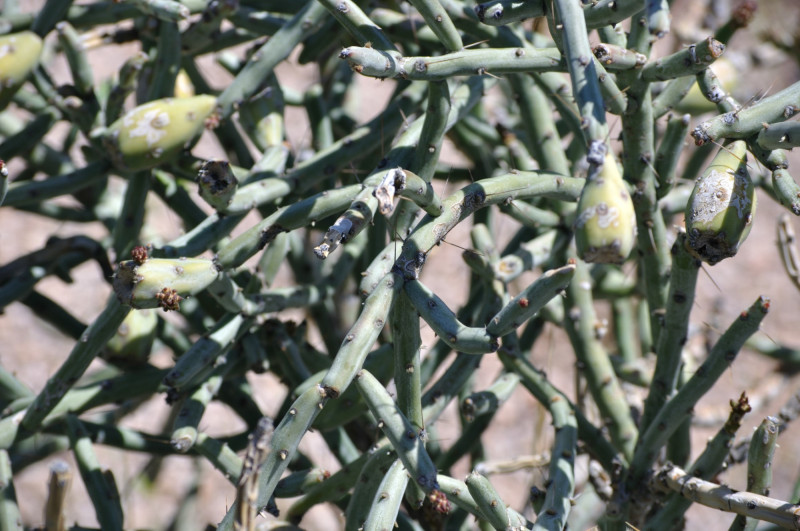
Named for the very slender stems, Pencil Cholla is a widespread Sonoran Desert species and easy to recognise - the thin stems bear few spines.
Pencil Cholla grows to around 2m tall, with a distinct tree-like trunk (hence the scientific name) and well-defined crown. The flower colour is variable, like many shrubby cholla species.
Pencil Cholla grows to around 2m tall, with a distinct tree-like trunk (hence the scientific name) and well-defined crown. The flower colour is variable, like many shrubby cholla species.
Cylindropuntia leptocaulis (Christmas Cholla)


The common name of this widespread cactus comes from the long-lasting red fruits, which are often still on the plants during winter. It is a very widespread species in both the Sonoran and Chihuahuan Deserts, and has the widest range of any cholla, extending as far Oklahoma in the mid-west.
Christmas Cholla is an understated plant, preferring to grow in more sheltered and less-sunny spots than many of its cousins. It can often be seen as a sprawling shrub beneath other desert vegetation. Unlike Pencil Cholla (see above), many joints bear only glochids and no mature spines.
Christmas Cholla is an understated plant, preferring to grow in more sheltered and less-sunny spots than many of its cousins. It can often be seen as a sprawling shrub beneath other desert vegetation. Unlike Pencil Cholla (see above), many joints bear only glochids and no mature spines.
Cylindropuntia versicolor (Staghorn Cholla)


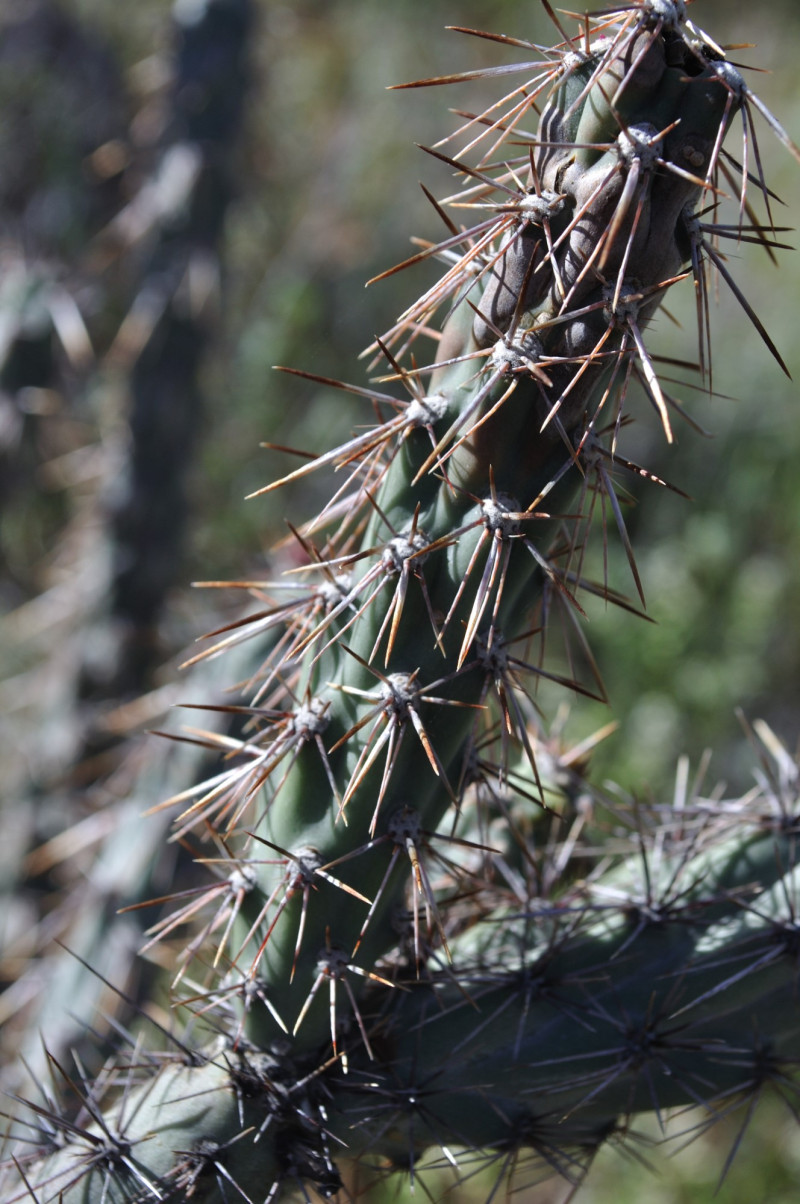
As its scientific name alludes to, Staghorn Cholla is very variable in the colour of its flowers. The ones shown here were an intense yellow, but they can be orange, red or purple.
Staghorn Cholla is locally abundant in the Sonoran Desert, but has a restricted distribution within Arizona. It occurs only in the central third of southern Arizona, reaching as far north as Florence in Pinal County.
Staghorn Cholla is one of several very similar shrubby chollas that can be hard to identify. Key features of C.versicolor are its fairly short spines (of a uniform length) and its smooth, persistent fruits. Cane Cholla (see below, especially third photo) is the most similar species, but its stems have more numberous tubercles and so appear more spiny.
Staghorn Cholla is locally abundant in the Sonoran Desert, but has a restricted distribution within Arizona. It occurs only in the central third of southern Arizona, reaching as far north as Florence in Pinal County.
Staghorn Cholla is one of several very similar shrubby chollas that can be hard to identify. Key features of C.versicolor are its fairly short spines (of a uniform length) and its smooth, persistent fruits. Cane Cholla (see below, especially third photo) is the most similar species, but its stems have more numberous tubercles and so appear more spiny.
Cylindropuntia spinosior (Cane Cholla)

fruit detail,

Catalina State Park, N of Tucson (all photos)
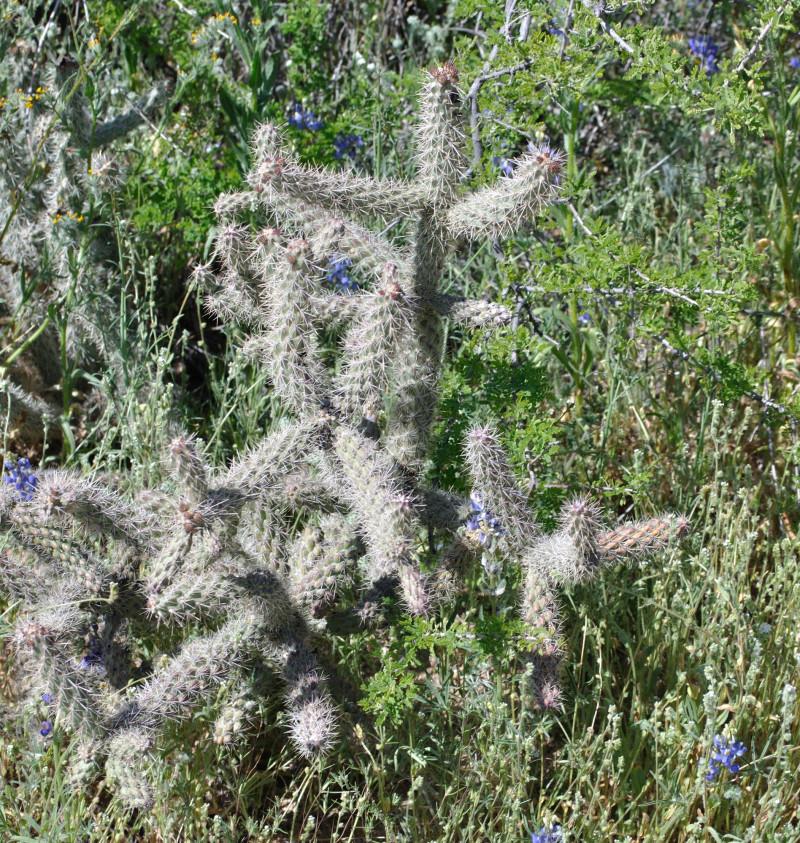
A common and widespread cholla of a wide range of habitats in southeastern Arizona and adjacent areas, Cane Cholla grows to around 2 metres tall. It is similar to Buckhorn Cholla (see above) and has an equally diverse range of flower colours. The fruits are much more 'lumpy' than Buckhorn Cholla, though, as seenin the first and second photos here.
Cylindropuntia fulgida var. fulgida (Chain-fruit / Jumping Cholla)


chain fruit detail,
This viciously-spined plant is locally dominant in low-lying areas of the desert, especially in the eastern section of Saguaro NP. Like Teddy-Bear Cholla (see above), it increases by shedding joints and limbs, which subsequently root in the desert soil, producing clonal colonies.
Chain-fruit Cholla is named for the persistent fruits, which stack up over time, because each year's flower emerge from last year's fruits. This species is restricted to the central third of southern Arizona and occurs in two varieties: fulgida (shown here) and mamillata, which has few spines and a much greener appearance, and is also shorter.

Chain-fruit Cholla is named for the persistent fruits, which stack up over time, because each year's flower emerge from last year's fruits. This species is restricted to the central third of southern Arizona and occurs in two varieties: fulgida (shown here) and mamillata, which has few spines and a much greener appearance, and is also shorter.
Opuntia engelmannii var. engelmannii (Engelmann Prickly Pear)


Perhaps the most common prickly pear species in southern Arizona, this attractive species is happy in desert habitats, as well as in grasslands and upland areas as well.
Key features in distinguishing this species from its cousins are its red-tipped white spines, lack of purple colouration around the stem joints and pure yellow flowers, which age to orange. The most similar species is O.phaeacantha (see below), which can hybridise with O.engelmannii and can looks very similar.
Key features in distinguishing this species from its cousins are its red-tipped white spines, lack of purple colouration around the stem joints and pure yellow flowers, which age to orange. The most similar species is O.phaeacantha (see below), which can hybridise with O.engelmannii and can looks very similar.
Opuntia phaeacantha (Brown-spine / Sprawling Prickly Pear)

One of the most widespread prickly pears in the United States, this species is a common sight in Arizona and occupies a variety of habitats. It is can be seen across the state, apart from in the most arid parts of the south-west.
It can be identified by its sprawling habit, brown spines and its yellow flowers which have orange centres (when seen).
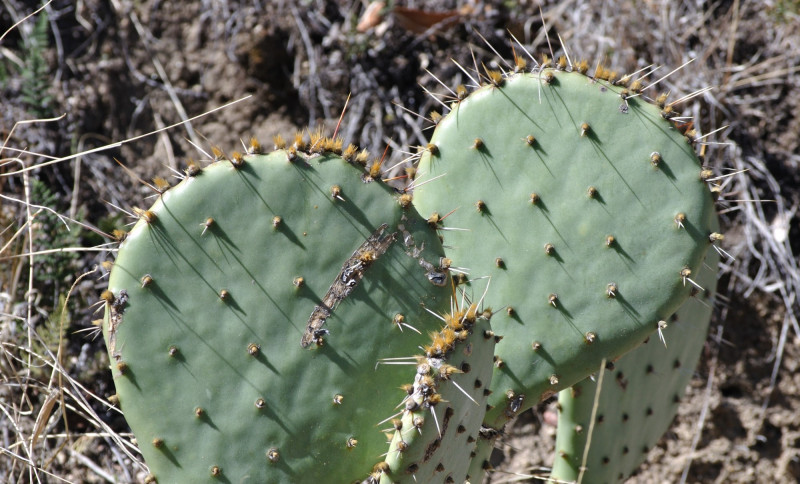
Santa Rita Mountains

Kartchner Caverns SP
It can be identified by its sprawling habit, brown spines and its yellow flowers which have orange centres (when seen).
Santa Rita Mountains
Kartchner Caverns SP
Opuntia chlorotica (Pancake Prickly Pear)

Named for the yellowish appearance of its spines, this species widespread in the United States, although not as common in the Sonoran Desert as species such as O.engelmanii and O.phaeacantha.
O.chlorotica has very round pads (hence the common name) and favours more rocky, upland areas than some other Opuntia species. It bears yellow flowers in spring, like many of its cousins.
O.chlorotica has very round pads (hence the common name) and favours more rocky, upland areas than some other Opuntia species. It bears yellow flowers in spring, like many of its cousins.
Agaves, etc.
Agave parryi var. parryi (Parry Agave)

Kitt Peak, Quinlan Mountains
This beautiful Agave is a common species in many parts of the Sonoran Desert, where it grows in rocky terrain. It is a plant of foothills and often ascends into forests and mountains slopes.
Parry Agave can be recognised by its highly symmetrical rosettes which become almost hemisphaerical with age. Individual leaves are quite short and broad compared to other Arizona Agaves, and end in a very sharp spine. The superficially similar A. utahensis is widespread in northern Arizona but is absent from the Sonoran Desert.
Var. huachucensis is a rare variety, restricted to the area around the Huachuca Mountains. It is described in the Flora of Upland Arizona section of the site.
Parry Agave can be recognised by its highly symmetrical rosettes which become almost hemisphaerical with age. Individual leaves are quite short and broad compared to other Arizona Agaves, and end in a very sharp spine. The superficially similar A. utahensis is widespread in northern Arizona but is absent from the Sonoran Desert.
Var. huachucensis is a rare variety, restricted to the area around the Huachuca Mountains. It is described in the Flora of Upland Arizona section of the site.
Dasylirion wheeleri (Sotol)

Catalina State Park

Kitt Peak, Quinlan Mountains
The most noticeable feature of Sotol is the very long, narrow serrated leaves. These are not viciously-spined like Agaves, but have small, recurved teeth. Individual leaves grow to around a metre in length. Flower spikes can reach to over four metres high.
Sotol inhabits gravelly hillsides at moderate elevations in the southern half of Arizona.
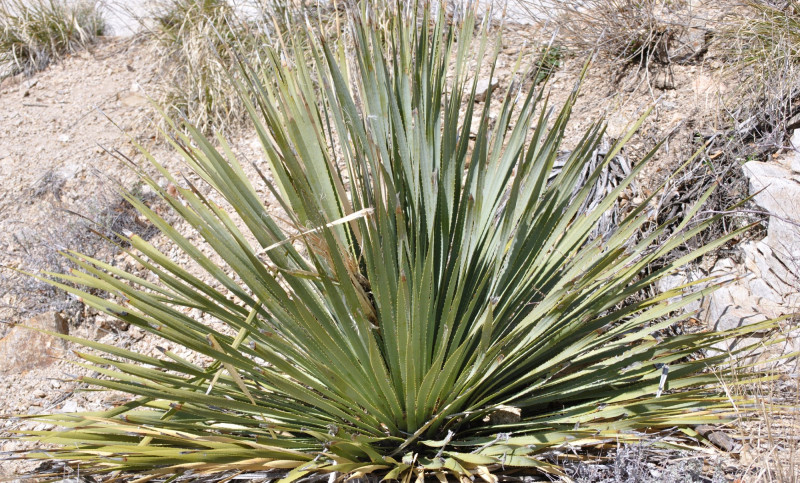
Kitt Peak, Quinlan Mountains
Sotol inhabits gravelly hillsides at moderate elevations in the southern half of Arizona.
Kitt Peak, Quinlan Mountains
Yucca elata (Soap-tree Yucca)


Sabino Canyon, Santa Catalina Mountains
Soap-tree Yucca is described in the Flora of Riparian & Grassland Areas section of the site.