


Salix repens (Creeping Willow)


Text coming soon!
Cerastium sp


Text coming soon!
Lychnis flos-cuculi (Ragged Robin)

This lovely wetland species grows in the damp dune sacks of Tentsmuir.
I've described it more in the Flora of Derbyshire section of the site.
I've described it more in the Flora of Derbyshire section of the site.
Parnassia palustris (Grass of Parnassus)

Grass of Parnassus is described in the Flora of Derbyshire section of the site.
Pyrola (Media?)


Centaurium littorale (Seaside Centaury)

+1
Seaside Centaury looks very similar to more common species but has narrower leaves and a dense inflorescence where the flowers have long calyces.
It is a northern and western species in Britain, where it grows in dune slacks.
It is a northern and western species in Britain, where it grows in dune slacks.
Lesser Twayblade (Listera cordata)


This little orchid is one of the least showy in Britain and is easily overlooked. It is a species of acidic habitats such as wet moorland and bogs, but also enjoys the lush, mossy habitat under pine trees at Tentsmuir.
The species looks very different to the Common Twayblade and is not really likely to be confused with any other orchid in Britain. The rather dull-coloured flower spikes can be surprisingly difficult to spot at first, and the easiest way to spot this species is to look for the distinctive pair of heart-shaped leaves lying flat on the ground.

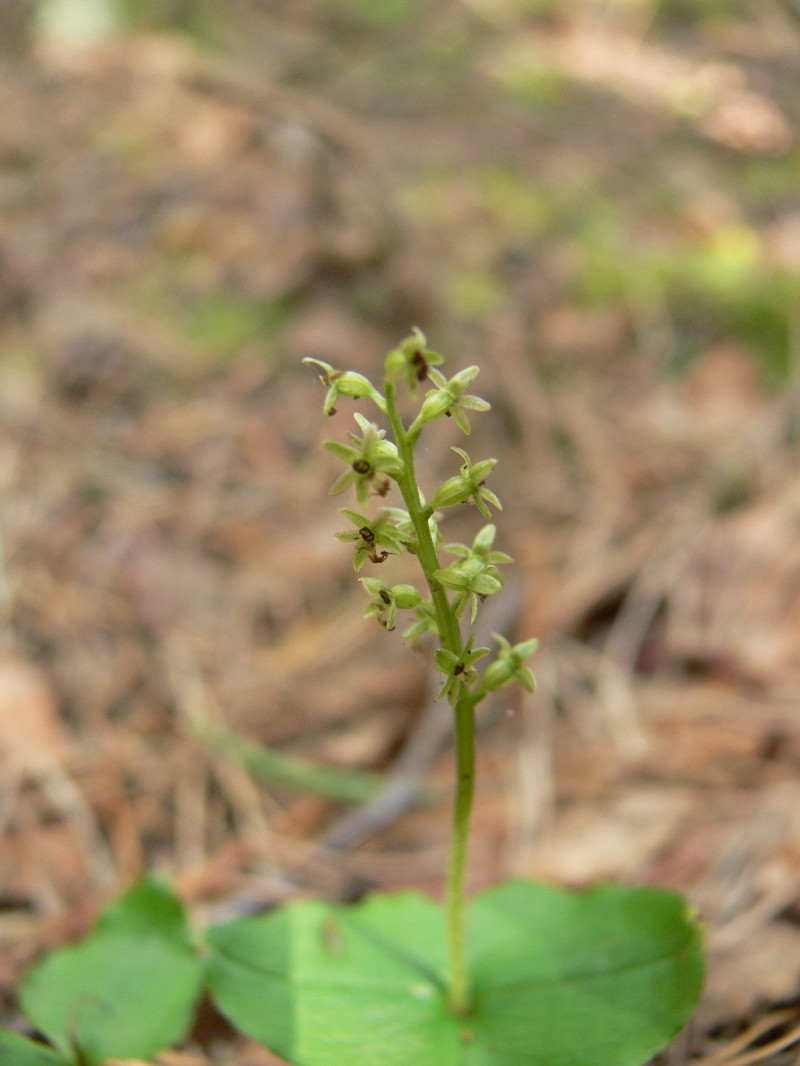
The species looks very different to the Common Twayblade and is not really likely to be confused with any other orchid in Britain. The rather dull-coloured flower spikes can be surprisingly difficult to spot at first, and the easiest way to spot this species is to look for the distinctive pair of heart-shaped leaves lying flat on the ground.
Corallorhiza trifida (Coralroot Orchid)

Eastern Scotland is the national stronghold of this small, rather understated orchid. I've not yet managed to see it in flower - these photos show the developing fruits. Although literature sources say it flowers from May to August, at Tentsmuir (at least) the peak flowering is from late May to early June.
In bloom, the Coralroot Orchid bears several small white flowers and scattered plants can be hard to spot in the shade of woodland, amidst leaf litter and lush mosses. Elsewhere in Scotland, this orchid also grows around the grassy margins of lochs.
In bloom, the Coralroot Orchid bears several small white flowers and scattered plants can be hard to spot in the shade of woodland, amidst leaf litter and lush mosses. Elsewhere in Scotland, this orchid also grows around the grassy margins of lochs.
Goodyera repens (Creeping Lady's-tresses)


The most showy of Tentsmuir's orchids, Creeping Lady's Tresses is a classic orchid of Scottish pine woodland, especially ancient Caledonian pine forest. The woodland at Tentsmuir isn't ancient, but the orchid thrives here.
In flower, this is a very beautiful species when viewed closely - each of the pure white flowers is covered in dense hairs and is sweetly-scented.
Like the closely-related Spiranthes species, this orchid flowers in the second half of summer, in July and August.
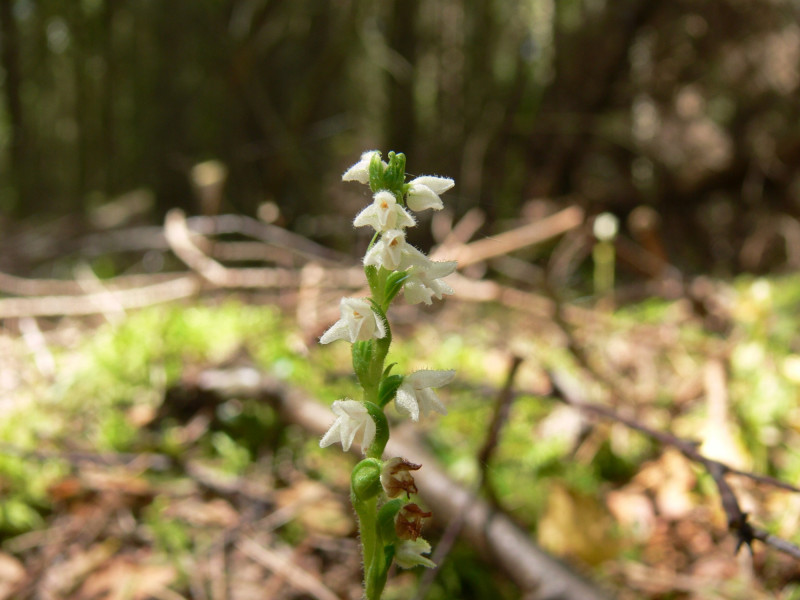
In flower, this is a very beautiful species when viewed closely - each of the pure white flowers is covered in dense hairs and is sweetly-scented.
Like the closely-related Spiranthes species, this orchid flowers in the second half of summer, in July and August.
Dactylorhiza purpurella (Northern Marsh-orchid)

Text coming soon!
Dactylorhiza fuchsii (Common Spotted-orchid)

This common species is described in the Flora of Derbyshire section of the site.
Galium verum (Lady's Bedstraw)

Lady's Bedstraw is a lovely creeping plant of open meadows and dunes. Its name comes from its former use as a stuffing for matresses - the foliage is pleasantly scented when crushed.
Lady's Bedstraw is very easy to recognise by its four-petalled yellow flowers and long, narrow leaves borne in whorls around the angular stems.
Lady's Bedstraw is very easy to recognise by its four-petalled yellow flowers and long, narrow leaves borne in whorls around the angular stems.
Achillea ptarmica (Sneezewort)

Text coming soon!
Carex arenaria (Sand Sedge)


As its name suggests, this sedge is strongly associated with sandy habitats, and has an almost totally coastal distribution in Britain.
The bright green, thick leaves are characteristically rough above and the inforescence is a cluster of 5-15 short, chunky spikes.
The bright green, thick leaves are characteristically rough above and the inforescence is a cluster of 5-15 short, chunky spikes.
Marram Grass (Ammophila arenaria)

This common coastal grass is a very important species ecologically, as it binds together sand dunes and helps prevent coastal erosion.
Marram can be recognised by sharply-pointed, greyish-green leaves with inrolled margins.
Marram can be recognised by sharply-pointed, greyish-green leaves with inrolled margins.
Dryopteris filis-mas (Male Fern)


Ferns are not really thought of as seaside plants in Britain, but Male Fern grows happily in the sheltered microclimate of the dune slacks at Tentsmuir.
Male Fern can be recognised by its large, bipinnate fronds which have blunt, toothed lobes. The stalks have pale brown scales. It is a common species in much of Britain, where it is first and foremost a woodland species.
Male Fern can be recognised by its large, bipinnate fronds which have blunt, toothed lobes. The stalks have pale brown scales. It is a common species in much of Britain, where it is first and foremost a woodland species.
Polypodium vulgare (Common Polypody)

Polypody is a very common fern of dry habitats, easily recognisable by its simple pinnate, leathery fronds.