


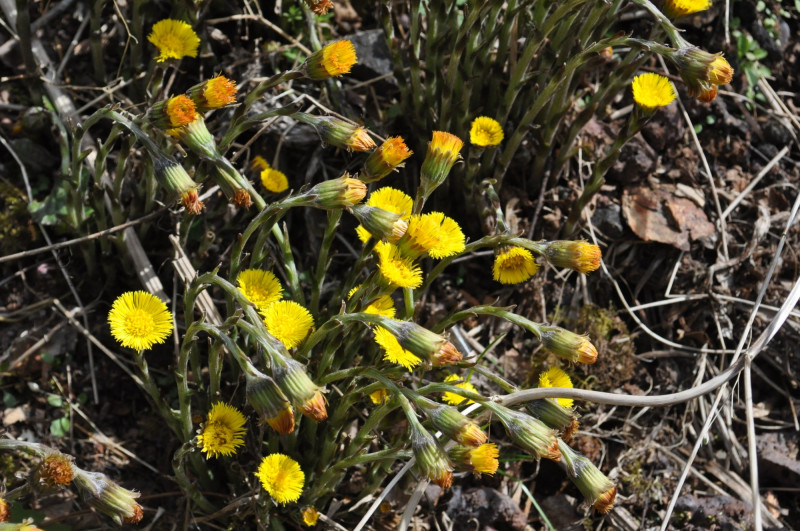
Colt's-foot (Tussilago farfara)

Clark's Plantation, Farley Moor
Common throughout Derbyshire, Colt's-foot is a colonist of bare, damp ground. The thick stems and bright yellow flowers with dozens and dozens of rays make it easy to recognise.
Jacobaea aquaticus (Marsh Ragwort)
image coming soon!
below Combs Moss
below Combs Moss
Text coming soon!
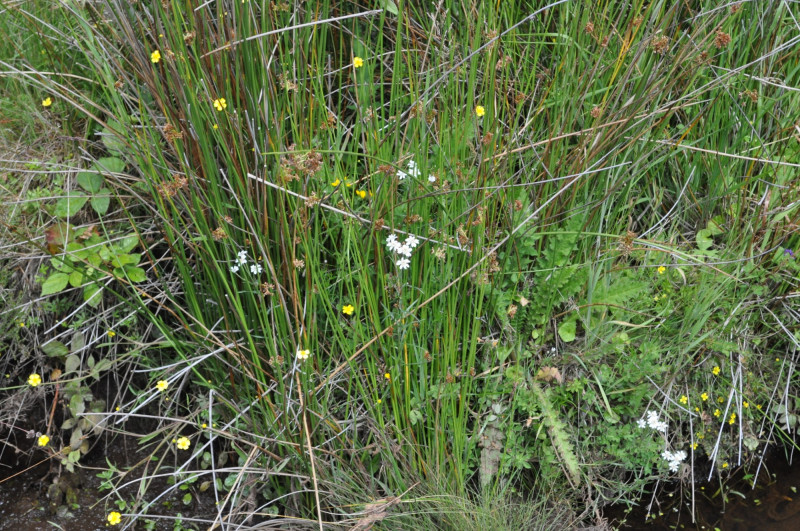
Achillea ptarmica (Sneezewort)

Bar Brook, Eastern Moors
Although widespread nationally, Sneezewort is fairly uncommon in Derbyshire, apart from in the Peak District, where it prefers to grow in damp pastures, marshes and other permanently wet sites. Unlike its cousin, the very common Yarrow (A. millefolium), Sneezewort has fewer, broader rays on its larger flowers.
Wild Daffodil (Narcissus pseudonarcissus)


Linacre Woods
Truly wild daffodils (as opposed to garden escapes) are fairly rare now, and tend to be found in ancient woodland.
This daffodil had a small group of beetles busily pollinating it (you can just make them out inside the flower).
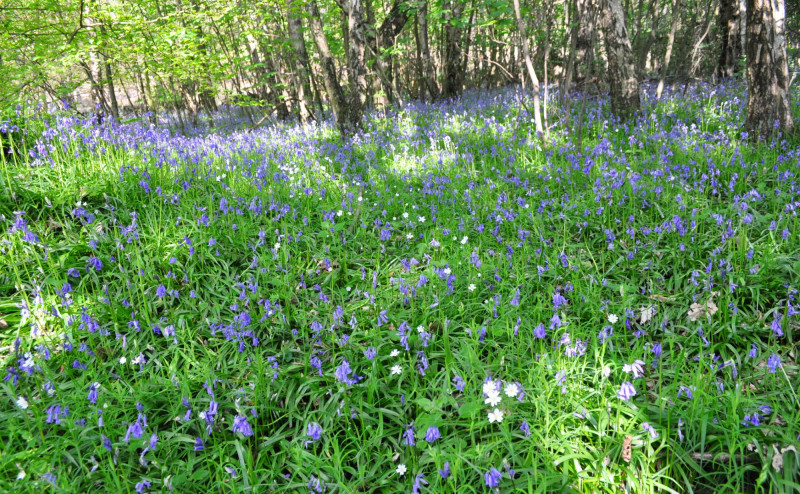
Bluebell (Hyacinthoides non-scripta)


Text coming soon!
Common Spotted-orchid (Dactylorhiza fuchsii)

Froggatt Wood
This cosmopolitan species is widespread in the Dark Peak on neutral soils, or mildly acidic ones.
The species is described in more detail in the Flora of Derbyshire - the White Peak grasslands part 2 section of the site.
The species is described in more detail in the Flora of Derbyshire - the White Peak grasslands part 2 section of the site.
Dactylorhiza praetermissa (Southern Marsh-orchid)
image coming soon!
Wragg's Quarry, Eastern Moors
Wragg's Quarry, Eastern Moors
Text coming soon!
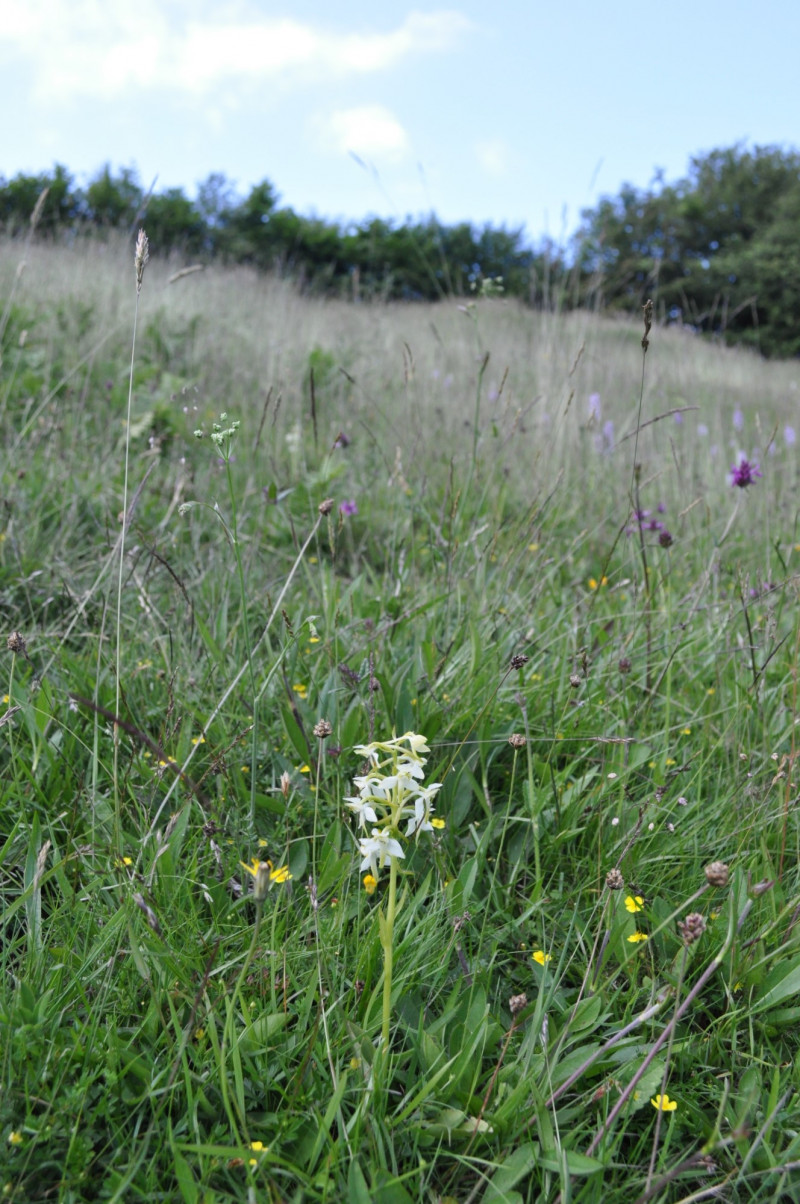
Greater Butterfly-orchid (Platanthera chlorantha)


Abney Clough
This beautiful species is Derbyshire's second rarest grassland orchid after the Burnt Orchid (not including several species which became extinct in the early part of the 20th century.
Greater Butterfly Orchid is restricted to scattered sites on the Peak Fringe, where it grows in often neutral grassland. It also grows in the Dark Peak.
Greater Butterfly Orchid is restricted to scattered sites on the Peak Fringe, where it grows in often neutral grassland. It also grows in the Dark Peak.
Narthecium ossiphragum (Bog Asphodel)

below Combs Moss
This attractive bulbous perennial is fairly common across the Dark Peak, where it grows in sunny, acidic marshes and sround the margins of boggy pools. The conspicuous orange-brown fruiting spikes can be seen from a long distance in late summer, and large patches in flower earlier in the year make a stunning sight.
Grasses & Woodrushes
Cock's-foot (Dactylis glomerata)


ligule detail, Calver Marshes (all photos)
Named for the distinctive shape of the mature flower heads, D. glomerata is a tall species, up to a metre in height.
The densely-clustered flower panicles are highly characteristic. Additional features to look out for are the long ligules and rough-textured leaves.
D. glomerata is very common in Derbsyhire, both in open grassland and in light woodland.
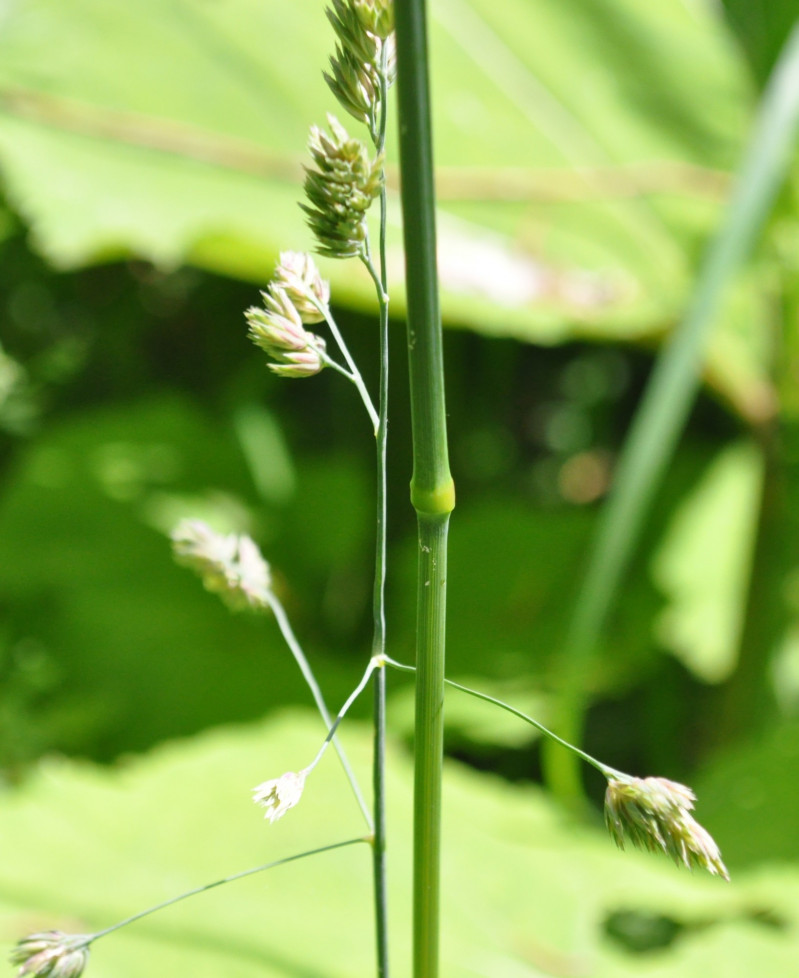
The densely-clustered flower panicles are highly characteristic. Additional features to look out for are the long ligules and rough-textured leaves.
D. glomerata is very common in Derbsyhire, both in open grassland and in light woodland.
Tall Fescue (Festuca altissima)


Shining Cliff Wood
More a grass of northern England and Scotland, this species is very rare in Derbyshire, where it is known from just five sites, all in the Dark Peak or Peak Fringe, except a population in Matlock Bath.
Tall Fescue is a very conspicuous and distinctive grass once its habitat of damp (or wet), rocky woodland is known. Here, Tall Fescue can be the dominant, or even the only grass present, and grows as solitary, upright tussocks. The flowering spikes are indeed tall, growing to over a metre in height and have unawned flowers (other tall woodland species in Derbyshire have conspicuous awns). The foliage is also very easy to recognise, as it is held at 45 degrees or so, with stiff, persistent purple sheaths around the base.
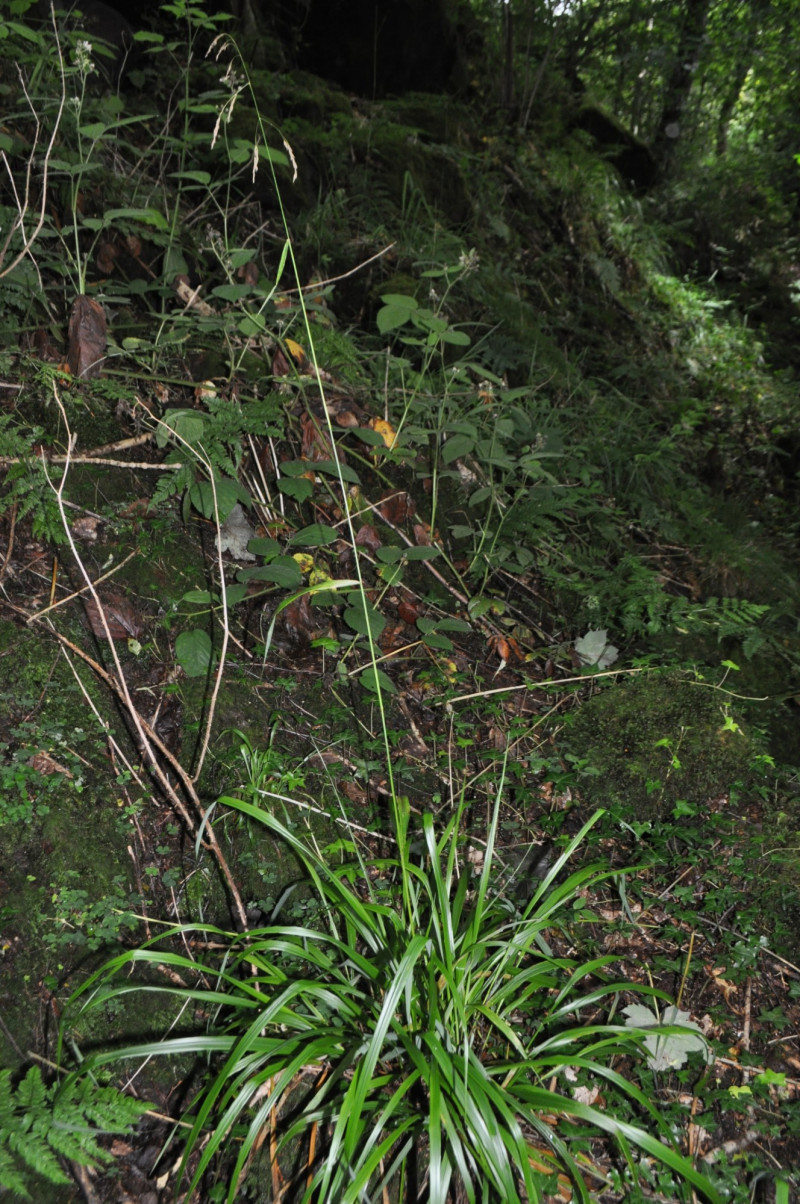
Tall Fescue is a very conspicuous and distinctive grass once its habitat of damp (or wet), rocky woodland is known. Here, Tall Fescue can be the dominant, or even the only grass present, and grows as solitary, upright tussocks. The flowering spikes are indeed tall, growing to over a metre in height and have unawned flowers (other tall woodland species in Derbyshire have conspicuous awns). The foliage is also very easy to recognise, as it is held at 45 degrees or so, with stiff, persistent purple sheaths around the base.
Giant Fescue (Schedonorus giganteus)


Calver Marsh
Formerly known as Festuca gigantea, this grass is very tall, as its name suggests. It can be identified by its shining, rough-edged leaves, dark purple leaf-junctions and droopng flower panicles. The individual flowers have long awns. S. arundinaceus (Tall Fescue) occurs in similar habitats but its flower spikes are not drooping and individual flowers lack awns. Its leaves are also no more than a centimetre wide.
Giant Fescue is a common species in damp, relatively shaded habitats throughout most of Derbyshire, although it avoids the highest elevations.
Giant Fescue is a common species in damp, relatively shaded habitats throughout most of Derbyshire, although it avoids the highest elevations.
Perennial Rye-grass (Lolium perenne)

Calver Marsh
Rye grasses are easily-recognised by their unstalked flower spikes. L.perenne can be distinguished by the awnless flowers - other Lolium species have long awns protruding from the flowers.
Perennial Rye-grass is very common throughout Britain, both as a native species and as a sown pasture species for livestock.

Reed Sweet-grass (Glyceria maxima)


Calver Marsh
All four British Glyceria species and one natural hybrid are found in Derbyshire, all growing in similar habitats. Distinguishing them can be very tricky, especially for grass novices like me!
Looking at the original close-up images of this grass, I think it's G. maxima, the tallest of the group. Key features are its groups of three stamens in the flowers, which also have narrow, acute lemmas (all other Glycerias have broad ones) and the stems have a brown ring mark around the junctions.
G. maxima is a rare species in northern Derbyshire, as it prefers lowland habitats.
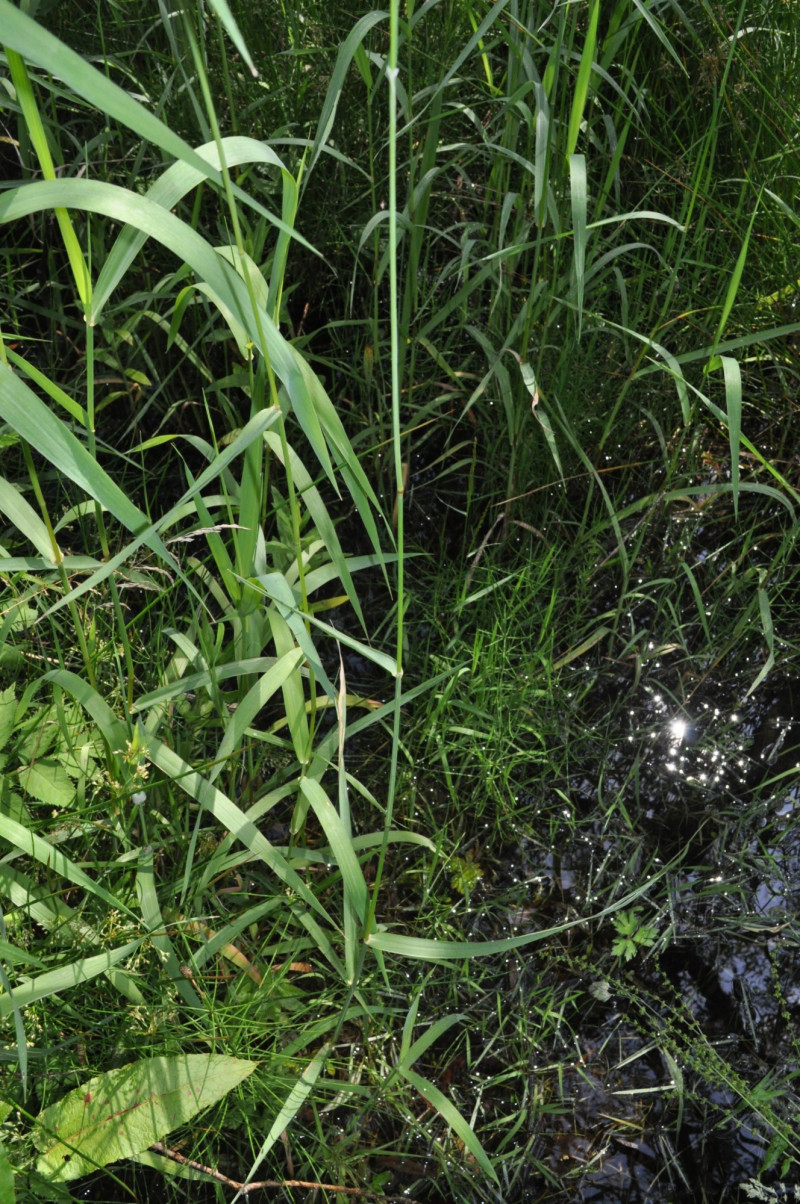
in habitat
Looking at the original close-up images of this grass, I think it's G. maxima, the tallest of the group. Key features are its groups of three stamens in the flowers, which also have narrow, acute lemmas (all other Glycerias have broad ones) and the stems have a brown ring mark around the junctions.
G. maxima is a rare species in northern Derbyshire, as it prefers lowland habitats.
in habitat
Timothy (Phleum pratense)

Calver Marsh
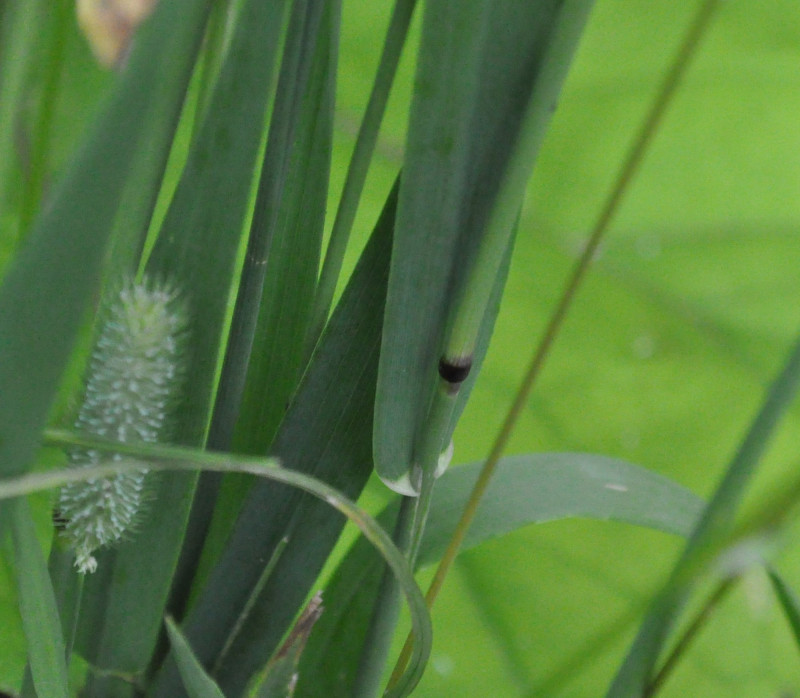
This very common species is widespread in Derbyshire. All Phleum species have a characteristic narrow oval or cylindrical inflorescence. P. pratense can be identified by its tall height (over 1 metre), long inflorescence and blunt ligules.
Crested Dog's-tail (Cynosurus cristatus)

Crested Dog's-tail has a very characteristic, symmetrical, flowering spike (although technically it is a panicle). It is a typical meadow plant, flowering from mid-summer onwards.
The leaves are narrow and the flowering stems rather wiry, with the whole plant growing to around 50cm tall. It is a common species across Derbyshire.
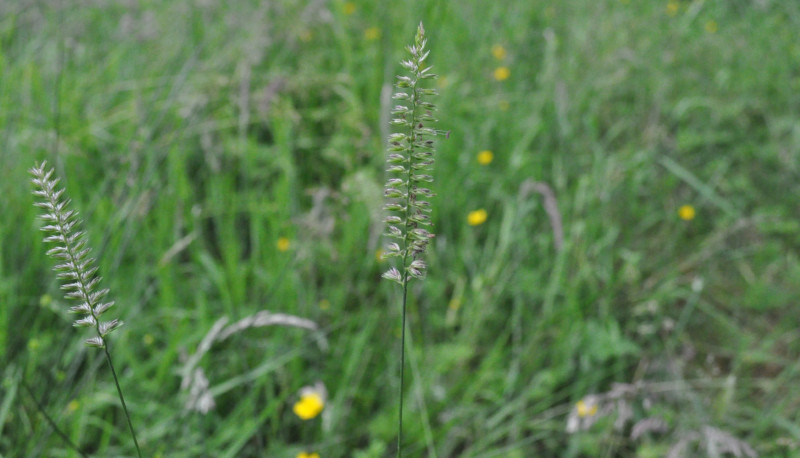
The leaves are narrow and the flowering stems rather wiry, with the whole plant growing to around 50cm tall. It is a common species across Derbyshire.
False Oat-grass (Arrhenatherum elatus)


ligule
False Oat-grass does indeed look similar to the true oat-grasses (Avenula spp). It is a tall species, often over 1 metre tall, with graceful, spreading panicles bearing narrow, oat-like flowers.
These flowers provide the best distinction between Avenula spp and Arrhenatherum: the flowers of the latter have long, straight awns protruding from them, whereas Avenula spp have flowers with bent awns.
False Oat-grass is a very common species in Derbyshire and in open habitats across much of Britain.
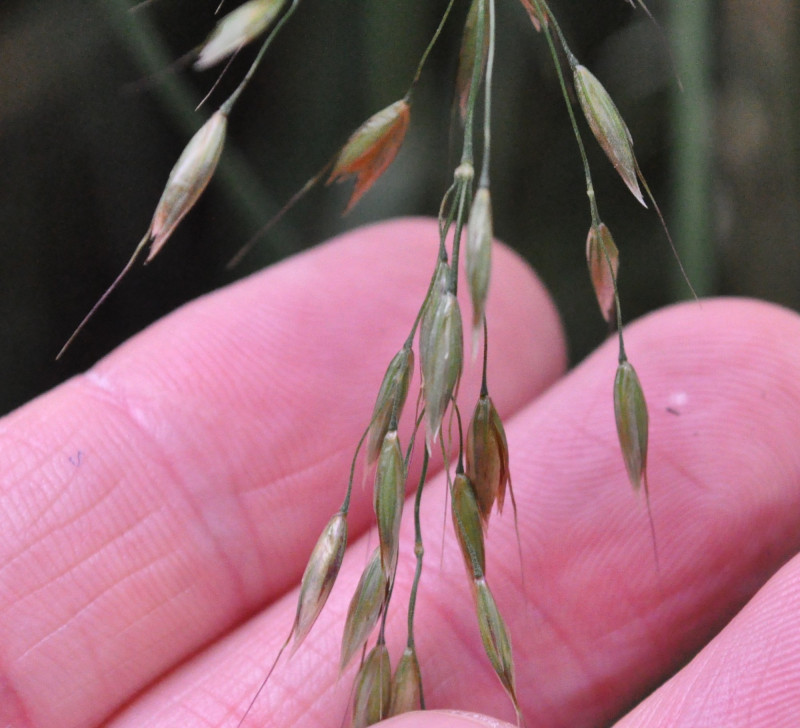
flower detail
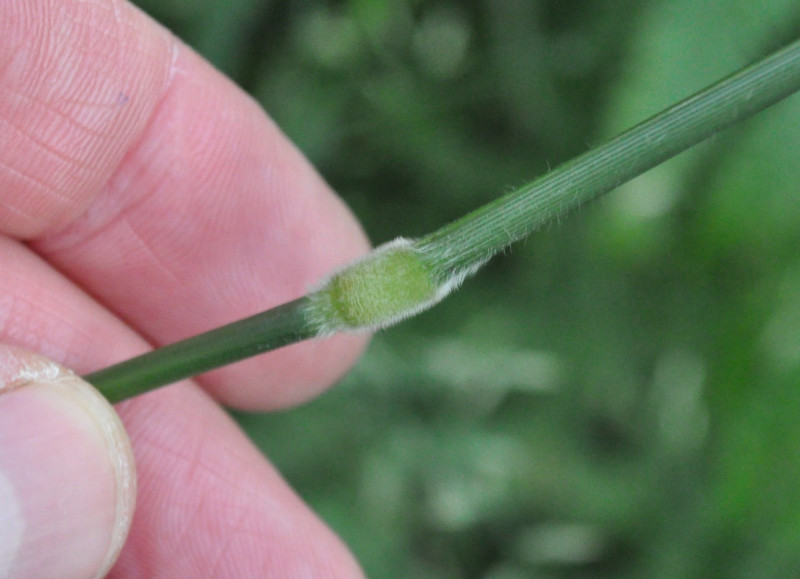
node detail
These flowers provide the best distinction between Avenula spp and Arrhenatherum: the flowers of the latter have long, straight awns protruding from them, whereas Avenula spp have flowers with bent awns.
False Oat-grass is a very common species in Derbyshire and in open habitats across much of Britain.
flower detail
node detail
Wood Millet (Milium effusum)


The spreading, umbrella-like flower panicles make this an easy grass to identify in our woodlands. It is a tall species, growing to well over a metre in height. The leaves are broad and pale and individual flowers lack awns.
This is a common species in damp woodland and is widespread in Derbyshire.
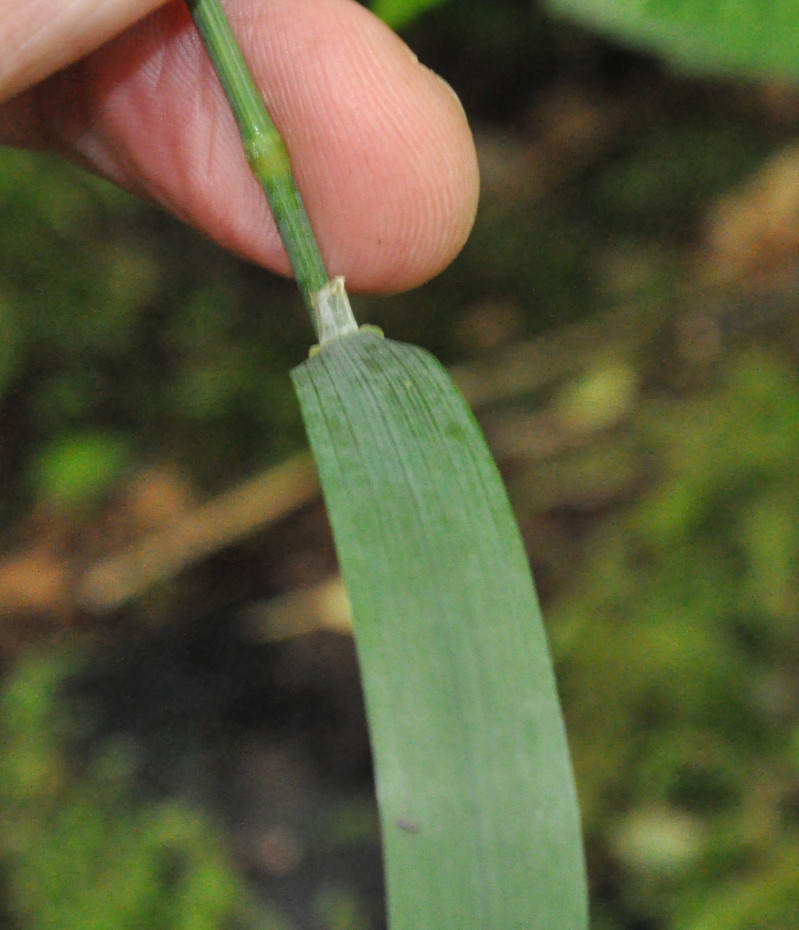
blunt ligule detail
This is a common species in damp woodland and is widespread in Derbyshire.
blunt ligule detail
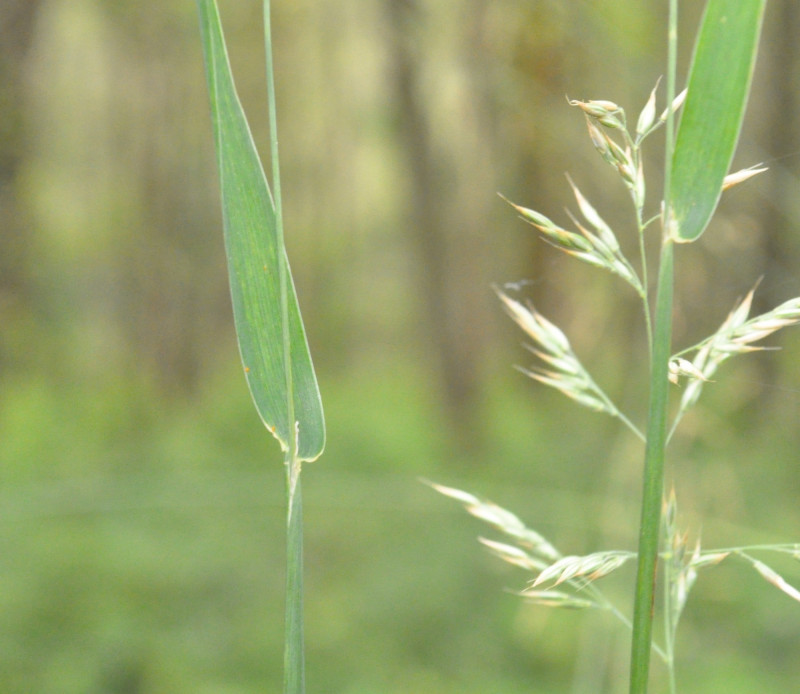
Soft-grass (Holcus mollis)

This very common grass is named for its soft leaves. It can be recognised by its bent awns and bearded stem joints (H. lanatus is otherwise quite similar).
Soft Grass is found widely in non-calcareous habitats in Derbyshire, although it avoids wet sites.
Soft Grass is found widely in non-calcareous habitats in Derbyshire, although it avoids wet sites.
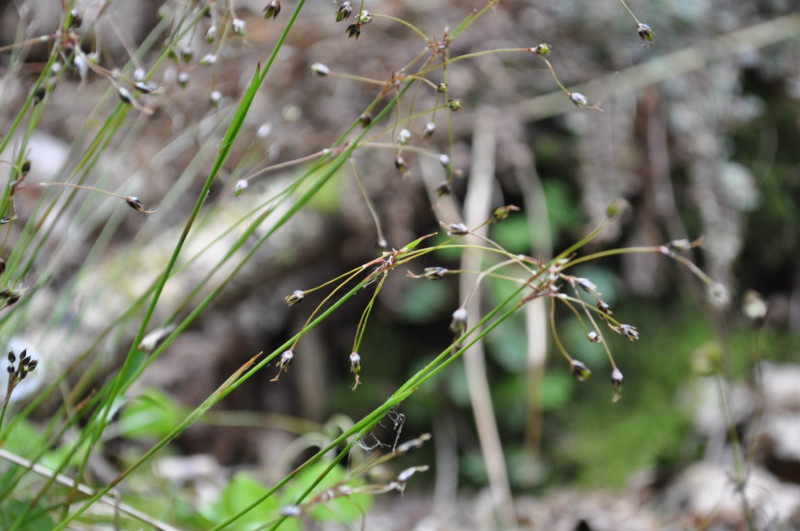
Luzula pilosa (Hairy Wood-rush)


Oxhay Wood, Lea
Hairy Wood-rush is an uncommon species in Derbyshire, restricted to areas of ancient woodland, where it grows on stony stream banks and leaf litter, where competition from more vigorous plants is reduced.
Hairy Wood-rush has distinctive drooping, branched flower spikes and a small, tufted habit - these features make it easy to recognise. The only other Wood-rush that occurs in similar habitat is L. sylvatica, which is a much larger, brighter green, creeping plant with erect inflorescences.
Hairy Wood-rush has distinctive drooping, branched flower spikes and a small, tufted habit - these features make it easy to recognise. The only other Wood-rush that occurs in similar habitat is L. sylvatica, which is a much larger, brighter green, creeping plant with erect inflorescences.
Luzula multiflora (Heath Wood-rush)

Mill Dale, Ladybower
On the moors of the Dark Peak, this is a common species. The globular inflorescences and small stature of the plants makes it an easy species to recognise. It grows in damp habitats, with flowering stems to around 30cm tall.
Wood Club-rush (Scirpus sylvaticus)


Calver Marsh
This beautiful plant is rare in Derbyshire. It grows in marshy or seasonally-flooded woodland, often near rivers and ponds. It is a large species, growing up to around a metre tall and is easily recognised in flower by its umbel-like inflorescences.

Sedges
Carex pulicaris (Flea Sedge)


Brampton Moor
Flea Sedge is a rare plant in Derbyshire, restricted to the Peak District.
It is a fairly distinctive species, identified by its relatively small stature, and few-flowered, spiky inflorescences. The only other similar sedges do not occur in Derbyshire.
Remote Sedge (Carex remota)


Shining Cliff Wood
A fairly common sedge of wet woodland, Remote Sedge is named for the widely-spaced flowers on the inflorescences. In Derbyshire, this species is widespread in the lowland areas where suitable habitat exists. It avoids higher parts of the Dark Peak and the limestone of the White Peak.
Identify Remote Sedge is easy - no other sedge has the distant, stalkless flower spikes, long, wispy bracts and tussock growth habit.
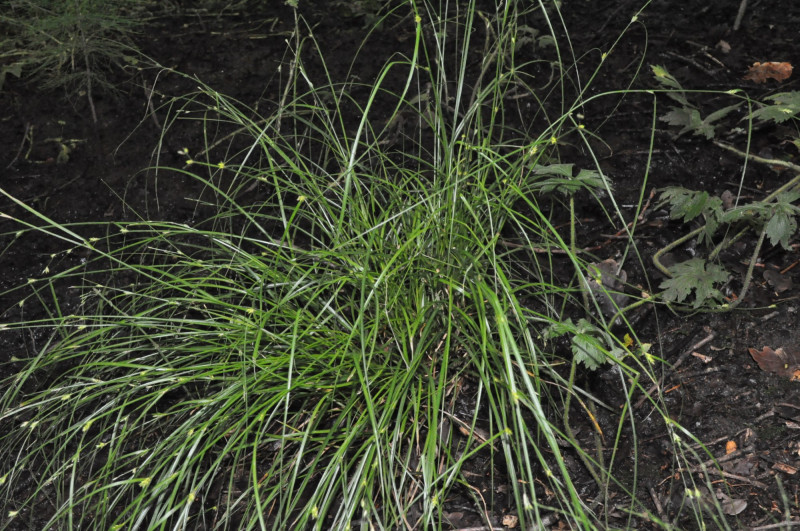
Froggatt Wood
Identify Remote Sedge is easy - no other sedge has the distant, stalkless flower spikes, long, wispy bracts and tussock growth habit.
Froggatt Wood
Wood Sedge (Carex sylvatica)
image coming soon
Wood Sedge is common across Britain, and is equally frequent within Derbyshire itself. It is usually the only sedge in deciduous woodlands, although the similar C.strigosa occurs very rarely in Derbyshire. The rarer species has short-beaked utricles and longer ligules.
Bladder Sedge (Carex vesicaria)


Fox House
Bladder Sedge is a very rare species in Derbyshire, although it has a scattered distribution across Britain as a whole.
It is a large sedge, growing up to one metre tall, and favours fen and mire habitats as well as streamsides. The similar C.rostrata grows in the Peak District and can be distinguished by its glaucous leaves dark green underneath, stomata on the upper (rather than lower) surface of the leaf and shorter, more abruptly-tapered utricles.
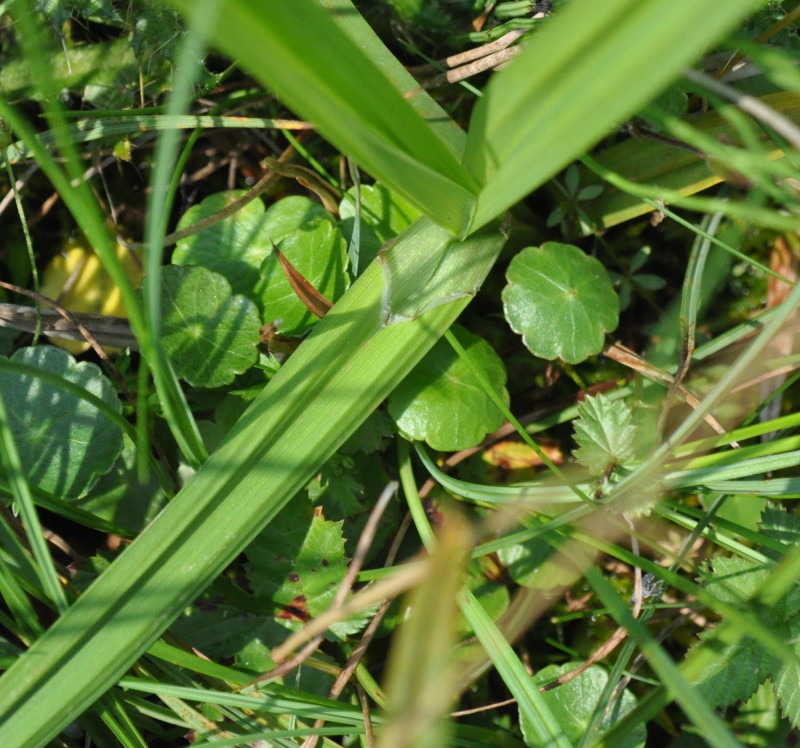
utricle detail
It is a large sedge, growing up to one metre tall, and favours fen and mire habitats as well as streamsides. The similar C.rostrata grows in the Peak District and can be distinguished by its glaucous leaves dark green underneath, stomata on the upper (rather than lower) surface of the leaf and shorter, more abruptly-tapered utricles.
utricle detail
Star Sedge (Carex echinata)

This species is described in the Sedges & Rushes of Ben Lawers NNR section of the site.
Carnation Sedge (Carex panicea)


This instantly-recognisable sedge is common in the White Peak, as it often favours calcareous soils, but can also be found widely in the Dark Peak, as here near Ladybower, where it grows in wet heath and mire habitats.
Key features of Carnation Sedge are its glaucous leaves (similar to C.flacca) and the sheathing bract on the flower spike and utricles which have their beaks obliquely-offset.
Key features of Carnation Sedge are its glaucous leaves (similar to C.flacca) and the sheathing bract on the flower spike and utricles which have their beaks obliquely-offset.
Carex canescens (White Sedge)

Brampton Moor
Wet acidic moorland is the home of this attractive and distinctive sedge. Here it grows in marshy and boggy niches, avoiding dry areas. The pale fruiting heads give the species its common name. In its habitat, no other sedge looks the same. White Sedge grows to around 50cm tall.
White Sedge is only locally common in Derbyshire, and almost completely restricted to the Derwent Valley moors, the Buxton area and the far north-west of the county.
White Sedge is only locally common in Derbyshire, and almost completely restricted to the Derwent Valley moors, the Buxton area and the far north-west of the county.
Carex acutiformis or riparia (Lesser / Greater Pond-sedge)


Brampton Moor
I'm unsure which of these two species are shown in these photos (and the NBN records neither for the site), but I'm confident one of the two Pond-sedges is shown here.
Both species occur at scattered sites in the Peak Fringe and both are very similar in overall appearance - they have distinctively glaucous, stiff leaves, similar inflorescences, a similar habit and grow in the same habitats. Small features such as the shape of the glume and number of male spikelets are usually conclusive, but impossible to judge from these photos!
Both species occur at scattered sites in the Peak Fringe and both are very similar in overall appearance - they have distinctively glaucous, stiff leaves, similar inflorescences, a similar habit and grow in the same habitats. Small features such as the shape of the glume and number of male spikelets are usually conclusive, but impossible to judge from these photos!
Carex pendula (Pendulous Sedge)


River Derwent, Cromford
This species is a classic plant of shaded pond and river margins. Its tall stature and weeping flowerheads make it very easy to recognise.
Pendulous Sedge is fairly common in suitable habitat in lowland areas of Derbyshire.
Pendulous Sedge is fairly common in suitable habitat in lowland areas of Derbyshire.
Carex acuta (Slender Tufted Sedge)


Brampton Moor
Text coming soon!
Carex otrubae (False Fox Sedge)


Cromford Canal
False Fox-sedge is a lowland species of permanently wet soil by still or slow-moving water. In Derbyshire it is almost entirely absent from the Peak District.
C. otrubae is very similar to True Fox-sedge (C. vulpina) but can be recognised by its only slightly-winged stems, narrow ligules and utricles which are not split at the back. True Fox Sedge is unknown from Derbyshire.
C. otrubae is very similar to True Fox-sedge (C. vulpina) but can be recognised by its only slightly-winged stems, narrow ligules and utricles which are not split at the back. True Fox Sedge is unknown from Derbyshire.
Carex hostiana (Tawny Sedge)


below Combs Moss
Although widespread and common in upland Britain, Tawny Sedge is very rare in Derbyshire, although much of this is down to destruction of lowland wetlands in the past. Now it is restricted to a few sites in the far north of the county.
Tawny Sedge can be recognised by its distinctive female flower spikes, which have dark glumes with silvery edges enclosing a green fruit. The leaves are also a bright yellow-green. In Derbyshire, it is found in weakly calcareous flushes on gritstone.
Tawny Sedge can be recognised by its distinctive female flower spikes, which have dark glumes with silvery edges enclosing a green fruit. The leaves are also a bright yellow-green. In Derbyshire, it is found in weakly calcareous flushes on gritstone.
Carex paniculata (Greater Tussock-sedge)


below Stanage Edge
A large and imposing species, this sedge has a scattered distribution in Derbyshire. It is a species of a variety of permanently boggy habitats, such as pond margins and fens, but in the Dark Peak can also be found in moorland flushes, where its size and characteristic appearance makes it a useful indicator of base enrichment and the possibility of rarer species being found.
Carex dioica (Dioecious Sedge)

below Stanage Edge
One of Derbyshire's rarest sedges, this inconspicuous and unassuming species is currently only known from four extant sites in the Dark Peak and Peak Fringe. Here it grows on the margins of base-enriched flushes. The plants shown here are male, and it appears the Stanage site is entirely devoid of female plants.
Carex lepidocarpa (Long-stalked Yellow-sedge)

Highshaw Clough, Derwent Moors
Text coming soon!
Carex leporina (Oval Sedge)

Mill Brook, Derwent Moors
Text coming soon!
Rushes
Heath Rush (Juncus squarrosus)

Curbar Edge
This common species is described in the Sedges & Rushes of Ben Lawers NNR section of the site. It is a common species of heathland and moorland in Derbyshire, and less dependent on abundant moisture than some other rushes.
Heath Rush's distribution in Derbyshire is largely restricted to acidic parts of the Peak District.
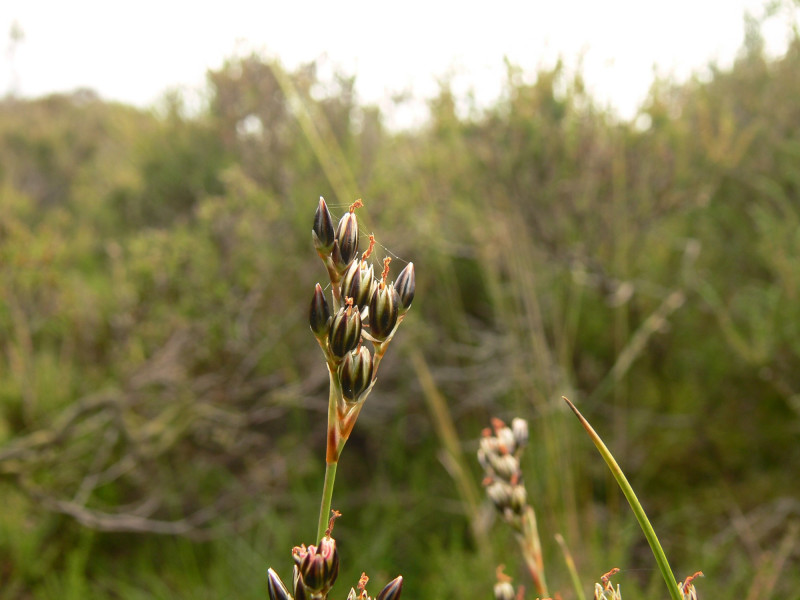
Heath Rush's distribution in Derbyshire is largely restricted to acidic parts of the Peak District.
Bulbous Rush (Juncus bulbosus)

Mill Brook, Derwent Moors
An easily-recognised species, this rush is common in the Dark Peak (but very rare elsewhere in Derbyshire), where it grows in a variety of damp or wet habitats. No other rush in Derbyshire has richly-divergent inflorescences with green, proliferous shoots.
Sharp-flowered Rush (Juncus acutiflorus)

Mill Brook, Derwent Moors
A common rush throughout much of Derbyshire, this species is quite unobtrusive, with creeping, thin stems and small inflorescences. As with many rushes, critical characters are best for identification - the fruits of J.acutiflorus taper gradually to a sharp point, surrounded by sharply-pointed tepals (hence the species name).
Sharp-flowered Rush grows in wet, acidic soils in flushes, on moorland and in marshes and swamps.
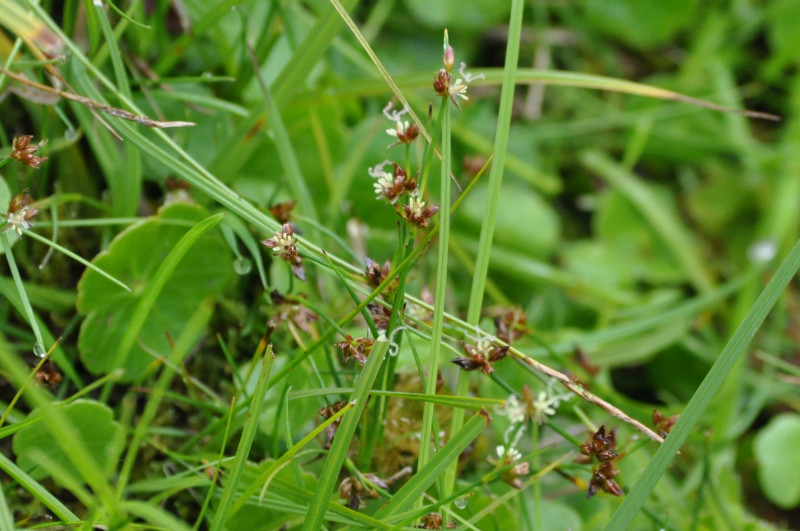
Sharp-flowered Rush grows in wet, acidic soils in flushes, on moorland and in marshes and swamps.
Ferns & Horsetails
Killarney Fern (Trichomanes speciosum)
 Shining Cliff Wood SSSI
Derbyshire's rarest fern is also its most unassuming and perhaps uninspiring! Killarney Fern is known from only two sites in the county but could easily be overlooked. In Derbyshire, it only grows as the juvenile gametophyte stage, where it looks like a dark green moss at first sight. The mature sporophyte stage, which looks like a 'standard' fern is unknown in Derbyshire, although it undoubtedly occured in the past.
Under a microscope, the 'leaves' are easily seen to not be a moss, but tiny, infant fronds.
Under a microscope, the 'leaves' are easily seen to not be a moss, but tiny, infant fronds.
Lady Fern (Athyrium filix-femina)


Fox House
A characteristic fern of moorland in the Dark Peak, Lady Fern is widespread in non-calcareous parts of Derbyshire and is one of Derbyshire's commonest ferns.
Identifying Lady Fern is fairly straightforward for typical plants in the open - the stipe (the stm of the frond) has a succulent texture and appearance and the fronds as a whole have a rather delicate, fine appearance and a characteristic bright yellow-green colour, quite unlike the darker, coarser Dryopteris and Polystichum species which can grow in the same habitats.
Identifying Lady Fern is fairly straightforward for typical plants in the open - the stipe (the stm of the frond) has a succulent texture and appearance and the fronds as a whole have a rather delicate, fine appearance and a characteristic bright yellow-green colour, quite unlike the darker, coarser Dryopteris and Polystichum species which can grow in the same habitats.
Broad Buckler-fern (Dryopteris dilatata)


Froggatt Wood
This handsome fern is can be seen almost anywhere in Derbyshire and is often common. It grows in a wide range of acidic habitats, from woods to moors to hedgerows.
Dryopteris species can be very tricky to identify, and several occur in Derbyshire (and the Dark Peak). D. carthusiana has paler green fronds and scales with no markings, D. affinis (and its segregates, D. cambrensis and D. borreri) are bipinnate species. All have been recorded from the Dark Peak and Peak Fringe areas.
Basic features of D. dilatata are the tripinnate, dark green fronds and erect, shuttlecock habit (the rhizome does not creep further afield).
Dryopteris species can be very tricky to identify, and several occur in Derbyshire (and the Dark Peak). D. carthusiana has paler green fronds and scales with no markings, D. affinis (and its segregates, D. cambrensis and D. borreri) are bipinnate species. All have been recorded from the Dark Peak and Peak Fringe areas.
Basic features of D. dilatata are the tripinnate, dark green fronds and erect, shuttlecock habit (the rhizome does not creep further afield).
Oreopteris limbosperma (Lemon-scented Fern)

Mill Brook, Derwent Moors
Text coming soon.
Blechnum spicant (Hard Fern)

Froggatt Wood
This very common fern is described in the Flora of Ben Lawers NNR section of the site.
Equisetum sylvaticum (Wood Horsetail)


Froggatt Wood

Clark's Plantation, Farley Moor
Wood Horsetail is fairly widespread in Derbyshire, but not especially common. It grows in damp woodland and in wetter, more open habitats such as stream banks.
The richly-branching habit (even the branches divide into further branches) and papery leaf sheaths make this one of the easier Horsetails to identify. The photo below this text shos the characteristic downward-drooping habit of the branches. Only E. pratense shares this habit, but this rare, northern species does not occur in Derbyshire.
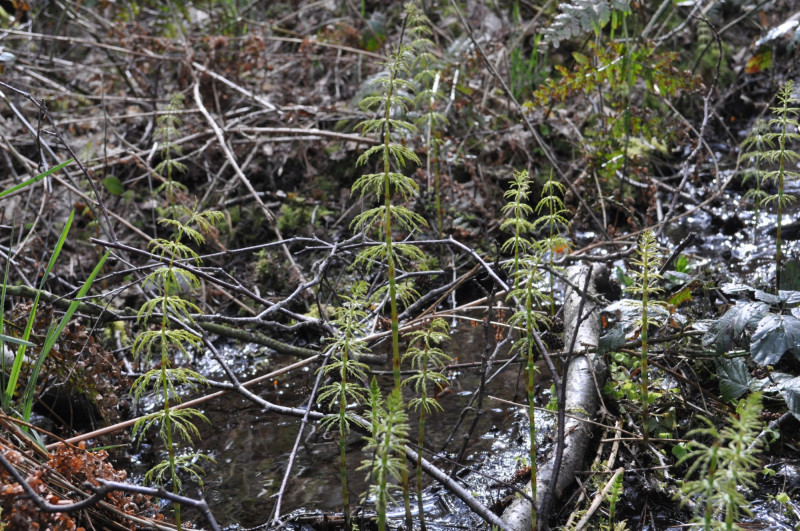
The richly-branching habit (even the branches divide into further branches) and papery leaf sheaths make this one of the easier Horsetails to identify. The photo below this text shos the characteristic downward-drooping habit of the branches. Only E. pratense shares this habit, but this rare, northern species does not occur in Derbyshire.
Equisetum palustre (Marsh Horsetail)

Brampton Moor
As the name suggests, this Horsetail is at home in permanently wet (or at least damp) habitats, such as fens, bog margins and marshes.
Marsh Horsetail looks similar to Water Horsetail, which can also grow in marshes - the two are best told apart by the teeth on the leaf sheath (they are very hard to see in this photo) - those of Marsh Horsetail have transparent, membranous margins, while those of Water Horsetail do not. The latter species also has a round, hollow stem, unlike the angular, solid stem of E. palustre.
Marsh Horsetail is widespread in Derbyshire, but most common in lower parts of the Dark Peak and Peak Fringe.
Marsh Horsetail looks similar to Water Horsetail, which can also grow in marshes - the two are best told apart by the teeth on the leaf sheath (they are very hard to see in this photo) - those of Marsh Horsetail have transparent, membranous margins, while those of Water Horsetail do not. The latter species also has a round, hollow stem, unlike the angular, solid stem of E. palustre.
Marsh Horsetail is widespread in Derbyshire, but most common in lower parts of the Dark Peak and Peak Fringe.
Equisetum fluviatile (Water Horsetail)

Mill Brook, Derwent Moors
Text coming soon!
Phegopteris connectilis (Beech Fern)

Blackden Brook, High Peak
Text coming soon.