


Forest Trees
Dacrycarpus dacrydioides (Rimu)

Abel Tasman NP
This species is described in the Flora of Stewart Island section of the site.
Pectinopitys ferruginea (syn. Prumnopitys ferruginea (Miro)


Pupu Springs, Golden Bay

Podocarpus totara (Totara)

Pupu Springs, Golden Bay
Totara is described in the Flora of the North Island section of the site.
Nothofagus fusca (Red Beech)

Lake Rotoroa, Nelson Lakes NP

Kahurangi NP
Named for the colour of its wood, this large tree is widespread in forests in damper areas of the northern South Island. The bright green, toothed leaves look very similar to those of European Beech.
The beautiul trunks of this species often have buttresses supporting their bases and thick, deeply-furrowed bark.
The beautiul trunks of this species often have buttresses supporting their bases and thick, deeply-furrowed bark.
Metrosideros umbellata (Southern Rata)

Abel Tasman NP

Rhopalostylis sapida (Nikau Palm)


trunk detail, showing lichen cover and characteristic ringed leaf scars.


Grove Scenic Reserve, Takaka (all photos)
Nikau Palm is New Zealand's only native palm species, and the most southerly-growing palm on Earth. It grows as far south as Hokitika on the west coast and the Banks Peninsula on the east. It is a common forest species in the north of South Island, such as in Abel Tasman National Park. If one was in any doubt about identifying it, the ringed scars on the trunk and broad, sheathing bases on the fronds will confirm it.


Fuchsia excorticata (Tree Fuchsia)

Pupu Springs, Golden Bay

Lewis Pass
Tree Fuchsia is described in the Flora of the Catlins and Canterbury section of the site.


Lake Rotoroa, Nelson Lakes NP (both photos)
Lake Rotoroa, Nelson Lakes NP (both photos)
Pseudopanax arboreus (Five-finger)

Grove Scenic Reserve, Takaka
Growing as a small tree or large shrub up to 8m tall, five-finger is a common sight in lowland forests throughout the North and South Islands. Despite its common name, leaves can have seven lobes. Key features for identifying it are the sharply-toothed leaf margins and glossy, bright green overall appearance, as well as the very long petioles on each leaf.
Pseudopanax crassifolius (Lancewood)

Lake Rotoroa, Nelson Lakes NP
Looking very different to P.arboreus, Lancewood is a classic New Zealand plant oddity, with its juvenile form bearing very narrow, rigid, drooping leaves, each of which bear sharp, distant teeth. Mature plants develop more 'normal' foliage whch is broader and shorter.
Lancewood is found at low elevations in forests throughout New Zealand. The similar P.ferox has much more prominent, coarse teeth on the leaf margins.
Lancewood is found at low elevations in forests throughout New Zealand. The similar P.ferox has much more prominent, coarse teeth on the leaf margins.
Weinmannia racemosa (Kamahi)

Lake Rotoroa, Nelson Lakes NP

Grove Scenic Reserve, Takaka
Kamahi is described in the Flora of the Catlins and Canterbury section of the site.
Olearia rani (Heketara)

Pupu Springs, Golden Bay
Primarily a plant of North Island forests, O.rani is found in a small area of the South Island in the Nelson-Marlborough region. Its distinctive features are the small, yellowish-green, mottled leaves with toothed edges and prominent veins. When in flower, it bears panicles of white daisies, typical of Olearia.
Heketara can grow as a large shrub or small tree, to around 7m in height.
Heketara can grow as a large shrub or small tree, to around 7m in height.
Brachyglottis repanda (Rangiora)

Grove Scenic Reserve, Takaka
This relative of Olearias is another 'tree daisy', growing up to 7m tall. The distinctive leaves have wavy, obscurely-toothed edges and a mottled colouration. Underneath, they are coated in a fine velvety bloom of white hairs, as are the stems. Fragrant, creamy-white flowers appear in early spring.
Like O.rani, Rangiora is a plant of warmer parts of New Zealand and in the South Island can be seen in coastal and lowland forests as far south as Greymouth and Canterbury, although it has been naturalised in other areas.
Like O.rani, Rangiora is a plant of warmer parts of New Zealand and in the South Island can be seen in coastal and lowland forests as far south as Greymouth and Canterbury, although it has been naturalised in other areas.
Dracophyllum traversii (Mountain Neinei)


Mt Arthur, Kahurangi NP
A speciality of montane forests in the northern parts of the South Island, this impressive species is easy to identify. Growing to 10 metres tall, with attractive peeling bark and red-pink, conical flower spikes, a grove of these trees makes a memorable sight on a mountain walk. The species also occurs in small parts of the North Island.

Coriaria arborea (Tutu)


Wainui Falls, Abel Tasman NP
A well-known, distinctive species of forests throughout New Zealand, Tutu is often found found near water (as in this photo), where it grows as a tall shrub. It has a very noticeable appearance, with robust branches carrying symmetrical, paired, strongly-veined leaves and snake-like flower racemes which develop black, poisonous berries later in the year.
Myrsine australis (Mapau)

Wainui Falls, Abel Tasman NP
Mapau is described in the Flora of the South-western South Island section of the site.
Macropiper excelsum ssp.excelsum (Kawakawa)

 Grove Scenic Reserve, Takaka
The distinctive heart-shaped, large leaves of this forest shrub or small tree make it easy to identify, as do the unusual flowering spikes. Kawakawa is an important native plant for birds, which eat the fruit.
Kawakawa is common throughout the North Island and lowland forests of the northern South Island.
Kawakawa is common throughout the North Island and lowland forests of the northern South Island.
Aristotelia serrata (Wineberry)

Wainui Falls Track, Abel Tasman NP
Wineberry is described in the Flora of Fiordland section of the site.
Corynocarpus laevigatus (Karaka)


Grove Scenic Reserve, Takaka (all photos)
The glossy, laurel-like leaves of this handsome tree make it easy to recognise. Karaka superficially resembles a larger Coprosma species but lacks the dots along the midrib and has very different flowers and fruits - panicles of small, green flowers, followed by paired, orange drupes on long stalks.
Like many other species in this section of the page, Karaka is a lowland forest species whose range extends only about half way down the South Island.

Like many other species in this section of the page, Karaka is a lowland forest species whose range extends only about half way down the South Island.
Carpodetus serratus (Putaputaweta)

Pupu Springs, Golden Bay
This species is described in the Flora of Stewart Island section of the site.
Griselinia littoralis (Kapuka)

Grove Scenic Reserve, Takaka
This common forest shrub is described along with G.lucida in the Flora of the Catlins & Canterbury section of the site.

Lake Rotoroa, Nelson Lakes NP
Lake Rotoroa, Nelson Lakes NP
Melicytus ramiflorus (Mahoe)

Grove Scenic Reserve, Takaka
A common large shrub or small tree, Mahoe can be seen throughout New Zealand's forests, although it is absent from Southland. It can be recognised by its toothed, soft leaves and white, blotchy bark. Its purple-black berries are a favourite of native birds.
Schefflera digitata (Pate / Seven-finger)


Lake Rotoroa, Nelson Lakes NP (both photos)
One of the most easily-recognised forest trees in New Zealand, Pate has a truly tropical look with its large leaves held on long stalks. Despite its common name, individual leaves can have anything from three to nine leaflets. Its unusual flower panicles bear insignificant green flowers, followed by inedible, purple berries.
Pate is reasonably common in damp, lowland forests and can be seen throughout New Zealand.

Grove Scenic Reserve, Takaka
Pate is reasonably common in damp, lowland forests and can be seen throughout New Zealand.
Grove Scenic Reserve, Takaka
Kunzea ericoides (Kanuka)


Wainui Falls Track, Abel Tasman NP
Often confused with Manuka, Kanuka is a larger, softer plant, lacking the prickly leaf tips of Manuka. It can grow as tall as 15m in height. Both are members of the Myrtaceae and have typical five-petalled, cup-shaped flowers rich in nectar for pollinating insects. Manuka is generally spring-flowering, while Kanuka flowers in summer, with its flowers present in small clusters, rather than being solitary.
Kanuka is a plant of dry forests and scrub and can be seen throughout the North Island and down the east coast of the South Island, as far as the Catlins.
Kanuka is a plant of dry forests and scrub and can be seen throughout the North Island and down the east coast of the South Island, as far as the Catlins.
Ascarina lucida (Hutu)


Grove Scenic Reserve, Takaka
With lanceolate, strongly-toothed leaves on deep red stems, Hutu is an easy species to recognise. It grows as a large shrub or small tree in lowland and subalpine forests throughout New Zealand. Unusually for a native species, it has a broad distribution beyond New Zealand and can be found as far away as the Polynesian islands and south-east Asia.
Forest Shrubs
Metrosideros perforata (Small-leaved white rata)

Grove Scenic Reserve, Takaka
Unlike its more famous cousins, this Metrosideros species grows as a climbing forest vine or occasionally a tangled shrub. It bears typical white pom-pom flowers in autumn.
M.perforata can be seen throughout the North Island in lowland and coastal forests and as far south as Banks Peninsula on the South Island.
M.perforata can be seen throughout the North Island in lowland and coastal forests and as far south as Banks Peninsula on the South Island.
Coprosma robusta (Kakaramu)

Pupu Springs, Golden Bay
As its name suggests, this is a robust species of Coprosma, growing as a tall shrub with large, leathery leaves. The leaves are glossy, dark green above and paler underneath, with the usual paired dots along the midribs. Berries are borne in dense clusters, ripening in late summer.
This species is very common across much of New Zealand, and just as likely to be seen away from forests as in them.
This species is very common across much of New Zealand, and just as likely to be seen away from forests as in them.
Coprosma tenuicaulis

Pupu Springs, Golden Bay
A small-leaved, lowland Coprosma, C.tenuicaulis can be recognised by its small, hairless, round leaves which have strong, easily-visible veins. It is found across the North Island but only in the northern half of the South Island.
Olearia arborescens

Mt Arthur Track, Kahurangi NP
This handsome shrub is beautiful in flower, but has attractive foliage too. The flowers are typical of Olearia, being clusters of white 'daisies'. The foliage is dark green and quite wavy, with somewhat indistinct teeth (these often look like no more than points). In favourable conditions, this species can become a small tree, hence the scientific name.
O.arborescens can be found throughout New Zealand at many elevations.
O.arborescens can be found throughout New Zealand at many elevations.
Hebe rakaiensis

Mt Arthur Track, Kahurangi NP
The leaves are the best feature for recognising this Hebe - they are glossy, thin and have pale edges. This attractive species is endemic to the eastern side of the South Island.
Smaller Plants (especially Alpines)
Celmisia gracilenta


Mt Robert, Nelosn Lakes NP
One of several narrow-leaved Celmisias, this species is common across a wide range of open habitats, from the lowlands to the alpine zone. The recurved leaf margins and solitary, tall, woolly flower heads are key characters of this species.
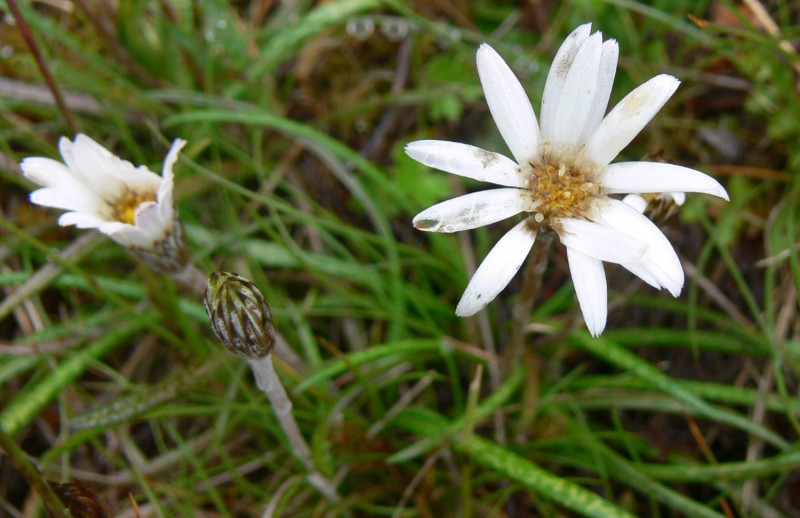
Celmisia verbascifolia

Mt Arthur, Kahurangi NP
This species is described in the Flora of Arthur's Pass section of the site.
Celmisia incana

Mt Arthur, Kahurangi NP
This species is described in the Flora of Arthur's Pass section of the site.
Ourisia lactea ssp. lactea or macrocarpa var. calycina

Mt Arthur Track Kahurangi NP
Ourisia lactea has hairy leaves, and obviously this photo doesn't allow that character to be judged. It is a widespread species in wetter parts of the New Zealand mountains.
O.macrocarpa is described in the Flora of Arthur's Pass NP section of the site.
O.macrocarpa is described in the Flora of Arthur's Pass NP section of the site.
Leucopogon fraseri

Mt Robert, Nelson Lakes NP
Distinguished by its prickly, spine-tipped foliage and sprawling habit, this shrub is widespread in New Zealand's mountains.
Its close relative L.colensoi is described in the Flora of Arthur's Pass NP section of the site.
Its close relative L.colensoi is described in the Flora of Arthur's Pass NP section of the site.
Ozothamnus vauvilliersii

Mt Arthur, Kahurangi NP
This species is described in the Flora of Arthur's Pass NP section of the site.
Arthropodium candidum (Star Lily)

Wainui Falls, Abel Tasman NP
The grass-like foliage of this delicate species belies its beauty when in flower. In summer, small white flowers emerge on spikes, with conspicuous hairy stamens.
Star Lily can be seen across the North and South Islands, generally in forests, but also in more open habitats.
Star Lily can be seen across the North and South Islands, generally in forests, but also in more open habitats.
Astelia fragrans (Flax Lily)

fruit detail, Pupu Springs, Golden Bay

Astelia epiphytes on forest tree, Wainui Falls track, Abel Tasman NP
This species is described in the Flora of Stewart Island section of the site.
Astelia nervosa

Mt Arthur, Kahurangi NP
This striking plant can be seen up to the low alpine zone throughout New Zealand's mountains, especially in damp, peaty, tussock grassland areas. The thin silvery coating on the long leaves makes it easy to identify.
Gastrodia cunninghamii (Huperei)

Lake Rotoroa, Nelson Lakes NP
The commonest of a group of similar orchids, G.cunninghamii is found in forests and shady scrub throughout lowland and subalpine New Zealand. Gastrodias have a fascinating life cycle, where they live as parasites on fungi, which in turn are parasitic on various forest tree species.
As well as three recognised species of Gastrodia in New Zealand, there are other, as-yet-undescribed forms. G.cunninghamii can be recognised by a combination of its large size (often 30cm tall or more), warty flowers, black-brown tip to the labellum (visible in the flower on the left of this photo) and short column (meaning it's not visible without dissecting the flowers).
As well as three recognised species of Gastrodia in New Zealand, there are other, as-yet-undescribed forms. G.cunninghamii can be recognised by a combination of its large size (often 30cm tall or more), warty flowers, black-brown tip to the labellum (visible in the flower on the left of this photo) and short column (meaning it's not visible without dissecting the flowers).
Prasophyllum colensoi

Mt Robert, Nelson Lakes NP
This species is described in the Flora of the North Island section of the site.
Microtis unifolia (Common Onion Orchid)


Wainui Falls, Abel Tasman NP (both photos)
An unassuming orchid with yellow-green flower spikes, M.unifolia is a common species across much of New Zealand, where it even grows in lawns and urban areas. Other Microtis species (there are at least three, but possibly more) are superficially very similar, and small differences like the shape of the lip in the tiny flowers need to be inspected to differentiate them.
Gaultheria crassa

Mt Robert, Nelson Lakes NP
The tallest of New Zealand's alpine Gaultherias, G.crassa is a widespread plant of subalpine and low-alpine habitats in the mountains of the North and South Island. The prominent flower clusters and very thick leaves help to identify it.

Hebe pauciramosa (probably)

Mt Arthur, Kahurangi NP
This species is described in the Flora of Arthur's Pass NP section of the site.
Celmisia sp

Pupu Springs, Golden Bay
Caladenia lyallii

Mt Arthur, Kahurangi NP
This species is described in the Flora of Arthur's Pass NP section of the site.
Ferns & relatives
Blechnum novae-zelandiae (Kiokio)

Pupu Springs, Golden Bay

Mt Arthur, Kahurangi NP
This robust fern is a common sight in disturbed habitats like damp, shady road cuttings and scrub, where it can spread with little competition. The fronds have a characteristic shrivelled look to them and new growth is tinged a distinctive pink or red.
Kiokio is a variable fern, ranging from small forms with fronds 30cm long to huge individuals with fronds in excess of 3 metres. It can be seen throughout New Zealand.
Kiokio is a variable fern, ranging from small forms with fronds 30cm long to huge individuals with fronds in excess of 3 metres. It can be seen throughout New Zealand.
Blechnum discolor (Piupiu / Crown Fern)

Mt Arthur, Kahurangi NP
A common forest fern, this lovely species often grows in attractive, large colonies becuase it spreads via stolons.
Crown Fern is easy to recognise - plants grow as spreading, erect shuttlecocks, much like a crown, and individual fronds have paler undersides (hence the scientific name).
Crown Fern occurs throughout New Zealand.
Crown Fern is easy to recognise - plants grow as spreading, erect shuttlecocks, much like a crown, and individual fronds have paler undersides (hence the scientific name).
Crown Fern occurs throughout New Zealand.
Cyathea dealbata (Silver Fern)

Wainui Falls Track, Abel Tasman NP
This species is described in the Flora of the North Island section of the site.
Dicksonia squarrosa (Wheki)

Grove Scenic Reserve, Takaka

Pupu Springs, Golden Bay

Wainui Falls Track, Abel Tasman NP
One of New Zealand's most common tree ferns, Wheki grows to around 7m tall, with a characteristic black trunk (technically a caudex) with protruding bases of the old stipes (the 'stems' of the fronds). Individual stipes are also very dark and covered in brownish-black hairs - the origin of its scientific name - although these are lost with age. Fronds are generally 1-2 metres long, with old ones usually falling away, so this tree fern tends not to have a scruffy 'skirt' of dead material (unlike its cousin, D.fibrosa - see below).

Grove Scenic Reserve, Takaka
Grove Scenic Reserve, Takaka
Dicksonia fibrosa (Wheki-Ponga)

characteristic 'skirt' of old fronds, Wainui Falls Track, Abel Tasman NP
This fern is described in the Flora of the Catlins & Canterbury section of the site.
Asplenium bulbiferum (Hen & Chickens Fern)

Wainui Falls Track, Abel Tasman NP
This common fern is described in the Flora of Stewart Island section of the site.

Lake Rotoroa, Nelson Lakes NP
Lake Rotoroa, Nelson Lakes NP
Asplenium oblongifolium (Shining Spleenwort)


Wainui Falls, Abel Tasman National Park
This handsome, endemic fern is very easy to recognise by its very glossy, shining fronds, which are very finely-toothed on close inspection. It is a plant of warmer parts of New Zealand, and not found south of Banks Peninsula.
A.oblongifolium is a terrestrial fern but can also be seen as an epiphyte.
A.oblongifolium is a terrestrial fern but can also be seen as an epiphyte.
Asplenium flaccidum (Hanging Spleenwort)

Pupu Springs, Golden Bay

Grove Scenic Reserve, Takaka
This species is described in the Flora of the Catlins & Canterbury section of the site.
Lastreopsis hispida (Hairy Fern)

Wainui Falls Track, Abel Tasman NP
Named for its bristly-hairy stalks, this species is a common fern throughout New Zealand. It has a distinctive look with its five-angled fronds. L.glabella is a very similar species, but lacks the long, dark bristles on the stems (they are visible onthis plant by zooming in on the original!)..
Leptopteris hymenophylloides (Single Crape Fern)

Wainui Falls Track, Abel Tasman NP
The flat-lying, translucent fronds help to identify this delicate, tall fern of damp forests. It is found throughout New Zealand in suitable habitat.
Grammitis sp

Wainui Falls Track, Abel Tasman NP
Grammitis species have a characteristic appearance, with narrow, strap-like fronds. Unfortunately, it's impossible to identify this plant further, as critical characters are necessary to distinguish individual species, especially the shape of the sporangia on the underside of the fronds, and whether they bear hairs or not. If only I'd known at the time I photographed them!
Gleichenia dicarpa (Tangle Fern)

Wainui Falls, Abel Tasman National Park
A fern of scrub and swamps, this straggly species is found throughout New Zealand (and further afield). It can be recognised by its forked fronds held aloft on reddish-brown stipes.
Zealandia pustulata (syn. Microsorum pustulatum)

Wainui Falls, Abel Tasman National Park
Another common fern throughout New Zealand, this species scrambles over rocks and soil, and is also frequently seen as an epiphyte.
Identifying this fern is starightforward - its fronds are thick, glossy and leathery. These starts out as entire and strap-shaped, becoming deeply-lobed with age.
Identifying this fern is starightforward - its fronds are thick, glossy and leathery. These starts out as entire and strap-shaped, becoming deeply-lobed with age.
Pteridium esculentum (Bracken)

Wainui Falls, Abel Tasman National Park
New Zealand's native bracken has the same characters as bracken the world-over. It grows as tall, rough, creeping patches with narrow, dull green pinnae. It can be found across the country in bright, sunny, open habitats.
Hymenophyllum demissum

Wainui Falls, Abel Tasman NP
Text coming soon!
Lycopodium scariosum (Creeping Clubmoss)

Mt Robert, Nelson Lakes NP
With its leaves held strongly all in the same plane, this sprawling clubmoss has a very distinctive appearance and is easy to identify. It occurs across New Zealand, especially in subalpine and montane areas.
Lycopodium volubile

Pupu Springs, Golden Bay
A common clubmoss of well-lit, lowland habitats, this sprawling and scrambling species has two types of leaves, which are flattened in one plane like L.scariosum (see above). In L.volubile, the smaller leaves occur on the upper and lower surfaces of the stem between branches. In L.scariosum, they only occur on th lower surface. The photo doesn't show this well, unfortunately!