


Trees
Eucalyptus regnans (Mountain Ash)


Great Otway NP
The iconic plant of the Otway Ranges, this huge gum tree is famous as the world's tallest hardwood tree, with individuals having been measured at 130m tall! The Otway Ranges population is actually disjunct, with the main centre of distribution being found east and north-east of Melbourne, where there is sufficient rainfall for the species to survive. It is also found in lowland areas of Tasmania.
Nothofagus cunninghamii (Myrtle Beech)

Great Otway NP
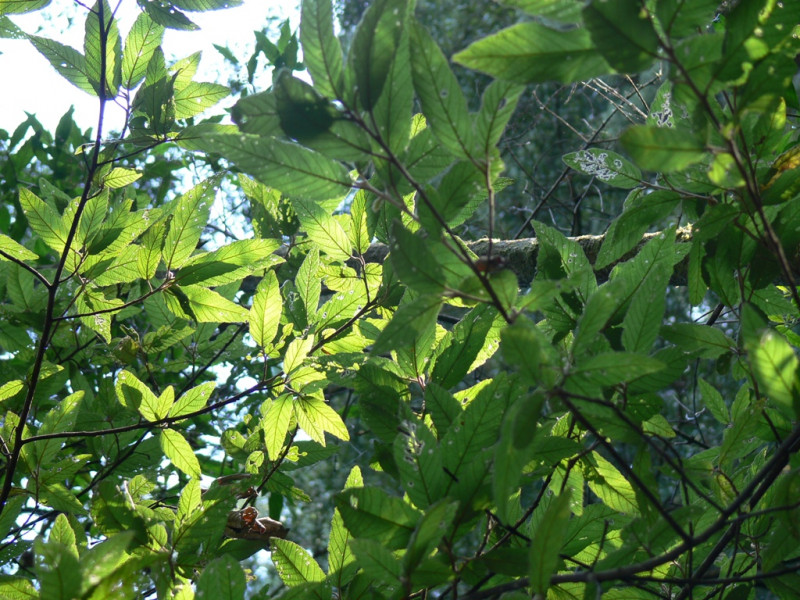
One if the main cool rainforest trees in south-eastern Australia, Myrtle Beech can grow up to 50m tall and live to a very old age. Unfortunately it is killed by forest fires, so large trees are only seen in particularly wet areas of forest such as in shaded gullies and alongside creeks. The distinctive triangular, serrated leaves make it easy to identify.

Mait's Rest, Great Otway NP
Mait's Rest, Great Otway NP
Bedfordia arborescens (Blanket-leaf)


Great Otway NP
A widespread understorey species, Blanket-leaf is named for the woolly lower surfaces of the leaves (not especially obvious here). The stems are also woolly-white. This species is related to Olearias, which are also often woolly but much smaller plants. Like them, Bedfordia has white daisy flowers.
This handsome tree is easy to identify from a distance in the forest, even when not in flower, as the leaves tend to be crowded at the end of branches, giving the trees a starry appearance, as seen in the second photo.
This handsome tree is easy to identify from a distance in the forest, even when not in flower, as the leaves tend to be crowded at the end of branches, giving the trees a starry appearance, as seen in the second photo.
Atherosperma moschatum (Southern Sassafras)

Great Otway NP
The serrated leaves all held in one plane along the branches help to identify this graceful and common forest plant. It bears small, white, cup-shaped flowers.
The scientific name of this species comes from the spicy fragrance emitted by the leaves and bark when they are rubbed or crushed.
The scientific name of this species comes from the spicy fragrance emitted by the leaves and bark when they are rubbed or crushed.
Pomaderris apetala (probably)

Great Otway NP
One of several Pomaderris species in Victoria's forests, P.apetala can be recognised by yellowish flowers that lack petals and by the simple, starry hairs on its leaves (the similar P.aspera has starry hairs).
Thanks to Paddy Dalton of UTas for the identification.
Thanks to Paddy Dalton of UTas for the identification.
Shrubs
Xanthorrhoea australis

Mt Richmond NP
One of the emblematic plants of Australia, Xanthorrhoeas are easy to recognise as a genus but can be tricky to separate as species without close inspection.
X.australis is one of the most widespread and is a common species of dry forests in Victoria. It can be recognised by a combination of its silvery-green foliage and four-angled leaves in cross-section. In Victoria, the only other species is X.minor, which is smaller and has leaves with a triangular corss-section.
X.australis is one of the most widespread and is a common species of dry forests in Victoria. It can be recognised by a combination of its silvery-green foliage and four-angled leaves in cross-section. In Victoria, the only other species is X.minor, which is smaller and has leaves with a triangular corss-section.
Cassinia laevis (Cough Bush)

Bay of Islands Coastal Park
A distinctive shrub of rocky areas, with woolly white flower stems and thin, thread-like leaves. The common name comes from the use of the leaves by Aborigines as a cough rememdy.
Leucopogon sp

Bay of Islands Coastal Park
Text coming soon!
Correa reflexa (Common Correa)

Mt Richmond NP
There are eleven species of Correa, all endemic to Australia, and this is the most widespread, occurring in temperate areas of all south-eastern states. It is a variable species, and flower colour can range from the typical red pictured here, to green or white.
Ferns & other plants
Dicksonia antarctica (Soft Tree Fern)


Juvenile plants forming rainforest understory. Thanks to Paddy Dalton for the identification of this photo.
A common tree fern in Australia, this widespread species can be seen in temperate wet forest from Tasmania, north to south-eastern Queensland.
Soft Tree Fern can be distinguished easily from the common Cyathea australis by its sporangia on the underside of the fronds - those of the latter are more numerous and covered by thin scales, whereas those of Dicksonia are protected by cup-like structures.
Soft Tree Fern can be distinguished easily from the common Cyathea australis by its sporangia on the underside of the fronds - those of the latter are more numerous and covered by thin scales, whereas those of Dicksonia are protected by cup-like structures.
Histiopteris incisa (Bat's Wing Fern)

A widespread fern in eastern Australia, it thrives in damp forests from here in Victoria all the way to northern Queensland. It is also found in New Zealand and other South Pacific countries. Key features for identifying it are the glaucous, pale green colour and broad, rounded lobules which resemble (slightly) oak leaves.
Thanks to Paddy Dalton of UTas for the identification.
Thanks to Paddy Dalton of UTas for the identification.
Blechnum sp (possibly chambersii)
Image coming soon!
Text coming soon!
Microsorum scandens (Kangaroo/ Fragrant Fern)

A common and distinctive fern, this species can recognised by its lobed, leathery fronds and ovate sporangia sunken into the leaf surface. It is a typical species of very humid sites, where it scrambles over rocks and tree trunks.

Blechnum wattsii (Hard Water Fern)

A common fern of damp shady areas, this species can be distinguished from similar Blechnum species by its wide leathery pinnae, the first of which are sharply angle away from the rachis.
Thanks to Paddy Dalton of UTas for confirming the identification.
Thanks to Paddy Dalton of UTas for confirming the identification.
Cyathophorum bulbosum

A common large moss of damp areas, this distinctive species is easily spotted once known. It can be found in all south-eastern states, as well as in New Zealand (you can see a photo from the North Island here). Thanks to Paddy Dalton (formerly of UTas) for the identification.
Hymenophyllum australe

Text coming soon!
Thanks to Paddy Dalton of UTas for the identification.
Thanks to Paddy Dalton of UTas for the identification.
Lunularia cruciata

Erskine Falls
According to Meagher & Fuhrer's 'Field Guide to Mosses & Allied Plants of Southern Australia', which I highly recommend as a book for interested beginners, this is probably the commonest liverwort worldwide! You may well have a specimen living in a plant pot in your garden, wherever you are reading this!
Here in the rainforest, the plant was forming a typical mat on the bare soil of the forest floor.
Thanks to Paddy Dalton of UTas for the identification.
Here in the rainforest, the plant was forming a typical mat on the bare soil of the forest floor.
Thanks to Paddy Dalton of UTas for the identification.
Unidentified fungus

Any ideas? Feel free to contact me!
Unidentified fungus

Any ideas? Feel free to contact me!
Unidentified fungus

Any ideas? Feel free to contact me!