


Desert Perennials
Phoradendron californicum (Desert Mistletoe)

Saguaro NP East


Sabino Canyon
Text coming soon!
Phoradendron sp

Catalina State Park

Santa Rita Mountains
I had identified this as P. serotinum (now known as P. leucarpum) but that species only occurs from NM eastwards. I'm researching what else this could be!
Allionia incarnata (Trailing Four o'clock)


Silver Bell Mountains (all photos)
Related to the well-known Mirabilis, this attractve plant grows as a mat of sprawling, sticky stems in open, sandy habitats, flowering throughout the warmer months. Unusually the 'flower' is actually three irregular, triangular flowers sitting very close together.
Three varieties are recognised and all occur in Arizona.

Three varieties are recognised and all occur in Arizona.
Anemone tuberosa (Desert Anemone)


Kartchner Caverns State Park, Whetstone Mountains
Found throughout the desert southwest, Desert Anemone is common on rocky slopes in the foothills. It flowers in early spring and easy to recognise. Surprsingly, the white-pale pink 'petals' are actually sepals. The true flowers lack petals.
Delphinium scaposum (Barestem Larkspur)

Saguaro NP East


Sabino Canyon, Santa Catalina Mountains
Text coming soon!

Lesquerella purpurea (Purple Bladderpod)

bottom of Madera Canyon, Santa Rita Mountains
Named for the colour of its seed pods, rather than the flowers, this little white-flowered crucifer occurs in open habitats in the desert. The broad, spathulate, wavy, greyish leaves grow as rosette with globular flower clusters rising above them. Other white-flowered members of this family have a different growth habit or solitary flower spikes, as well as different pods.
Streptanthus carinatus ssp. arizonicus (Arizona Jewelflower)

Saguaro NP West
An unusual-looking member of the Brassica family, this winter-spring-flowering species inhabits rocky terrain in southern Arizona and adjacent New Mexico and Mexico. The bell-shaped flowers are actually mostly sepal - the true petals are the darker, curved extremities visible at tthe tips.
The nominate form of S.carinatus has purple flowers and is less common in Arizona than the yellow-flowered arizonicus.
The nominate form of S.carinatus has purple flowers and is less common in Arizona than the yellow-flowered arizonicus.
Coursetia glandulosa


Sabino Canyon, Santa Catalina Mountains
Text coming soon!
Lotus rigidus (Wiry Lotus)

Saguaro NP West (both photos)
A true desert plant, this species has reduced, stiff, narrow foliage and yellow pea lowers in groups of one to three. Depending on conditions, it can grow up to a metre tall, always in dry, harsh habitats, like washes and hill slopes.
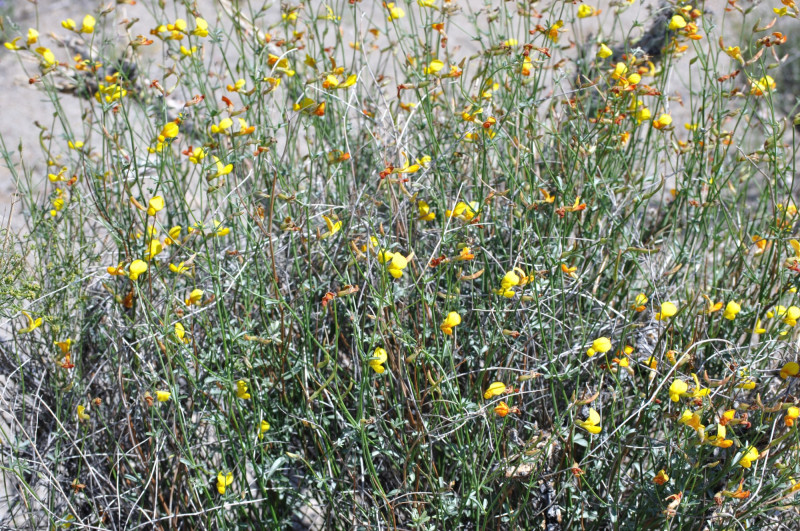
Astragalus crotalariae

Carr Canyon, Huachuca Mountains
Text coming soon!
Janusia gracilis (Janusia)

Sabino Canyon, Santa Catalina Mountains
A rather nondescript plant, this species grows as a vine that twines through other desert shrubs. The unusual flower petals with very slender stalks make is easy to identify. Janusia forms part of the diet of the Desert Tortoise.
Euphorbia albomarginata (Rattlesnake Weed)

Saguaro NP East
Also known as Chamaesyce albomarginata, this mat-forming plant flowers from late winter through to autumn. Like other Euphorbiaceae, the 'flower petals' are actually large bracts, with the true flowers being the tiny structures in the centre of the flowers.
This species resembles others, and to be sure of its identity, the presence of a white flap between the leaf bases needs to be confirmed. It is widespread in the southwestern United States.
This species resembles others, and to be sure of its identity, the presence of a white flap between the leaf bases needs to be confirmed. It is widespread in the southwestern United States.
Euphorbia polycarpa (Smallseed Sandmat)

Text coming soon!
Herissantia crispa (Curly Bladder Mallow)


Saguaro NP West (both photos)
It's not obvious from the photo, but the easiest feature to identify this very widespread species is the presence of a joint and kink in the flower stalks. Otherwise, the pale yellow flowers and heart-shaped, grey-green leaves with a velvety coating of short hairs make it easy to distinguish.
Sphaeralcea ambigua (probably) (Desert Globemallow)

probably S.ambigua, Saguaro NP West
Sphaeralceas are beautiful shrubby species of open, dry habitats with distinctive brightly-coloured flowers. Individual species can be difficult to distinguish without close examination of critical characters such as how the fruits split, and the texture of their segments. Flower colour is not a reliable character and is variable within a species and even within local populations.
S.ambigua is a widespread species, along with S.coulteri and S.laxa (see below). Ambigua usually has larger flowers than the other two, and laxa has purple anthers.
S.ambigua is a widespread species, along with S.coulteri and S.laxa (see below). Ambigua usually has larger flowers than the other two, and laxa has purple anthers.
Sphaeralcea laxa (Caliche Globemallow)


purple-flowered form, Saguaro NP West
This species is described with S.ambigua, above.

Camissonia californica (California Suncup)

Sabino Canyon, Santa Catalina Mountains
An understated member of the Evening Primrose family, this species occurs in dry habitats, growing as a spindly plant up to around 2 metres tall. The small, bright yellow, four-petalled flowers, present in spring, make it easy to recognise. Unlike many Sonoran Desert plants in Arizona, the species goes no further east from here and is absent from the Chihuahuan Desert.
Daucus pusillus (Wild Carrot)


Catalina State Park
Text coming soon!
Funastrum cyanchoides var. hartwegii (Narrowleaf Climbing Milkweed)

Saguaro NP East
The distinctive pink-tinged flower clusters of this desert vine make it easy to recognise. The foliage is narrow and often long.
This species occurs across the desert southwest, favouring gravelly or disturbed sites.

Saguaro NP West
This species occurs across the desert southwest, favouring gravelly or disturbed sites.
Saguaro NP West
Ipomopsis longiflora

Chiricahua Mountains
This beautiful species grows in dry, calcareous sites and is easily recognised when its very long, pale blue-violet flowers are present. It is a short-lived species, growing as either an annual or biennial.
Chamaesaracha sordida (Dingy Chamaesaracha)

Kartchner Caverns State Park
Text coming soon!
Nicotiana trigonophylla

Sabino Canyon, Santa Catalina Mountains
Text coming soon!
Solanum eleagnifolium (Silverleaf Nightshade)

Saguaro NP East
With typical purple, five-petalled, tomato-like flowers, this plant is clearly a member of the Nightshade family (Solanaceae). Other species bear similar flowers, but Silverleaf Nightshade can be distinguished by its silvery leaf surfaces and prickly stems.
Castilleja lanata
Mimulus guttatus (Seep Monkey-flower)


in habitat, Sabino Canyon
The bright yellow flowers of this common species carpet wet seeps and springs across many habitats in Arizona from spring to late summer. The species can be found at all elevations in the state - all it needs is reliable moisture to thrive.
Penstemon parryi (Parry's Beardtongue)

Route 77, Gila County
A common and beautiful Penstemon of rocky slopes and canyons, this attractive species doesn't occur in the lowest portions of the Sonoran Desert, but is common as ou ascend into hilly terrain. The flowers are a rich magenta colour (much darker and brighter than shown here) and can often be seen along highways where wildflower seed has been sown for land rehabilitation.
P.parryi's national range is entirely restricted to southern Arizona, although it also occurs in adjacent northern Mexico.

P.parryi's national range is entirely restricted to southern Arizona, although it also occurs in adjacent northern Mexico.
Dicliptera resupinata (Arizona Foldwing)


Sabino Canyon, Santa Catalina Mountains
A relative of the well-known garden Acanthus, Dicliptera inhabits upper elevations in the Sonoran Desert and in the high elevation grasslands of south-eastern Arizona. The tubular flowers with two recurved petals (actually more than that but fused together) and long, protruding anthers and stamens make it easy to identify.
It's not easy to see on this photo, but the flowers emerge from between heart-shaped bracts, which occur in groups of three at the end of the stems.
It's not easy to see on this photo, but the flowers emerge from between heart-shaped bracts, which occur in groups of three at the end of the stems.
Justicia longii (Dwarf White Honeysuckle)

Sabino Canyon, Santa Catalina Mountains
Known previously as Siphonoglossa longiflora, this attractive species is very easy to identify when its long, tubular flowers with flared tips are present. It is a small, slightly shrubby plant of rocky canyons and southern Arizona is the only place you can see it in the United States (it is also present in northern Mexico).
Ambrosia ambrosioides (Canyon Ragweed)


Sabino Canyon, Santa Catalina Mountains
Text coming soon!
Cirsium neomexicanum (New Mexico Thistle)

Saguaro NP East
A common species throughout the desert southwest, New Mexico Thistle is a tall, spring-flowering plant. All parts of the plant are covered in a fine, white wool that gives a greyish tinge to the foliage.
Erigeron sp

Sabino Canyon, Santa Catalina Mountains
Text coming soon!
Encelia farinosa (Brittlebush)


Saguaro NP West
Brittlebush is a classic wildflower of the desert southwest and can flower profusely after good winter rains, when it makes a spectacular sight.
Brittlebush can be distinguished from similar species like Desert Marigold by its silvery foliage, shrubby habit and fewer, non-overlapping rays on the flowerheads.

Brittlebush can be distinguished from similar species like Desert Marigold by its silvery foliage, shrubby habit and fewer, non-overlapping rays on the flowerheads.
Lasthenia californica

Catalina State Park
Text coming soon!
Porophyllum gracile (Odora)

Saguaro NP East
It's a poor photo of this species, but all I was able to get! P.gracile is an unusual species with a strong scent, blue-green linear leaves and rather unattractive purplish-white flowers which lack rays.
It is common in rocky, lowland habitats across much of Arizona and adjacent California and Nevada.
It is common in rocky, lowland habitats across much of Arizona and adjacent California and Nevada.
Pseudognaphalium canescens

Sabino Canyon, Santa Catalina Mountains
Text coming soon!
Zinnia acerosa (White Zinnia)

Saguaro NP West

Sabino Canyon, Santa Catalina Mountains
Growing to around 30cm tall, this attractive species flowers from mid-spring onwards into early autumn. The six broad white rays surrounding a yellow centre make it easy to recognise. The scientific name comes from the foliage, which has sharp tips.
Zinnia acerosa has a more eastern distribution than many Arizona desert plants - the Sonoran Desert represents the western edge of its range in the United States, which extends east, across New Mexico and into Texas.
Zinnia acerosa has a more eastern distribution than many Arizona desert plants - the Sonoran Desert represents the western edge of its range in the United States, which extends east, across New Mexico and into Texas.
Baileya multiradiata (Desert Marigold)


Saguaro NP West
This common desert plant is one of the conspicuous flowers of early spring. Superficially, it resembles Brittlebush (see above), but the flowers have more petals, which are arranged in layers. The foliage is also much more woolly and is an overall pale grey colour.
Desert Marigold is a variable plant, behaving as an annual, biennial or perennial, depending on growing conditions.

Desert Marigold is a variable plant, behaving as an annual, biennial or perennial, depending on growing conditions.
Monocots
Calochortus kennedyi var. kennedyi (Desert Mariposa)


Sabino Canyon, Santa Catalina Mountains
With its three bright orange petals, this is an easily-recognised desert species. It is the only Calochortus species to occur in southern Arizona and is found in desert flats up into forest areas, always in very dry sites. It blooms from early spring into early summer, depending on the site, elevation and previous season's water.
Nationally, it is found from southern California (where the original specimens were collected in the 19th century) across to the Big Bend area of Texas, south across northern Mexico.

Nationally, it is found from southern California (where the original specimens were collected in the 19th century) across to the Big Bend area of Texas, south across northern Mexico.
Dichelostemma capitatum (Blue Dicks)

Saguaro NP West
Flowering in early spring, this delicate desert bulb bears 6-petalled pale lavender flowers in spring.
It can be found throughout most of Arizona except the far south-west and north-east of the state. It's the only Dichelostemma species present in Arizona.
In Epple's 'Plants of Arizona', this species is called D.pulchellum.
It can be found throughout most of Arizona except the far south-west and north-east of the state. It's the only Dichelostemma species present in Arizona.
In Epple's 'Plants of Arizona', this species is called D.pulchellum.
Allium macropetalum

Saguaro NP West
Widespread in Arizona, this Allium grows to around 30cm tall and inhabits a range of dry habitats. It is very similar to Allium textile, with very subtle differences such as details of the nerves on the bracts.

Desert Annuals
Eschscholzia californica ssp. mexicana (Mexican Gold-poppy)


Catalina State Park
One of the iconic spring annuals of the Sonoran Desert, this lovely species can carpet large areas after good winter rains. Its highly-divided, greyish-green foliage and cheerful yellow-orange flowers make it very easy to recognise.

Platystemon californicus (Cream Cups)


Catalina State Park
A common spring-flowering annual of damp washes, this species often grows in the company of other classic desert annuals. In this community, it is the only one with six broad petals and flattened white stamens (hence the genus name).
Lesquerella gordonii (Bladderpod Mustard / Gordon's Bladderpod)

Silver Bell Mountains
Unlike L.purpurea (above), this species grows as an annual. Like many crucifers, the most reliable way to identiy them is to look at the shape and hairness of the seed pods, but in the Sonoran Desert, this species is very common and the most likely to be seen.

Lupinus concinnus (Bajada Lupine)


Catalina State Pink
The beautiful soft-hairy leaves of this little lupin make it the type of plant that just has to be stroked! By lupin standards, the flowers are rather disappointing, being pinkish-purple, small and on short spikes, but the foliage more than makes up for them! Concinnus means beautiful or pleasing - a very apt name for this species.
L.concinnus occurs throughout the desert southwest in sandy areas (hence the common name).
L.concinnus occurs throughout the desert southwest in sandy areas (hence the common name).
Lupinus sparsiflorus (Arroyo Lupine)

Sabino Canyon, Santa Catalina Mountains

Silver Bell Mountains
A common winter-spring-flowering desert annual, this attractive species grows in areas of gravelly soil at lower elevations in the desert. The rich blue-purple flowers have a white central patch with a yellow blotch. The blotch has a scattering of red spots. The foliage has very narrow leaflets which are soft-hairy, although less dense than L.concinnus (above).

Saguaro NP West
Saguaro NP West
Mentzelia jonesii (Jones' Blazing-star)

Sabino Canyon, Santa Catalina Mountains
The beautiful yellow flowers with five borad petals help to identiy this lovely species. It grows in rocky habitats as a sprawling plant. The larger photo shows the petals having pointed tips, but this is not always present and not a diagnostic feature.
M.jonesii only occurs in the western half of Arizona, as well as adjacent California and Nevada.

M.jonesii only occurs in the western half of Arizona, as well as adjacent California and Nevada.
Emmenanthe penduliflora (Whispering Bells)


Sabino Canyon, Santa Catalina Mountains
A delicate plant of dry lowlands, Emmenanthe is widespread in Arizona. The flowers can be yellow or cream (and shown here). The common name comes from the sound the dried, old flowers make in the breeze, as they remain on the plant. Flowering occurs throughout spring.
Emmenanthe penduliflora is the only species in its genus, and is distantly related to borage and forget-me-nots.
Emmenanthe penduliflora is the only species in its genus, and is distantly related to borage and forget-me-nots.
Nama demissum (Purplemat)

Saguaro NP West
A pretty, mat-forming annual of sandy washes, this lovely species flowers from late winter into spring. By the time summer arrives, the seeds have been released and the parent plant dies, ready for its offspring to germinate once the winter rains arrive again.
The flowers of purplemat are a richer red-purple colour than shown here - the strong sun and hue of the flowers can make it difficult to photograph accurately.
The flowers of purplemat are a richer red-purple colour than shown here - the strong sun and hue of the flowers can make it difficult to photograph accurately.
Phacelia crenulata var. ambigua (Notch-leaf Scorpion-weed)

Saguaro NP West
A common species of gravelly desert lowlands, P.crenulata is named for its scalloped leaves, although this is hardly diagnostic, as other species have similar foliage! A better character is the often purplish flowers in branched clusters (although those here are blue-violet), large basal leaves and coating of glandular hairs on all parts of the plant.
Phacelia distans (Blue-eyed Scorpion-weed)


Saguaro NP West
Phacelias are a familiar sight as the Sonoran Desert bursts into flower in spring. Individual species can be difficult to identify without examining critical characters like the flower stalks.
P.distans has pinnate, scalloped, hairy leaves and pale flowers where the petals soon drop. It inhabits slopes and washes, entending from low elevations into the hills.
P.distans has pinnate, scalloped, hairy leaves and pale flowers where the petals soon drop. It inhabits slopes and washes, entending from low elevations into the hills.
Amsinckia menziesii var. intermedia (Rancher's Fireweed)

Saguaro NP East
A lovely yellow-flowered member of the borage family, this species is very common and conspicuous as a weedy annual in spring. The tiny five-petalled flowers and bristly stems make it easy to recognise.

Cryptantha sp

Sabino Canyon, Santa Catalina Mountains
Text coming soon!
Owl Clover (Castilleja exserta)

Catalina State Park

Sabino Canyon, Santa Catalina Mountains
Owl Clover is one of the classic spring-flowering desert annuals of the south-west. Unrelated to clover (and owls), this species occurs only in California, southern Arizona and adjacent Mexico - it does not occur in Chihuahuan Desert areas.
Owl Clover can be recognised by its distinctive purple flower spikes with yellow tips on the lower petals. The leaves are hairy and threadlike.
Like Nama demissum (above), the flowers of Owl Clover are a richer purple than these washed-out photos suggest.

Catalina State Park
Owl Clover can be recognised by its distinctive purple flower spikes with yellow tips on the lower petals. The leaves are hairy and threadlike.
Like Nama demissum (above), the flowers of Owl Clover are a richer purple than these washed-out photos suggest.
Catalina State Park
Malacothrix fendleri (probably) (Fendler's Desert-Dandelion)

Pinaleno Mountains
Dandelion-like flowers are often very difficult to identify without looking at critical features, so it's impossible to be certain if this photo shows M.fendleri. The flowers are slightly pale, but the glaucous, highly-divided foliage visible at the top right of the image resembles this species more than the narrow, linear leaves of M.glabrata. I'm happy to receive any advice!
Perityle emoryi (Desert Rockdaisy)

Saguaro NP West
An understated desert annual with small white and yellow flowers, this species is not especially widespread in Arizona, being restricted to the south-west of the state. The green leaves are fairly short and broad with deep lobes. Desert Rockdaisy can flower in almost any month from mid-winter to early autumn.
Antheropeas lanosum (White Easter Bonnet)

Silver Bell Mountains
Known in some references as Eriophyllum lanosum, this lovely plant grows as little, grey-leaved, woolly plants with erect stems branching from the base. Each stem is tipped with a yellow flower surrounding by broad, drooping white rays.
This species is widespread in the desert southwest, and like other annuals is strongly-dependent on its habitat receiving good winter rain.
This species is widespread in the desert southwest, and like other annuals is strongly-dependent on its habitat receiving good winter rain.
Calycoseris wrightii (White Tackstem)

Catalina State Park
Resembling a white-flowered dandelion, this beautiful annual flourishes after good winter rains. The leaves are divided into narrow lobes. White Tackstem can be identified by the dark, glandular hairs on the upper stems. The flowers alone are not diagnostic, as Desert Chicory are very similar.