


Crotaphytus collaris (Eastern Collared Lizard)


Sabino Canyon, Santa Catalina Mountains
This medium-sized, charismatic lizard is seen on sunny days, basking on exposed rocks. The beautiful coloration and patterning of the males makes it easily-recognisable, but the females are no less charming, with bands of red and black.
C.collaris is found across much of eastern and north-western Arizona, emerging slightly later in spring than other lizards (in my limited experience) when the days really are beginning to get hot.
Two other Crotaphytus species occur in Arizona: C.bicinctores and C.nebrius, both of which occur outside the range of C.collaris.
Callisaurus draconoides (Zebra-tailed Lizard)


juvenile


A common lizard on lowland desert terrain, C.draconoides is frequently-seen on desert washes and sandy areas. When still, it is easily overlooked but when it curls its zebra tail it gives its persence away.
Superficially, this species resembles Cophosaurus (see below), but the two species are found in different habtitats, Cophosaurus being a more upland lizard. Callisaurus is also slightly larger, has external ear openings and has side bars by the front, rather than back, legs.
Superficially, this species resembles Cophosaurus (see below), but the two species are found in different habtitats, Cophosaurus being a more upland lizard. Callisaurus is also slightly larger, has external ear openings and has side bars by the front, rather than back, legs.
Cophosaurus texanus ssp.scitulus (Greater Earless Lizard)


female

juvenile
Kartchner Caverns SP

juvenile

threat display
Very much the upland counterpart of Callisaurus, C.texanus is superficially similar but has side bars next to the rear legs and lacks ear openings, hence the common name.
It is a common lizard in the right habitat and easily seen. Like its close cousin, it often curls its zebra tail over its back to alert predators.
It is a common lizard in the right habitat and easily seen. Like its close cousin, it often curls its zebra tail over its back to alert predators.
Holbrookia elegans (Elegant Earless Lizard)


Kartchner Caverns SP
Restricted to south-eastern Arizona, H.elegans is a small lizard found in a wide variety of habitats. Superficially, it resembles a juvenile Cophosaurus or Callisaurus, but can be recognised by having two spots on the underside near the front legs (see upper photo) and lacking any zebra stripes on the underside of the tail.
The very similar H.maculata is found across much of central and north-eastern Arizona, intergrading with H.elegans in Graham County. It has a proportionally shorter tail and smaller feet and legs, although I personally find this hard to judge! The identification of these Kartchner specimens is based on range!
The very similar H.maculata is found across much of central and north-eastern Arizona, intergrading with H.elegans in Graham County. It has a proportionally shorter tail and smaller feet and legs, although I personally find this hard to judge! The identification of these Kartchner specimens is based on range!
Phrynosoma solare (Regal Horned Lizard)

The Regal Horned Lizard is an impressive creature, distinguished by the equally-sized four long spikes on the back of its neck.
Five other horned lizards occur in Arizona although only two have a wide distribution - P.hernandesi and P.platyrhinos.
This photo was taken on the western flank of the Silver Bell Mountains. Only P.solare occurs in this area (it is widespread in Saguaro NP). P.hernandesi can be found in the eastern portion of the park, especially in more upland areas, but is scarce, being at the western edge of its US range here.
Sceloporus clarkii (Clark's Spiny Lizard)


Box Canyon, Santa Rita Mountains

suburban Tucson

individual with regenerating tail


juvenile
Clark's Spiny Lizard is a common species in south-eastern Arizona, with a distribution closely matching that of the Regal Horned Lizard.
It can be seen at all elevations, from desert washes up into Madrean woodland in the Sky Islands. Along with S.magister, it is the largest of the Arizona Sceloporus species The two are similar in appearance but S.clarkii has black bands around its forelimbs.
It can be seen at all elevations, from desert washes up into Madrean woodland in the Sky Islands. Along with S.magister, it is the largest of the Arizona Sceloporus species The two are similar in appearance but S.clarkii has black bands around its forelimbs.
Sceloporus jarrovii (Yarrow's Spiny Lizard)


rivals


threat display


juvenile


juvenile
Yarrow's Spiny Lizard is one of southeast Arizona's Sky Island specialities. In oak woodlands of most of the regions mountain ranges, it is a common, gregarious lizard. Its beautiful blue colouration (in breeding males) makes it a very attractive animal to observe.
The solid black collar which completely encircles the neck is unique to S.jarrovii, which can look like S.clarkii, especially females and juveniles.
The solid black collar which completely encircles the neck is unique to S.jarrovii, which can look like S.clarkii, especially females and juveniles.
Sceloporus magister (Desert Spiny Lizard)


Arizona's most widespread Spiny Lizard, S.magister is found across the state apart from the northeast and high elevations in the mountains of the southeast.
In lowland desert areas like Saguaro NP it often occurs with the similarly-sized S.clarkii but can be recognised by its heavier body build and lack of banded front legs.
S.magister is a wary species, often difficult to approach closely.
In lowland desert areas like Saguaro NP it often occurs with the similarly-sized S.clarkii but can be recognised by its heavier body build and lack of banded front legs.
S.magister is a wary species, often difficult to approach closely.
Sceloporus slevinii (Slevin's Bunchgrass Lizard)


Distinnguished from the similarly-sized and similarly-marked S.virgatus by its horizontally-arranged scale rows, this rare species is predominantly a montane lizard which inhabits forest clearings where bunchgrass grows (hence the common name).
To see the diagnostic scale rows, one needs to look at the protruding keels. In S.virgatus these point diagonally upwards and backwrds, whereas in S.slevinii they point horizontally backwards.
To see the diagnostic scale rows, one needs to look at the protruding keels. In S.virgatus these point diagonally upwards and backwrds, whereas in S.slevinii they point horizontally backwards.
Sceloporus virgatus (Striped Plateau Lizard)


gravid female


The rarest of Arizona's eight Sceloporus species, this small lizard is restricted to two sky island ranges in the far south-east of the state - the Chricahuas and Peloncillos.
The back and side stripes are a characteristic feature of this lizard (although note the scale rows mentioned in the S.slevinii accoint). The rocky canyon bottom habitat also helps distinguish this species from the very similar slevinii (but virgatus can also occur in grassy woodland clearings like slevinii).
In the right habitat, this lizard can be locally common and easily observed, as here in the Chiricahuas.
Urosaurus ornatus (Ornate Tree Lizard)

male

male


male, Chiricahua Mountains

Kartchner Caverns State Park

juvenile, Chiricahua Mountains
One of Arizona's most common lizards, this small species (Only the Desert Night Lizard is smaller) can be seen just about anywhere in the state.
The common name derives from the intricate dark lines which mark the head. Other markings are variable, with some lizards being rather plain and others boldly marked with dark patches.
The common name derives from the intricate dark lines which mark the head. Other markings are variable, with some lizards being rather plain and others boldly marked with dark patches.
Uta stansburiana (Common Side-blotched Lizard)

Red Rock, NW of Tucson

snpe

dorsal pattern


Common across much of Arizona, this lowland lizard is named for the single black blotch just behind the front legs. This feature distinguishes it most easily from the otherwise similar Urosaurus species.

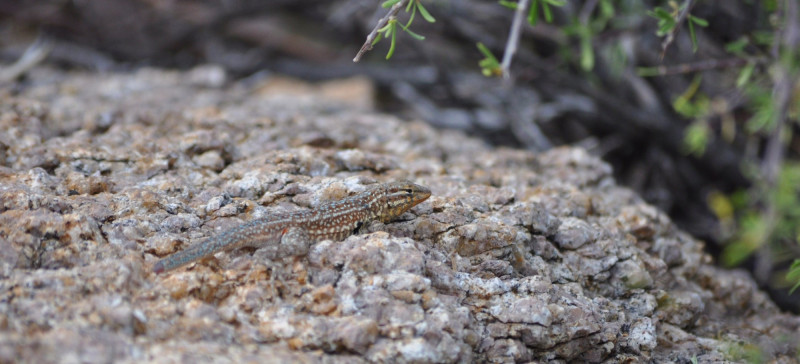
Aspidoscelis tigris (Tiger Whiptail)


The Whiptails are fast, wary lizards of lowland habitats. Around eleven species are recognised from Arizona but the taxonomy is in a state of flux currently, with probably more species awaiting description as a result of ongoing studies.
The Tiger Whiptail is one of the larger species and also the most widespread in Arizona. Despite its common name, it is not especially stripy, being more mottled in appearance. It is a lowland species, found in desert habitats and rocky canyons.
The Tiger Whiptail is one of the larger species and also the most widespread in Arizona. Despite its common name, it is not especially stripy, being more mottled in appearance. It is a lowland species, found in desert habitats and rocky canyons.
Aspidoscelis sonorae (Sonoran Spotted Whiptail)


Sabino Canyon
Another whiptail with a perhaps-poorly-chosen common name, A.sonorae is only faintly-spotted and is distinguished by its bold beige stripes which extend clearly all the way to the head. The very simlar-looking A.flagellicauda inhabits a largely more nothern distribution in Arizona and has two, rather than three preanal scales.
Like several whiptail species, A.sonorae is parthenogenetic, meaning all populations are female and require no fertilisation of their eggs, the offspring being clones of their mother.
Like several whiptail species, A.sonorae is parthenogenetic, meaning all populations are female and require no fertilisation of their eggs, the offspring being clones of their mother.
Aspidoscelis uniparens (Desert Grassland Whiptail)


San Pedro Riparian NCA
As its scientific name suggests, this is another parthenogenetic species of whiptail. It inhabits grasslands and chapparal from the southeastern corner of the state north-west to beyond Phoenix.
It lacks any spotting between the stripes and has a greenish-blue tail. The very similar Plateau Striped Whiptail inhabits the northern half of the state and overlaps the northern edge of the range of A.uniparens. The two lizards occur in diferent habitats, however, and differ in the arrangement of the preanal scales.
It lacks any spotting between the stripes and has a greenish-blue tail. The very similar Plateau Striped Whiptail inhabits the northern half of the state and overlaps the northern edge of the range of A.uniparens. The two lizards occur in diferent habitats, however, and differ in the arrangement of the preanal scales.
Heloderma suspectum (Gila Monster)


Surely one of the icons of the American south-west, the Gila Monster needs little introduction. To see one is a rare treat, given that they spend well over 90% of their lives underground. Despite their bold colour and pattern, they are extremely well-camouflaged for their shrubby habitats where there is much dappled shade.
I am indebted to some fellow hikers who alerted me to this one on a hot sunny April day in Sabino Canyon. They had seen me photographing other lizards in the canyon and mentioned they had just seen a Gila Monster when they walked past me. Pointing out the area to me, I quickly ran down the track. There was nothing to be seen! I decided to wait in the scrubby canyon clearing and before long I heard unhurried rustling coming from a shrub. Sure enough, out came this Gila Monster, wandering slowly on the search for food, or perhaps a mate. It was totally unbothered by my presence and certainly not in the least bit aggressive.
The law is very strict on observing Gila Monsters - it is illegal to even disturb one of the these lizards (I stayed out of its way and didn't prevent it moving anywhere it wanted to for these photos). I understand and welcome this protection for such a wonderful creature, but find it ridiculous that this means it is also illegal to rescue them from danger. If you came across a Gila Monster crossing a busy road, you would be duty-bound by the law to leave it alone and risk it being killed by a following car - you would be breaking the law to even encourage it to cross the road more quickly.