


Kangaroos & Wallabies
Euro (Macropus robustus)


Mambray Creek, Flinders Ranges, South Australia
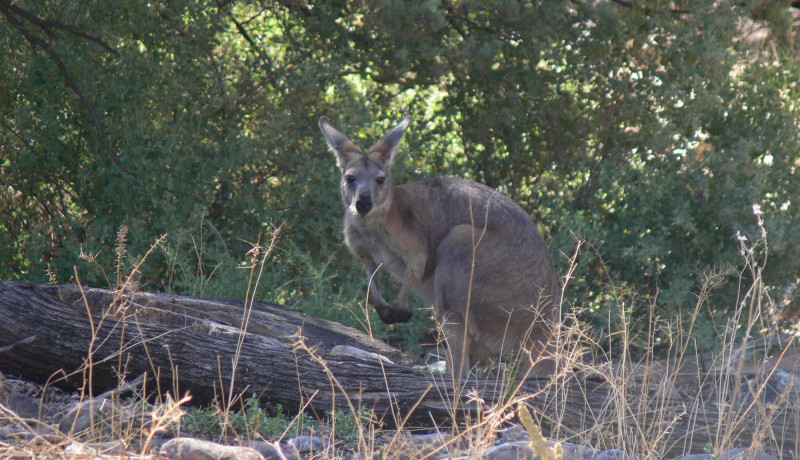
Euros are easily seen in the Mambray Creek area of the southern Flinders Ranges, where they sometimes have a very pale colour, as shown here.
The Euro is one of four geographical races of the Common Wallaroo, a species which inhabits much of continental Australia from east to west. It is a kangaroo of rocky habitats and has a shaggier coat than the Grey or Red Kangaroos.
The Euro is one of four geographical races of the Common Wallaroo, a species which inhabits much of continental Australia from east to west. It is a kangaroo of rocky habitats and has a shaggier coat than the Grey or Red Kangaroos.
Western Grey Kangaroo (Macropus fuliginosus)

Wilpena Pound, Flinders Ranges, South Australia


female with joey in the pouch

Brookfield CP, Murray Region, South Australia (this and previous two photos)

Onkaparinga River NP, Adelaide Hills, South Australia
This species has the larger range of the two species of Grey Kangaroo and is found from Western Australia to central New South Wales and south-central Queensland. In the eastern states, its range overlaps with the Eastern Grey Kangaroo. In Western Australia and most of South Australia, it is the only Grey Kangaroo present. This is a southern species which is not found in the arid centre of the continent - here it is replaced by the Red Kangaroo.
Kangaroo Island in South Australia is named after this species, although like much of the island's wildlife, it is a separate, endemic subspecies.
Mt Remarkable NP, Flinders Ranges
Kangaroo Island in South Australia is named after this species, although like much of the island's wildlife, it is a separate, endemic subspecies.
Mt Remarkable NP, Flinders Ranges
Red-necked Wallaby (Macropus rufogriseus)


Piccaninnie Ponds CP, South Australia
Sadly, these terrible photos are the only record I have of my only encounter with a Red-necked Wallaby, a common species in the eastern states, but very rare in South Australia, where its range only just enters the far south-east of the state.
The individual on the left was quite dark and doesn't clearly show the rusty neck and shoulders of this species, but the paler thighs and faint face stripe are visible.
The Red-necked is quite a large wallaby, albeit significantly smaller than an adult kangaroo.
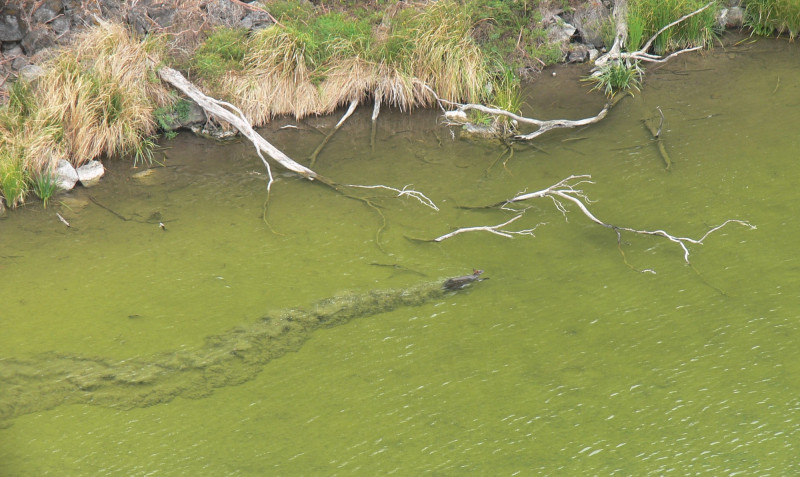
The photos below show one swimming across a lake in Victoria!


The individual on the left was quite dark and doesn't clearly show the rusty neck and shoulders of this species, but the paler thighs and faint face stripe are visible.
The Red-necked is quite a large wallaby, albeit significantly smaller than an adult kangaroo.
The photos below show one swimming across a lake in Victoria!
Other marsupials
Southern Brown Bandicoot (Isodon obesus)


Cleland CP, Adelaide Hills, South Australia
Unlike many species of native Australian mammal, the Southern Brown Bandicoot has managed to survive in some areas in the face of relentless predation by alien animals such as the Red Fox. Ironically, it is a terrible invasive weed, the Bramble, that has helped it, as Red Foxes are unable to hunt in the dense, prickly thickets that bramble creates, allowing the bandicoots a safe place to hide.
The Southern Brown Bandicoot remains widespread in coastal regions from Sydney, west to the Adelaide area in South Australia, although it depends on good-quality native forest to survive.
The Southern Brown Bandicoot remains widespread in coastal regions from Sydney, west to the Adelaide area in South Australia, although it depends on good-quality native forest to survive.
Southern Ningaui (Ningaui yvonnae)
Image coming soon!
Pinkawillinie CP, Eyre Peninsula, South Australia
Pinkawillinie CP, Eyre Peninsula, South Australia
This tiny marsupial is no bigger than a mouse. Like many small dasyurids, it is a ferocious and fearless predator, capable of tackling prey larger and heavier than itself. Also, in common with many of the smallest marsupials, it is a short-lived creature, with adults reproducing within a year of birth and dying shortly after.
The Southern Ningaui inhabits semi-arid and arid mallee regions from WA to NSW.
The individual photographed here was captured in a pitfall trap during reptile surveying. Despite its all-action lifestyle, it was happy to rest in my hands and showed no aggression at all.
The Southern Ningaui inhabits semi-arid and arid mallee regions from WA to NSW.
The individual photographed here was captured in a pitfall trap during reptile surveying. Despite its all-action lifestyle, it was happy to rest in my hands and showed no aggression at all.
Koala (Phascolarctos cinereus)

Morialta CP, Adelaide Hills, South Australia

Mt Eccles NP, Victoria


Mt Richmond NP, Victoria
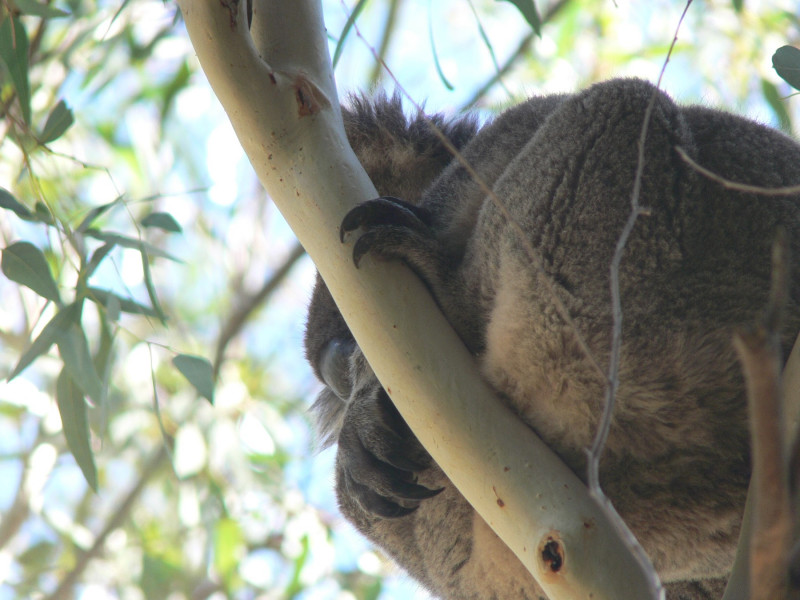
Which is Australia's most iconic animal - the koala or kangaroo? It's impossible to say, but whatever the answer, the koala is always endearing to see, even more so now that their plight is becoming well-known. Chlamydia has been a problem for years, but climate change, leading to more frequent and ferocious forest fires is now just as big a threat, as is catastrophic land clearance, especially in Queensland.
Their sleepy behaviour is well-known , although perhaps a little unjustified - they prefer to feed during cooler weather, and in the summer, this means they eat during the night. This is also when they mate, and I vividly remember being woken in the night by the males' load, grunting pig-like snorting calls in the summer I lived in the Adelaide Hills!
Their sleepy behaviour is well-known , although perhaps a little unjustified - they prefer to feed during cooler weather, and in the summer, this means they eat during the night. This is also when they mate, and I vividly remember being woken in the night by the males' load, grunting pig-like snorting calls in the summer I lived in the Adelaide Hills!
Southern Hairy-nosed Wombat

faeces


burrows, Brookfield CP, South Australia (all photos)
I wasn't lucky enough to be able to take a photo of these very fast, diminutive wombats, but did enjoy watching them at Brookfield CP, where their burrows make some of the land look like some recovering war zone! The characteristic cube-shape faeces are easily found as well.
Evening is a great time to watch wombats, and this rare species is no exception. As the heat of the day dissipates, they come of their burrows and sccurry around to forage for seeds. Unfortunately, they are just so quick and mobile, getting a photo of any kind is unbelievably difficult!
Evening is a great time to watch wombats, and this rare species is no exception. As the heat of the day dissipates, they come of their burrows and sccurry around to forage for seeds. Unfortunately, they are just so quick and mobile, getting a photo of any kind is unbelievably difficult!