


Fissidens viridulus

above Pin Dale, Bradwell Moor
Text coming soon!
Fissidens pusillus

Sydnope Brook, Two Dales
This tiny Fissidens is characteristic of permanently damp, shaded rocks, especially where splashed by streams in woodland. It is very similar to F. gracilifolius (below) and intermediate forms can be largely impossible to identify with certainty.
F. pusillus is widespread in Derbyshire and can often be identified by its size and habitat.
F. pusillus is widespread in Derbyshire and can often be identified by its size and habitat.
Fissidens gracilifolius

Deep Dale
Very much the dry habitat counterpart of F. pusillus, this species has few confirmed records in Derbyshire, largely because so many specimens exhibit characters intermediate between the two species. The key character used to diferentiate them is the relative length and breadth of the perichaetial leaves.
The colony photographed here was examined microscopically and corresponded well to 'typical' F. gracilifolius.
The colony photographed here was examined microscopically and corresponded well to 'typical' F. gracilifolius.
Fissidens incurvus
image coming soon!
Text coming soon!
Fissidens bryoides


Padley Gorge
This small species is one of Britain's commonest Fissidens species and occurs on bare soil in non-calcareous habitats. It is particularly common in shaded sites such as woodland banks. The erect capsules differentiate it from the rarer F. incurvatus.
Fissidens crassipes

Bentley Brook, near Mapleton
This widespread species is Derbyshire's most common aquatic Fissidens. It is common on stones and exposed tree roots at or even beneath the water level on slow-flowing rivers and streams.
The closely-related F. rufulus is not known from Derbyshire.
The closely-related F. rufulus is not known from Derbyshire.
Fissidens rivularis


Shining Cliff Wood
Despite its seemingly ordinary habitat requirements, this is an extremely rare species in Derbyshire (and much of England). It is currently only known from Shining Cliff Wood, where it grows in some abundance on inundated rocks in a stream bed.
While similar in appearance to other Fissidens, F.rivularis can be easily identified by the prominent yellowish border to the leaves, which merges into a rather rounded leaf point.

While similar in appearance to other Fissidens, F.rivularis can be easily identified by the prominent yellowish border to the leaves, which merges into a rather rounded leaf point.
Fissidens taxifolius

Ashop Clough
Along with F. bryoides, this is Britain's most common Fissidens and it is widespread in Derbyshire. It is especially common on base-rich soil in damp, shaded sites but also occurs widely on neutral and slightly acidic soil. A good field character is the excurrent nerve in the leaves.
Fissidens dubius

Coombs Dale SSSI
image coming soon
Westend Valley, High Peak
In the White Peak of Derbyshire this is by far the commonest Fissidens species, occuring in turf in grassland and on limestone crags.
This species is very similar to F. adianthoides but generally grows in drier sites. F. dubius has narrower leaf cells and smaller spores.

Coombs Dale SSSI
This species is very similar to F. adianthoides but generally grows in drier sites. F. dubius has narrower leaf cells and smaller spores.
Coombs Dale SSSI
Fissidens adianthoides

William Clough, High Peak
This handsome species is fairly frequent in the High Peak, where it is a typical resident of more or less neutral flushes. Elsewhere in Derbyshire, it is extremely rare. One favoured habitat is damp ground in old quarries.
The species is described more fully in the Bryophytes of northern England section of the site.
The species is described more fully in the Bryophytes of northern England section of the site.
Fissidens osmundoides


Grindsbrook, Edale
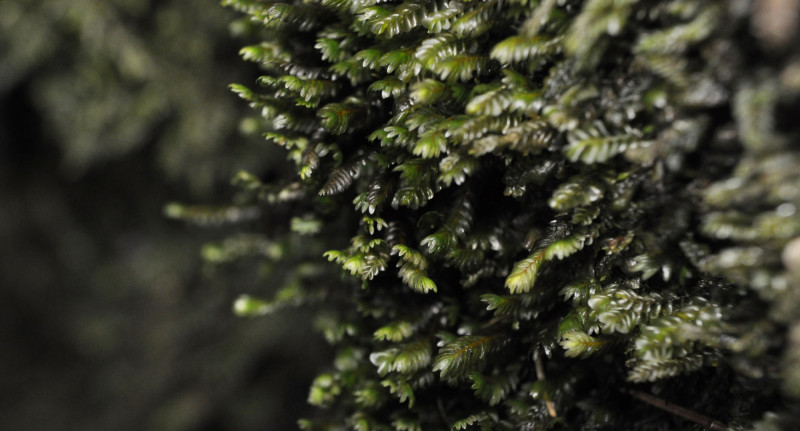
The downturned shoot tips of this moisture-loving Fissidens are a good indicator of its presence. Under a hand lens the leaves are seen to lack a border and have no marginal teeth.
F. osmundoides is a species of base-rich, flushed slopes and is rare in Derbyshire, where it is restricted to the High Peak. The limestone dales of the White Peak are too dry to provide suitable habitat for it.
Westend Valley, High Peak
F. osmundoides is a species of base-rich, flushed slopes and is rare in Derbyshire, where it is restricted to the High Peak. The limestone dales of the White Peak are too dry to provide suitable habitat for it.
Westend Valley, High Peak
Eucladium verticillatum

Slinter Wood, Via Gellia
Typical of dripping tufa crags in the White Peak, Eucladium is the most abundant of this group of mosses found in this habitat and often the only one present.
Microscopically, the long, narrow leaves have hyaline sheathing bases with toothed margins near the junction with the chlorophyllose cells, as well as narrow nerves. These features immediately separate it from the superficially-similar Gymnostomum aeruginosum, which also tends to be a brighter green.
Microscopically, the long, narrow leaves have hyaline sheathing bases with toothed margins near the junction with the chlorophyllose cells, as well as narrow nerves. These features immediately separate it from the superficially-similar Gymnostomum aeruginosum, which also tends to be a brighter green.
Weissia controversa var.controversa
image coming soon
Cressbrook Dale NNR

Westend Valley, High Peak
Cressbrook Dale NNR
Westend Valley, High Peak
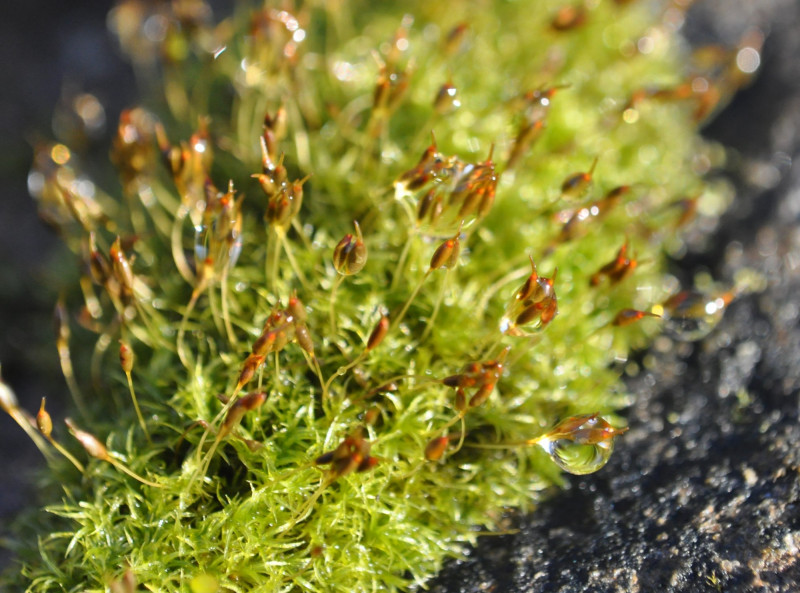
Weissia species are colonist of bare soil and W. controversa is a common species, especially in the White Peak, where it is often seen in limestone grassland. It is a small species with distinctive pale green, pointed foliage.
Capsules are often abundant and (only when mature) are necessary to distinguish it from the equally common W. brachycarpa - controversa has wide-mouthed casules with a well-developed peristome. W. brachycarpa has narrow-mouthed capsules without a peristome.
Capsules are often abundant and (only when mature) are necessary to distinguish it from the equally common W. brachycarpa - controversa has wide-mouthed casules with a well-developed peristome. W. brachycarpa has narrow-mouthed capsules without a peristome.
Weissia brachycarpa
image coming soon!
Text coming soon!
Tortella tortuosa (sensu lato)

Coombs Dale SSSI
This common moss is one of the most characteristic species of damp limestone in Derbyshire. I've described it in the Mosses of Ben Lawers section of the site.
Tortella bambergeri
image coming soon
Text coming soon
Tortella fleischeri
image coming soon
Text coming soon
Tortella fasciculata

below Roych Tor, High Peak
Text coming soon.
Tortella nitida

Mill Dale, Dovedale
One of Derbyshire's rarest mosses, T.nitida is known from a single site in the county, in Dovedale - one of very few in eastern England as a whole. Here it grows on a vertical crags. I'll take a better photo one day - it was a dull and wintry day when I took this with flash!
Trichostomum brachydontium

Long Dale (Hartington)
Text coming soon!
Trichostomum herzogii

Mill Dale, Dovedale
This newly-defined species is widespread in the White Peak of Derbyshire, where it characteristically occupies damp, shaded limestone crags in woodland, either directly on the rock or on thin soil on rock ledges - it avoids the sunny, dry habitats favoured by T. crispulum and T. brachydontium. Formerly, it was regarded as a well-known narrow-leaved form of T. brachydontium. The latter species now seems to be uncommon in Derbyshire.
Trichostomum littorale

SE of Peak Dale
Recently separated from T. brachydontium sensu lato, this species is very rare in Derbyshire and currently only known from igneous outcrops in the White Peak.
Trichostomum crispulum

Mill Dale, Dovedale
In Derbyshire this common species tends to be found on exposed, dry limestone crags where it typically grows as compact cushions in crevices and along cracks. The key feature in differentiating the it is in the shape of the leaf apices - those of T. crispulum are hooded and the whole leaf appears narrower than in T. brachydontium.

Conies Dale
Conies Dale
Tortella squarrosa (syn. Pleurochaete squarrosa)


Monks Dale NNR
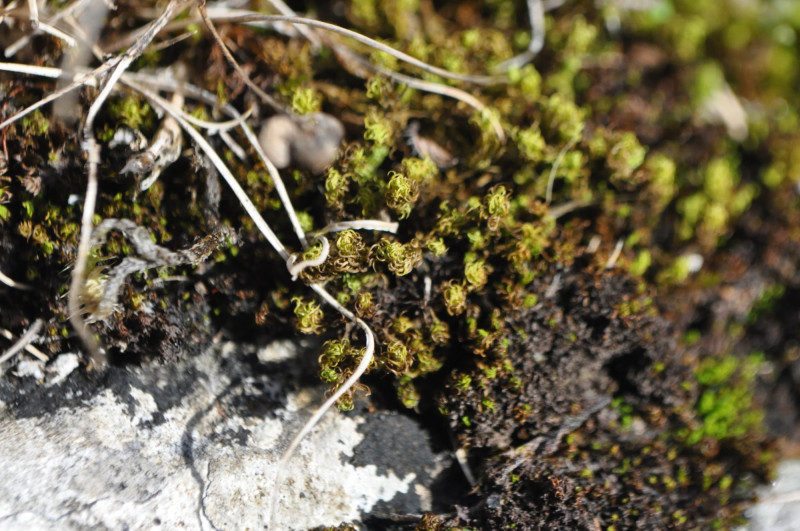
In northern areas of Britain this moss is a great rarity, and the White Peak of Derbyshire represents the northern limit of its national distribution, apart from colonies along the north coast of Wales and an outlier on the limestone of south Lancashire. Its typical habitat is sunny, south-facing soil ledges on limestone outcrops.
Although rather similar to the very common T. tortuosa, T. squarrosa has more translucent, shorter leaves which curve strongly away from the stem when wet (separated leaves almost curve back on themselves on a micrscope slide). Stems are also much more loosely-gathered, with clear gaps between them, unlike the dense cushions of T. tortuosa, meaning collections fall apart in the hand, unlike T. tortuosa.
Although rather similar to the very common T. tortuosa, T. squarrosa has more translucent, shorter leaves which curve strongly away from the stem when wet (separated leaves almost curve back on themselves on a micrscope slide). Stems are also much more loosely-gathered, with clear gaps between them, unlike the dense cushions of T. tortuosa, meaning collections fall apart in the hand, unlike T. tortuosa.
Dialytrichia mucronata

River Dove, near Ashbourne
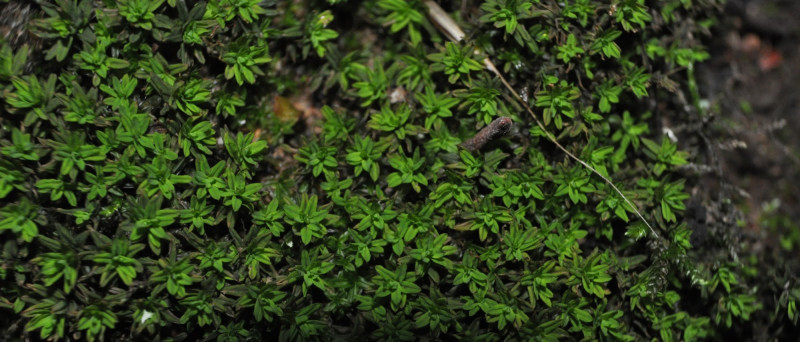
This very rare species occurs only in a small part of Derbyshire, where it grows on periodically flooded tree bases in a section of the River Dove and adjacent brooks west of Ashbourne. It forms opaque, green patches with lingulate leaves. Individual leaves bear a small point at the tip, have recurved margins and are strongly papillose.
Pseudocrossidium hornschuchianum

Eldon Hill Quarry, High Peak
This small species is easily-overlooked but is common in its favoured habitat of open, base-rich soil. It is especially abundant in old limestone quarries, where its prickly, starry, bright green shoots look like no other bryophyte in the same habitat.
Pseudocrossidium revolutum

Elmton
This common moss is a species of thin, bare soil on calcareous rocks and old dry-stone walls. It is also fairly common in old quarries.
Its small size and leaves which have revolute margins along their full length are characteristic. At the apex, the recurved margins meet the nerve, giving a much more rounded tip than in P. hornschuchianum. Microscopically, this species has characteristic leaf gemmae, although these are uncommon, at least in Britain.
Capsules are rather uncommon but the colony photographed here was richly-fertile.
Its small size and leaves which have revolute margins along their full length are characteristic. At the apex, the recurved margins meet the nerve, giving a much more rounded tip than in P. hornschuchianum. Microscopically, this species has characteristic leaf gemmae, although these are uncommon, at least in Britain.
Capsules are rather uncommon but the colony photographed here was richly-fertile.
Bryoerythrophyllum recurvirostrum

by River Dove
Although typically a moss of open, calcareous soil and rocks, this species also occurs on silty soil on tree bases next to rivers. Typical forms have red-brown lower parts to their stems and several teeth near the leaf apex, but others lack teeth and are completely green and thus resemble Didymodon species. In such cases the shape of the leaf is an important character, with Didymodons evenly tapering to the apex but Bryoerythrophyllum leaves usually showing a distinctive kink near the apex.
Bryorythrophyllum ferruginascens

Milltown Quarry, Ashover
This small, attractive species has a scattered distribution in limestone areas of Derbyshire but it can be remarkably abundant where it does occur - it is especially frequent on sun-baked, stony soil on entrance tracks to old limestone quarries. Elsewhere, it occurs on thin soil on rock ledges.
Unlike B. recurvirostrum, this species never bears capsules - it reproduces by rhizoidal gemmae, which are easily seen under a microscope when stems are separated.
Unlike B. recurvirostrum, this species never bears capsules - it reproduces by rhizoidal gemmae, which are easily seen under a microscope when stems are separated.
Leptodontium flexifolium

Westend Valley, High Peak
A typical moss of bare peat exposures, L. flexifolium is not uncommon in suitable habitats on moorland in the High Peak and Peak Fringe. It also occurs rarely on acidic soil over limestone in the White Peak.
Superficially, the species resembles a Barbula, but those species avoid stongly acidic habitats. Also, the leaves of Leptodontium are strongly-toothed at the apex, unlike Barbula.

Ramsley Reservoir, Eastern Moors
Superficially, the species resembles a Barbula, but those species avoid stongly acidic habitats. Also, the leaves of Leptodontium are strongly-toothed at the apex, unlike Barbula.
Ramsley Reservoir, Eastern Moors
Gyroweisia tenuis

Wyn's Tor, Winster
Text coming soon!
Gymnostomum calcareum

Monks Dale NNR
This very small moss is rare in Derbyshire, where much of the limestone is too dry for it to inhabit.
G. calcareum is a much smaller moss (usually) than G.aeruginosum (see below) and is found on permanently damp limestone outcrops and tufa. Microscopically, the leaves have a narrower nerve and leaf cells than its more common cousin.
The third British member of the genus, G. viridulum, is not known from Derbyshire. It has markedly rounded, very short leaves.
G. calcareum is a much smaller moss (usually) than G.aeruginosum (see below) and is found on permanently damp limestone outcrops and tufa. Microscopically, the leaves have a narrower nerve and leaf cells than its more common cousin.
The third British member of the genus, G. viridulum, is not known from Derbyshire. It has markedly rounded, very short leaves.
Gymnostomum aeruginosum

Mill Dale, Dovedale
This species is described in the Mosses of other areas of northern England section of the site.
It is somewhat similar to Eucladium verticillatum (see above), but has shorter, spreading leaves and is a brighter green colour. It is much rarer than Eucladium in Derbyshire.
It is somewhat similar to Eucladium verticillatum (see above), but has shorter, spreading leaves and is a brighter green colour. It is much rarer than Eucladium in Derbyshire.
Streblotrichum convolutum (syn. Barbula convoluta)

Coombs Dale SSSI
A very common colonist of sunny, bare soil, S. convolutum is a small but conspicuous moss and is easily found across Derbyshire. The var. commutatum (formerly known as B. sardoa) is more robust and is a common part of the community of mosses that colonise limestone dry-stone walls.
Both S. convolutum and B. unguiculata (below) occupy similar habitats and some intermediate forms occur, which can be hard to name. Typical S. convolutum lacks recurved leaf margins and B. unguiculata typically has a shortly-excurrent nerve and is a generally larger plant.
Fertile plants are much easier to distinguish - S. convolutum has capsules with yellow setae, while those of B. unguiculata are purple.
Both S. convolutum and B. unguiculata (below) occupy similar habitats and some intermediate forms occur, which can be hard to name. Typical S. convolutum lacks recurved leaf margins and B. unguiculata typically has a shortly-excurrent nerve and is a generally larger plant.
Fertile plants are much easier to distinguish - S. convolutum has capsules with yellow setae, while those of B. unguiculata are purple.
Barbula unguiculata

Tearsall Quarry, SE of Winster
This species is described with S. convolutum, above.

capsules, below Mam Tor, Castleton
capsules, below Mam Tor, Castleton
Didymodon icmadophilus


Furness Quarry, Stoney Middleton
Text coming soon!
Didymodon fallax

Coombs Dale SSSI

Bonsall Moor
This is a common Didymodon in Derbyshire and occurs in a variety of habitats. It is especially frequent on old lead mining sites. Unlike most other Didymodons, it will also tolerate mildly acidic conditions.
I've described the species in more detail in the Mosses of other areas of northern England section of the site, where there is a far better photo!
I've described the species in more detail in the Mosses of other areas of northern England section of the site, where there is a far better photo!
Didymodon spadiceus

Mill Dale, Dovedale

Via Gellia
A species of flushed or permanently wet base-rich sites, this fairly tall Didymodon has a scattered distribution across Derbyshire.
Given its habitat, it is a fairly distinctive species but is very similar to D. fallax, which can occur in damp sites. The two are easily distinguished when fertile, as the peristome of D. fallax is spirally twisted but that of D. spadiceus is straight. When sterile, the leaves of D. spadiceus are not strongly recurved when wet, whereas those of D. fallax tend to be.
Given its habitat, it is a fairly distinctive species but is very similar to D. fallax, which can occur in damp sites. The two are easily distinguished when fertile, as the peristome of D. fallax is spirally twisted but that of D. spadiceus is straight. When sterile, the leaves of D. spadiceus are not strongly recurved when wet, whereas those of D. fallax tend to be.
Didymodon rigidulus

Grin Low, Buxton
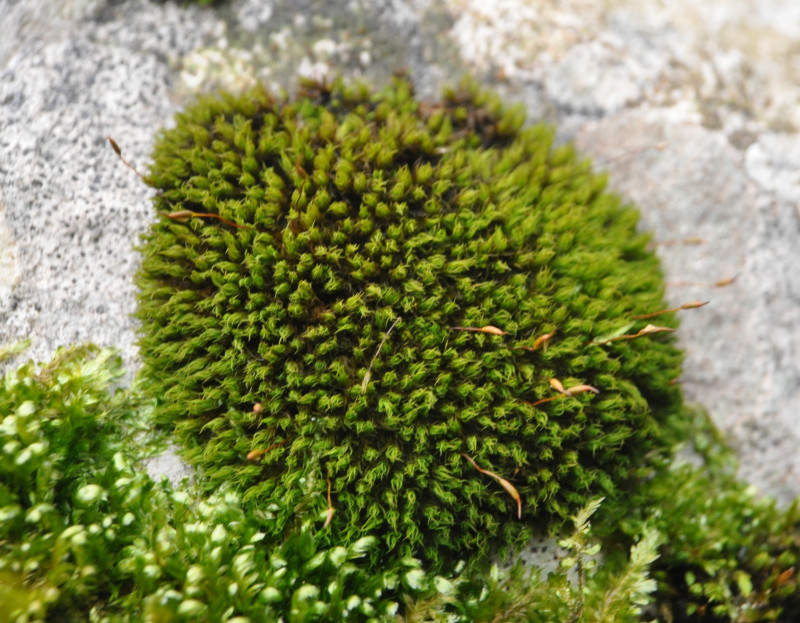
A typical habitat for this widespread Didymodon is on exposed limestone walls, where it forms dense, rounded cushions which are often abundantly fertile. It is also common in old limestone quarries and even damp, natural outcrops. Under a hand lens, the leaves can be seen to have a blunt point with a long, narrow apex.
Microscopically, D. rigidulus is easily confirmed by the presence of small, rounded gemmae in the leaf axils - these are usually easy to spot as they spill out onto a microscope slide.
Microscopically, D. rigidulus is easily confirmed by the presence of small, rounded gemmae in the leaf axils - these are usually easy to spot as they spill out onto a microscope slide.
Didymodon tophaceus

Westend Valley, High Peak
Along with D. spadiceus, this is the most moisture-loving of Derbyshire's Didymodon species. It is usually easy to identify due to its low-growing (only 1cm or so) habit and lingulate leaves with a rounded apex. The most similar species is D. luridus.
Didymodon vinealis

Elmton
This Didymodon is very common in south-eastern England but is rather rare in Derbyshire, where it is most commonly seen in the east of the county on the Magnesian Limestone. Here it is well-known on dry-stone walls.
Historically, D. vinealis has been confused with the very similar and common D. insulanus. The two species are easiest to differentiate when dry - the leaves of insulanus become strongly crisped, whereas those of vinealis become only slightly curved and twisted. Vinealis also grows as cushions of short stems and is generally a smaller species than insulanus.
Historically, D. vinealis has been confused with the very similar and common D. insulanus. The two species are easiest to differentiate when dry - the leaves of insulanus become strongly crisped, whereas those of vinealis become only slightly curved and twisted. Vinealis also grows as cushions of short stems and is generally a smaller species than insulanus.
Didymodon insulanus

above Treak Cliff Cavern, Castleton
This species is described with D. vinealis above.
Didymodon ferrugineus

Mill Dale (Dovedale)
This species is described in the Bryophytes of other areas of northern England section of the site.
Didymodon sinuosus

Milltown Quarry, Ashover

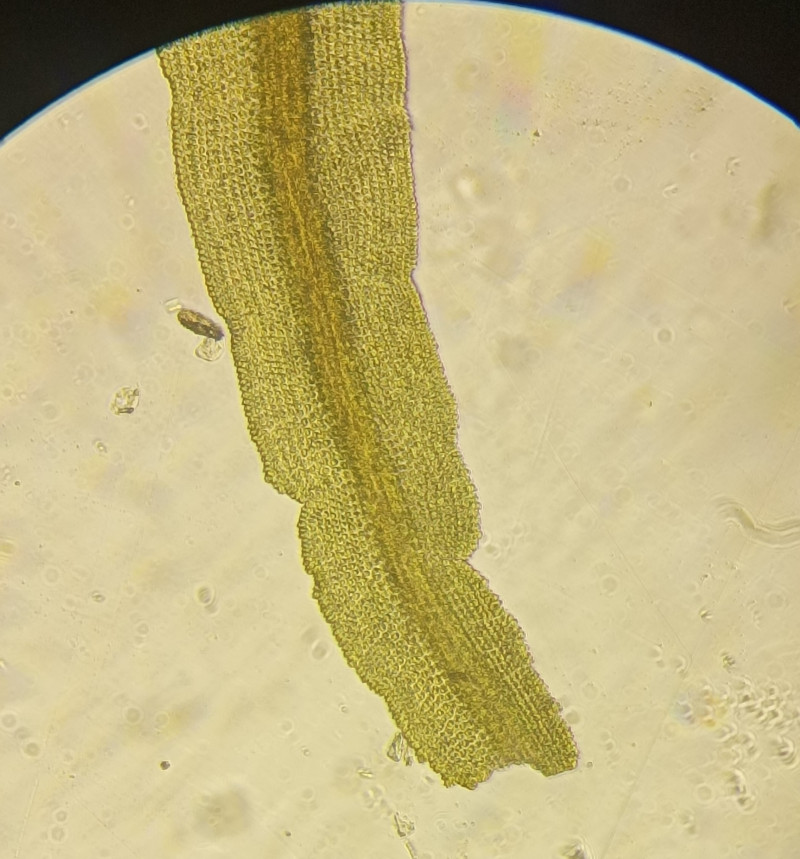
leaf detail
Text coming soon.
Aloina aloides


Furness Quarry, Stoney MIddleton
A typical colonist of bare, calcareous soil in the Peak District, often in old quarries, A. aloides is easily recognised by its thick leaves and abundant capsules on a long seta.
This species and its very similar close cousin A. ambigua are distinguished by how much the basal membrane of the peristome projects above the edge of the capsule. In A. aloides, it does not (so is not visible in the field).

This species and its very similar close cousin A. ambigua are distinguished by how much the basal membrane of the peristome projects above the edge of the capsule. In A. aloides, it does not (so is not visible in the field).
Aloina rigida
image coming soon!
by Crich Quarry, Crich/Wakebridge
by Crich Quarry, Crich/Wakebridge
This very small Aloina has recently been rediscovered in Derbyshire, after a long absence.
Text coming soon!
Text coming soon!
Tortula subulata

Cressbrook Dale NNR

Bradwell Moor
This attractive, richly-fertile moss is common in short turf and on rock ledges in the White Peak. As its name suggests, the leaves have only a short point at the apex, enabling easy differentiation from the more common T. muralis.

Tortula lindbergii (syn. T. lanceola)


Mill Dale, Dovedale
This very small ephemeral moss is described with T.caucasica below.

Tortula marginata
image coming soon
In Derbyshire, this moss is almost entriely restricted to the Magnesian Limestone, where it is moderately frequent. Elsewhere, it known in very small quantity from only two sites in the White Peak, both on dolomitic limestone outcrops.
Tortula truncata

Winster
One of the commonest mosses of non-calcareous arable fields, this distinctive species is easily found. Even though the plants are very small, they invariably grow in extensive colonies at any one site and plants are easily seen when the characteristic short capsules are present.
Tortula caucasica (syn. T. modica)

Cressbrook Dale NNR

Mill Dale, Dovedale
This very small ephemeral moss occupies two distinct habitats in Derbyshire: bare soil in calcareous grassland and on mildly calcareous clay in arable fields. It is similar to other little Tortula species but they are usually easy to distinguish and occupy slightly different habitats.
T. lindbergii and T. caucasica are the most similar and differ in their capsules: T. lindbergii has a well-developed peristome, while T. caucasica usually lacks one entirely. T. lindbergii is not a plant of arable fields, either - it is typical of stable soil ledges on limestone outcrops. The very common T .truncata (see above) has shorter, goblet-shaped capsules (widest at the top) and often grows in dense patches.
T. lindbergii and T. caucasica are the most similar and differ in their capsules: T. lindbergii has a well-developed peristome, while T. caucasica usually lacks one entirely. T. lindbergii is not a plant of arable fields, either - it is typical of stable soil ledges on limestone outcrops. The very common T .truncata (see above) has shorter, goblet-shaped capsules (widest at the top) and often grows in dense patches.
Tortula protobryoides (syn. Protobryum bryoides)

Mill Dale, Dovedale
Another very small spring ephemeral moss of calcareous soil, T. protobryoides can be found in sunny grassland in the dales of the White Peak.
While similar in overall appearance to other mosses that occur on bare soil, this species characteristically retains the lid on its capsules. The stems also have leaves which increase in size towards the top - a feature which similar species lack.
While similar in overall appearance to other mosses that occur on bare soil, this species characteristically retains the lid on its capsules. The stems also have leaves which increase in size towards the top - a feature which similar species lack.
Tortula acaulon (syn. Phascum cuspidatum)

Bonsall Moor

Winster
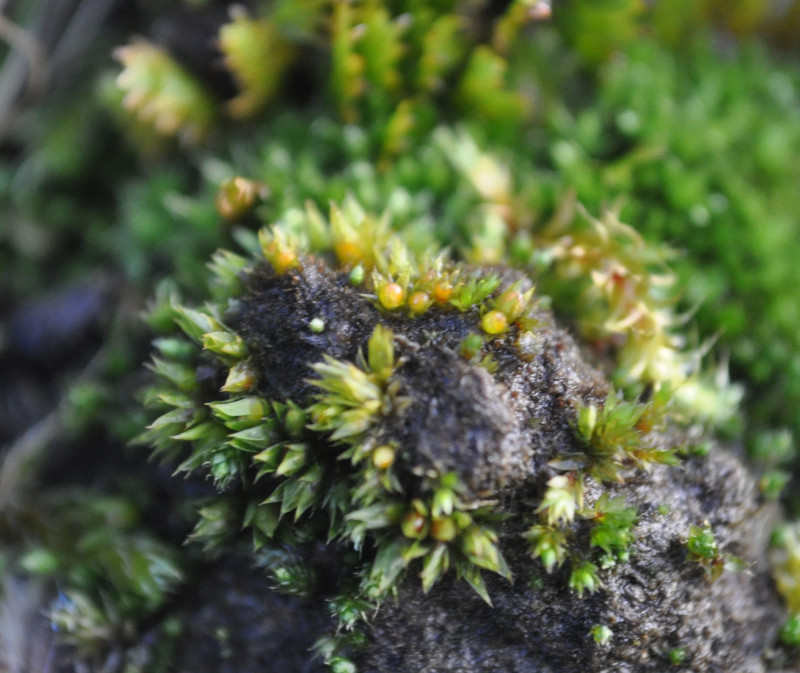
A very common moss of arable fields and bare soil in meadows, T. acaulon (formerly known as Phascum cuspidatum) can be recognised by its immersed, almost spherical capsules which are nestled among tufts of lanceolate leaves with longly-excurrent nerves.
Microbryum davallianum

Calver Quarry
This species is described with M. starckeanum below.
Microbryum starckeanum


Gang Mine NR, Cromford (this and previous two photos)

single fruiting stem of Microbryum starckeanum, showing well-developed peristome

peristome and spores, Bonsall Leys SSSI (this and previous two photos)
This tiny species is very rare in Derbyshire and seemingly restricted to bare soil on several old lead-mining spoil heaps (although it is absent from many others). It is indistinguishable in the field (more or less) from M. davallianum and must be examined microscopically to confirm its identity.
M. starckeanum is characterised by its ridged spores and well-developed peristome. M. davallianum has spiny or smoooth spores and no, or at best a poorly-developed, peristome. It is much more widespread in Derbyshire (although still by no means common) and less fussy about habitat, being found in limestone grassland and calcareous arable fields.

tiny scale of fruiting plants, Gang Mine NR

Microbryum habitat, Gang Mine NR
M. starckeanum is characterised by its ridged spores and well-developed peristome. M. davallianum has spiny or smoooth spores and no, or at best a poorly-developed, peristome. It is much more widespread in Derbyshire (although still by no means common) and less fussy about habitat, being found in limestone grassland and calcareous arable fields.
tiny scale of fruiting plants, Gang Mine NR
Microbryum habitat, Gang Mine NR
Microbryum rectum

Elmton
Despite its small stature, this tiny moss is a beautiful species and always a very special find. In Derbyshire, most records are from temporary habitats on the Magnesian Limestone with scattered occurrences on bare soil in limestone grassland in the White Peak.
Where present, this tends to be a very gregarious species, with colonies forming patches on the bare soil. The erect capsules often completely obscure the foliage, leaving the moss looking like a miniature pincushion.
Where present, this tends to be a very gregarious species, with colonies forming patches on the bare soil. The erect capsules often completely obscure the foliage, leaving the moss looking like a miniature pincushion.
Microbryum curvicollum


Calver Quarry
A very rare moss in Derbyshire, M.curvicolle is characteristic of old quarries and stable, calcareous soil (unlike its arable cousins). It is currently only known from two sites in the county (one discovered in 2024), where it occurs in very small quantity. There are older records from the Magnesian Limestone but it has not been seen there for a very long time.
As its name suggests, the consistently curved seta is distinctive. Other Microbryum species have setae that are occasionally curved, but never uniformly.

in habitat
As its name suggests, the consistently curved seta is distinctive. Other Microbryum species have setae that are occasionally curved, but never uniformly.
in habitat
Syntrichia montana


Coombs Dale SSSI
A common colonist of bare, sun-baked limestone, this moss is often seen as part of a characteristic suite of species on dry-stone walls in the Peak District.
Capsules are often abundant in S. montana and its calcicolous habitat and typical lingulate leaves with a long hair-point makes it an easy species to identify.

Capsules are often abundant in S. montana and its calcicolous habitat and typical lingulate leaves with a long hair-point makes it an easy species to identify.
Syntrichia princeps
Lathkill Dale NNR
Text coming soon.
Syntrichia ruralis
image coming soon
Text coming soon.
Syntrichia papillosa

by River Dove, near Mapleton
Only recently discovered in Derbyshire, this distinctive epiphyte remains rare but is thought to be slowly spreading. Its occurrence is unpredictable, despite its very ordinary habitat requirements.
S.papillosa is easy to identify in the field as upper surface of the leaves bear abundant green gemmae. When dry, the leaves characteristically curve inwards and assume a recognisable glaucous green look.
S.papillosa is easy to identify in the field as upper surface of the leaves bear abundant green gemmae. When dry, the leaves characteristically curve inwards and assume a recognisable glaucous green look.
Syntrichia virescens

by River Dove
This almost exclusively epiphytic Syntrichia is uncommon in Derbyshire. It resembles S.montana, but the habitat and lack of capsules (this species fruits only very rarely) are strong indicators of this species.
Like many in the genus, microscopical confirmation is wise - S. virescens has a much less prominent nerve (seen in cross section) and shorter basal leaf cells than S. montana. The leaf apex is also distinctly notched.

Elton Common
Like many in the genus, microscopical confirmation is wise - S. virescens has a much less prominent nerve (seen in cross section) and shorter basal leaf cells than S. montana. The leaf apex is also distinctly notched.
Elton Common
Syntrichia latifolia

epiphytic on sycamore branch, Wirksworth

gemmae and leaf margin
Recognisable by its blunt, wide leaves (it is the only Derbyshire Syntrichia to lack a hair point) and leaves dusted with tiny, round gemmae, S. latifolia can be a common epiphyte on trees lying in the flood zone of lowland rivers, where some silt remains in the bark crevices. Moist plants are an opaque, yellow-green colour but dry plants become contorted and brownish-green.
Another habitat for this moss is near limestone quarries, where it grows as an epiphyte on bark enriched by limestone dust in the air.

leaf detail
Another habitat for this moss is near limestone quarries, where it grows as an epiphyte on bark enriched by limestone dust in the air.
leaf detail
Syntrichia laevipila
Image coming soon!
Unlike the previous two species, this epiphytic Syntrichia has a very long, smooth hair point but its most important field character is the wide, rounded leaf apex caused by the leaf being constricted below the middle. Capsules are normally common in this species.
S. laevipila is widespread and common in southern England but generally rarer further north. In Derbyshire it has a scattered distribution.
S. laevipila is widespread and common in southern England but generally rarer further north. In Derbyshire it has a scattered distribution.