


Cinclidotus fontinaloides

by River Dove
An aquatic moss of base-rich habitats, Cinclidotus can be locally common. The immersed capsules are usually abundant - a feature that few other mosses share in the same habitat. The dark, olive-green leaves are lanceolate and have prominently thickened borders. Schistidium rivulare is extremely rare in Derbyshire and lacks the thick leaf borders.
The much rarer C. riparius does not occur in Derbyshire.
The much rarer C. riparius does not occur in Derbyshire.
Ephemerum recurvifolium

Elmton
A very rare moss in Derbyshire, this tiny species is primarily a specialist of stubble fields and in Derbyshire is only found in Magnesian Limestone areas.
Despite its size, this species can be confidently identified in the field because the leaves have a strong nerve, unlike the usual arable species, E. serratum.
Despite its size, this species can be confidently identified in the field because the leaves have a strong nerve, unlike the usual arable species, E. serratum.
Ephemerum serratum
image coming soon
Text coming soon.
Coscinodon cribrosus


Mam Tor
A very rare moss in Derbyshire, Coscinodon is restricted solely to the Mam Tor escarpment in our county. Here, it grows on unstable, exposed shale soils and on scattered acidic boulders on sparse block scree.
Superficially, it resembles a Grimmia, but the straight, short seta and cribrose (crinkled) leaves under the microscope reveal its identity.
Superficially, it resembles a Grimmia, but the straight, short seta and cribrose (crinkled) leaves under the microscope reveal its identity.
Schistidium apocarpum


Westend Valley, High Peak
A common and widespread Schistidium, this species grows on a variety of base-rich rocks and is a characteristic species of slightly base-rich gritstone in the High Peak. It can resemble forms of S. crassipilum and microscopic examination is advisable.
S. apocarpum differs in having shorter capsules with many stomata around their base and predominantly isodiametric exothecial cells (S. crassipilum has, at most, just a few stomata and often none at all, and its exothecial cells are predominantly elongate).
The published character in Smith's Moss Flora of basal cell wall thickness is not reliable for separating the two species - capsules need to be examined to determine which Schistidium is present.
S. apocarpum differs in having shorter capsules with many stomata around their base and predominantly isodiametric exothecial cells (S. crassipilum has, at most, just a few stomata and often none at all, and its exothecial cells are predominantly elongate).
The published character in Smith's Moss Flora of basal cell wall thickness is not reliable for separating the two species - capsules need to be examined to determine which Schistidium is present.
Schistidium crassipilum

Grin Low, Buxton
This species is described with S. apocarpum above. It is the most common Schistidium in limestone areas of Derbyshire.
Schistidium elegantulum
Image coming soon!
It takes a bit of experience to spot this elusive and scarce moss, and even then, candidates must be confirmed microscopically. S.elegantulum has a scattered distribution across the White Peak in Derbyshire, and always seems to occur in very small quantity.
This species resembles a small, slightly starved-looking S.crassipilum in the field, with long, very thin hairpoints on the leaves, which do not broaden at their base. Microscopically, the capsules have around 8 stomata and lack the elongate exothecial cells of S.crassipilum.
This species resembles a small, slightly starved-looking S.crassipilum in the field, with long, very thin hairpoints on the leaves, which do not broaden at their base. Microscopically, the capsules have around 8 stomata and lack the elongate exothecial cells of S.crassipilum.
Schistidium pruinosum

Cressbrook Dale NNR
Nationally, this species is a great rarity. It is known from two sites in Derbyshire, both on sunny, exposed igneous intrusions.
Microscopically, S. pruinosum can be recognised by its densely-papillose leaf cells, large perichaetial leaves and prominent hair points. Three other British Schistidium species possess papillose cells - S. maritimum, S. strictum and S. papillosum - none of these are found in Derbyshire.
Microscopically, S. pruinosum can be recognised by its densely-papillose leaf cells, large perichaetial leaves and prominent hair points. Three other British Schistidium species possess papillose cells - S. maritimum, S. strictum and S. papillosum - none of these are found in Derbyshire.
Schistidium robustum

High Edge
This species is described in the Bryophytes of other areas of northern England section of the site.
It is very rare in Derbyshire, and only recently discovered (circa 2010). The only known sites are on high limestone ridges near Buxton and a single record from base-rich gritstone in the High Peak.
It is very rare in Derbyshire, and only recently discovered (circa 2010). The only known sites are on high limestone ridges near Buxton and a single record from base-rich gritstone in the High Peak.
Grimmia laevigata

Peak Forest
Derbyshire's rarest Grimmia is known only from a few scattered volcanic rocks near Peak Forest in the north of the county. This site is a long way from the nearest colonies near the Welsh border.
G. laevigata has a characteristically hoary appearance and rarely fruits, which helps to differentiate it in the field from the common G. pulvinata. Microscopically, it has wide basal cells and a rounded leaf section (unlike the keeled profile of many Grimmias).

Grimmia donniana

Ladybower Reservoir
This typical upland Grimmia is extremely rare in Derbyshire, and known from a couple of tiny populations in the High Peak. This rarity is largely due the scarcity of upland, igneous rock outcrops.
The species is described in more detail in the Bryophytes of Cumbria section of the site.
The species is described in more detail in the Bryophytes of Cumbria section of the site.
Grimmia pulvinata

Cressbrook Dale NNR
A ubiquitous moss, common in many habitats in Derbyshire including garden walls and roof slates, G. pulvinata is not a moss one has to travel far to see. When dry, its cushions look very hairy but become greener when wet.
The key feature which instantly identifies this moss (within Derbyshire) is the curved seta - all the other Grimmias which bear capsules in the county have them on straight setae.

Westend Valley, High Peak
The key feature which instantly identifies this moss (within Derbyshire) is the curved seta - all the other Grimmias which bear capsules in the county have them on straight setae.
Westend Valley, High Peak
Grimmia dissimulata

Cressbrook Dale NNR

Mill Dale, Dovedale
Essentially the dry limestone counterpart of G. trichophylla, this species is relatively frequent in suitable habitats in Derbyshire, mainly in the White Peak.
Derbyshire is a stronghold for this species, which in Britain is known almost exclusively from England. It is primarily a lowland species here, favouring mild, sunny sites, reflecting its wider, southern distribution in Europe.
The short hair points, lack of capsules and calcareous habitat are enough to identify this species, although technically it is separated from G. trichophylla on the nature of its different leaf section.
Derbyshire is a stronghold for this species, which in Britain is known almost exclusively from England. It is primarily a lowland species here, favouring mild, sunny sites, reflecting its wider, southern distribution in Europe.
The short hair points, lack of capsules and calcareous habitat are enough to identify this species, although technically it is separated from G. trichophylla on the nature of its different leaf section.
Grimmia pulvinata
Grimmia trichophylla

Peak Forest
As described in G. dissimulata above, this Grimmia is a cushion-forming species with distinctive short hair points and only rarely produces capsules. Unlike its close relative, it is a moss of acidic habitats, from the lowlands to montane altitudes.

Racomitrium aciculare

Bar Brook, Eastern Moors

Westend Valley, High Peak
Periodically-splashed, acidic, boulder tops in and beside rivers and stream are the classic habitat of this common moss. It is usually abundantly fertile and its capsules are held above the leaves on a long seta, helping distinguish this moss from Schistidium species. Under a lens or microscope, the leaves of R. aciculare are very blunt, with (usually) several prominent teeth along the margins at the leaf apex.
R. aciculare is common in suitable habitat throughout Derbyshire.

Westend Valley, High Peak
R. aciculare is common in suitable habitat throughout Derbyshire.
Westend Valley, High Peak
Racomitrium aquaticum

Alport Valley
Text coming soon.
Racomitrium obtusum

Padley Gorge

Westend Valley, High Peak
Text coming soon!

Racomitrium fasciculare


Westend Valley, High Peak
This species is described in the Mosses of Ben Lawers NNR section of the site.
It is a fairly common species on the gritstone of the High Peak in Derbyshire, but very rare elsewhere - in the White Peak it is known from only two sites, both on igneous rocks.
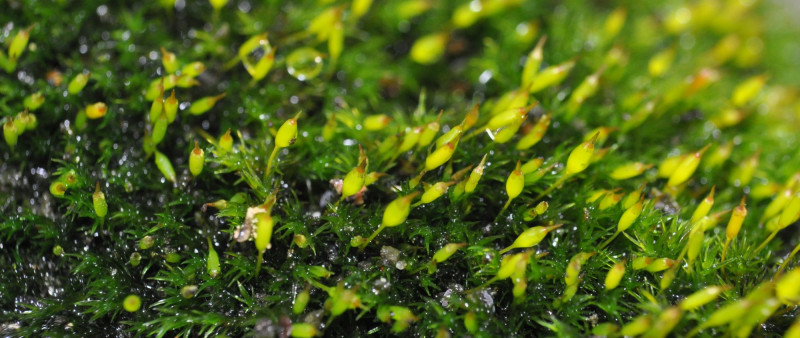
It is a fairly common species on the gritstone of the High Peak in Derbyshire, but very rare elsewhere - in the White Peak it is known from only two sites, both on igneous rocks.
Racomitrium ericoides

Grin Low, Buxton
Although this is a common and often abundant species in northern Britain and Scotland, in Derbyshire this is an extremely rare moss indeed. It is known from only a handful sites. At three of the sites, it is a colonist of old mining sites on calcareous soil.
R. ericoides is described in more detail in the Bryophytes of Cumbria section of the site.
R. ericoides is described in more detail in the Bryophytes of Cumbria section of the site.
Racomitrium heterostichum

Calton Hill Quarry SSSI, Chelmorton
Text coming soon.
Racomitrium affine

Dirtlow Rake, Bradwell Moor

hair point detail
Text coming soon!
Racomitrium lanuginosum

Cressbrook Dale NNR (on igneous outcrop)

Grin Low, Buxton (growing on limestone)
This moss is often the most abundant and commonly-seen bryophyte on exposed rocks in much of upland Britain, where it can form large, hoary-grey hummocks on acidic, sunny rocks.
Given its liking for such habitats, the distribution of this moss is somewhat restricted in Derbyshire, but it remains common here, especially in the High Peak. In the White Peak, it is much rarer, but can be found growing directly over the limestone as part of an unusual limestone heath plant community.

Westend Valley, High Peak

hair point detail
Given its liking for such habitats, the distribution of this moss is somewhat restricted in Derbyshire, but it remains common here, especially in the High Peak. In the White Peak, it is much rarer, but can be found growing directly over the limestone as part of an unusual limestone heath plant community.
Westend Valley, High Peak
hair point detail
Ptychomitrium polyphyllum

Tideswell Dale
Very rare indeed in Derbyshire, this attractive and distinctive species occupies two distinct habitats in the county: as a colonist of dry-stone walls in the High Peak where there is some (un-natural) base enrichment and as a species of natural igneous and chert outcrops in the White Peak, which are very scarce in Derbyshire, but where the moss can be very abundant locally.
This species is described in more detail in the Mosses of other areas of Scotland section of the site.
This species is described in more detail in the Mosses of other areas of Scotland section of the site.
Campylostelium saxicola

Sydnope Brook, Two Dales


in habitat - Campylostelium is in the red oblong area, Sydnope Brook
This tiny moss is a speciality of my 'home patch' in the Derbyshire Dales, where it there are more records than in many areas of Britain.
This tiny relative of Seligerias is a plant of damp (but not wet) fine gritstone boulders in shaded, humid woodland gorges, where it tends to occur on boulders within streams, but where it is seldom splashed and certainly never inundated for any length of time. Even in these habitats, it may be in small quantity, with some patches only covering a square centimetre or so.
The easiest way to spot this rare species is to look for the peculiar, wavy seta and erect capsule, which are present in late spring and early summer.

This tiny relative of Seligerias is a plant of damp (but not wet) fine gritstone boulders in shaded, humid woodland gorges, where it tends to occur on boulders within streams, but where it is seldom splashed and certainly never inundated for any length of time. Even in these habitats, it may be in small quantity, with some patches only covering a square centimetre or so.
The easiest way to spot this rare species is to look for the peculiar, wavy seta and erect capsule, which are present in late spring and early summer.
Blindia acuta


Westend Valley, High Peak
Outside the Dark Peak, this is a very rare moss in Derbyshire, with only a handful of scattered records, including the last one photographed, which I discovered by accident when searching for Campylostelium! The photo shows the diagnostic orange leaf base and auricles.
This species is described in more detail in the Mosses of Ben Lawers section of the site.

microscope image of specimen 10/074, Sydnope Brook - photo © Tom Blockeel
This species is described in more detail in the Mosses of Ben Lawers section of the site.
microscope image of specimen 10/074, Sydnope Brook - photo © Tom Blockeel
Seligeria trifaria s.lat.

Cave Dale, Castleton
The most moisture-loving of Derbyshire's Seligerias, S. trifaria is very rare in the county and occurs in small quantity at the few known sites. It grows on permanently wet, open limestone outcrops, where it is easy to overlook. The 'largest' populations are in Cave Dale and Conies Dale.
In the field, this tiny species resembles dark, juvenile Eucladium, but with a hand lens the 'leaves' are actually very small stems with even smaller, three-ranked leaves. Mature capsules have never been seen in Derbyshire, so it is impossible to determine if the plants here are S. trifaria s.str. or S. patula, which has larger spores and a different mature capsule anatomy.
In the field, this tiny species resembles dark, juvenile Eucladium, but with a hand lens the 'leaves' are actually very small stems with even smaller, three-ranked leaves. Mature capsules have never been seen in Derbyshire, so it is impossible to determine if the plants here are S. trifaria s.str. or S. patula, which has larger spores and a different mature capsule anatomy.
Seligeria pusilla

Slinter Wood, Via Gellia

microscopical image of leaves - specimen from Slinter Wood
This tiny moss is rare in Derbyshire and restricted to wet, shaded limestone crags in wooded gorges. Unlike the situation nationally, S. pusilla is rarer in the Peak District than the similar S. acutifolia.
S. pusilla can be identified by its upper leaves, which have non-excurrent nerves - those of S. acutifolia have excurrent nerves. Both species sometimes have teeth at the bases of the leaves. S. donniana is also similar and can grow alongside the other species in mixed patches. It usually has wider leaf bases and its mature capsules lack a peristome. This character makes limestone Seligerias best looked for from mid-summer onwards when most capsules are mature.
S. pusilla can be identified by its upper leaves, which have non-excurrent nerves - those of S. acutifolia have excurrent nerves. Both species sometimes have teeth at the bases of the leaves. S. donniana is also similar and can grow alongside the other species in mixed patches. It usually has wider leaf bases and its mature capsules lack a peristome. This character makes limestone Seligerias best looked for from mid-summer onwards when most capsules are mature.
Seligeria acutifolia

Cressbrook Dale NNR
This species is described above, with S. pusilla. In Derbyshire it tends to favour less damp and shaded sites than S. pusilla.
Seligeria brevifolia


Grindsbrook, Edale
A very rare moss in Derbyshire and nationally, S. brevifolia is restricted to a specialised series of slightly base-enriched orange gritstones that occasionally outcrop in the valleys of the High Peak. This same rock formation hosts a variety of other montane calcicoles which are extremely rare in Derbyshire, such as Anoectangium aestivum, Diphysicum foliosum, Pohlia elongata and Bartramia ithyphylla.
In its Derbyshire sites, the only other 'Seligeria' which shares its habitat is B.recurvatus, which is immediately distinguished by its seta (see below). It is most similar to S. pusilla (see above) but is smaller and differs in characters of the capsule. The two never occur together in Derbyshire.

In its Derbyshire sites, the only other 'Seligeria' which shares its habitat is B.recurvatus, which is immediately distinguished by its seta (see below). It is most similar to S. pusilla (see above) but is smaller and differs in characters of the capsule. The two never occur together in Derbyshire.
Seligeria donniana


Tideslow Rake SSSI
Along with S. acutifolia, this is the commonest Seligeria in Derbyshire. It grows on damp, sheltered limestone and, locally, can be quite abundant.
S. donniana is easy to recognise in late summer and into autumn, when the mature capsules clearly lack a peristome. The mature capsules are also distinctly-shaped, being almost spherical, whereas those of pusilla become almost like inverted cones (T. Blockeel, pers. comm.). Earlier in the year, the lack of long perichaetial leaves separates it from S. acutifolia and the stout, excurrent nerve in the upper leaves distinguishes it from S. pusilla, whose leaves have nerves ending below the apex. The basal margins of S. donniana leaves are often toothed as well.
S. donniana is easy to recognise in late summer and into autumn, when the mature capsules clearly lack a peristome. The mature capsules are also distinctly-shaped, being almost spherical, whereas those of pusilla become almost like inverted cones (T. Blockeel, pers. comm.). Earlier in the year, the lack of long perichaetial leaves separates it from S. acutifolia and the stout, excurrent nerve in the upper leaves distinguishes it from S. pusilla, whose leaves have nerves ending below the apex. The basal margins of S. donniana leaves are often toothed as well.
Blindiadelphus recurvatus (syn. Seligeria recurvata)

Ashop Clough
Britain's most widespread 'Seligeria' species is also much the commonest in Derbyshire, although here it is by no means frequent at all. As its name suggests, it has a curved seta and typical, very small, bristly Seligeria foliage.
In its upland habitat it cannot be confused with any other species in Derbyshire and has never been recorded growing in the same sites where the somewhat similar Campylostelium saxicola grows.

In its upland habitat it cannot be confused with any other species in Derbyshire and has never been recorded growing in the same sites where the somewhat similar Campylostelium saxicola grows.
Encalypta streptocarpa

Coombs Dale SSSI
image coming soon
Mill Dale (Dovedale)
The most widespread of Derbyshire's Encalypta species, E. streptocarpa typically forms patches on bare, calcareous soil and on limestone crags. It is also a common species of old dry-stone walls.
The rosettes of broad, opaque, glaucous leaves have a distinctive look, unlike other Derbyshire mosses. This species never bears capsules.

Matlock

Conies Dale
The rosettes of broad, opaque, glaucous leaves have a distinctive look, unlike other Derbyshire mosses. This species never bears capsules.
Matlock
Conies Dale
Encalpyta vulgaris

Calver Quarry

leaves, Via Gellia
This beautiful Encalypta is at its best in late winter, when the capsules are fresh and brightly coloured. E. vulgaris grows on rock and soil, and is common in calcareous areas of Derbyshire.
When fruiting, this species is unmistakable in Derbyshire, although the very rare E. pilifera (see below) resembles it. When sterile, E. vulgaris can be distinguished from E. streptocarpa by its wider leaf cells.
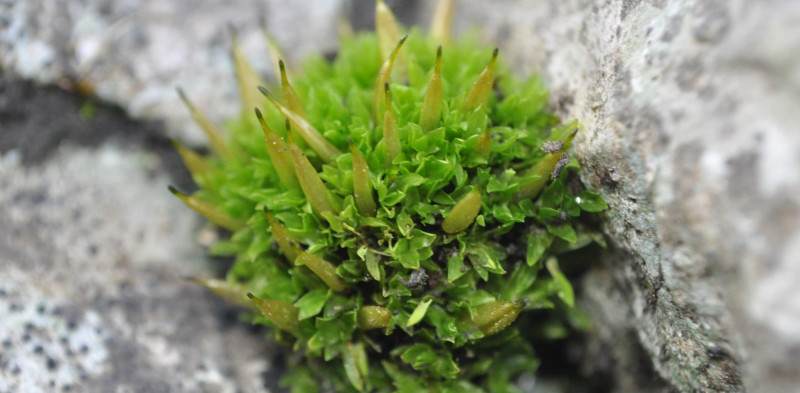

Coombs Dale SSSI
When fruiting, this species is unmistakable in Derbyshire, although the very rare E. pilifera (see below) resembles it. When sterile, E. vulgaris can be distinguished from E. streptocarpa by its wider leaf cells.
Coombs Dale SSSI
Encalypta pilifera

Hipley Hill, Ballidon

Hob's House, Monsal Dale

Conies Dale
Derbyshire is the national stronghold of this recently-described species. It has been known for almost two centuries but was considered a variety of E. vulgaris. The species is now considered distinct and is very rare nationally, with few occurrences outside Derbyshire.
Within Derbyshire, this species is known from scattered localities in the White Peak. It occupies rather arid, vertical, exposed limestone crags where competition from other species is low - in these sites, this is often the only moss present. E. pilifera is a smaller plant than E. vulgaris and grows as compact cushions, rather than the spreading mats. This character means the two species are not likely to be confused, as well as the very obvious wavy hair point of E. pilifera.

Within Derbyshire, this species is known from scattered localities in the White Peak. It occupies rather arid, vertical, exposed limestone crags where competition from other species is low - in these sites, this is often the only moss present. E. pilifera is a smaller plant than E. vulgaris and grows as compact cushions, rather than the spreading mats. This character means the two species are not likely to be confused, as well as the very obvious wavy hair point of E. pilifera.
Discelium nudum

Ladybower Reservoir
This very unusual moss is something of a speciality of the Pennines in northern England, where it is more common than anywhere else in Britain. It is a rare species in Derbyshire, known mainly from reservoir margins near the border with South Yorkshire, but has also been recorded rarely from bare mud around pond margins.
This species is described in more detail in the Bryophytes of northern England section of the site.
This species is described in more detail in the Bryophytes of northern England section of the site.
Funaria hygrometrica


Mill Dale
A very common colonist of bare soil, this little moss is very distinctive when fruiting. It can be seen in arable fields and well as disturbed soil. The leaves are typical of the Funariales, in being spearhead-shaped, widest above the middle and with large, lax, hexagonal cells.

Entosthodon fascicularis

Lathkill Dale NNR

mature capsules, Burfoot, White Peak
Two Entosthodon species are found in Derbyshire, where both are ephemeral mosses of open soil ledges overlying limestone outcrops in the White Peak. The two species are sometimes found growing together.
E. fascicularis is less common than E. muhlenbergii in the county, and can be recognised by its erect, symmetrical capsule. which has a double peristome. That of E. muhlenbergii is asymmetrical and noticeably inclined. The latter species also has leaves with a very long, single-celled hair point. The apex of E. fascicularis is only shortly-pointed (see below).
image coming soon!
leaf detail
E. fascicularis is less common than E. muhlenbergii in the county, and can be recognised by its erect, symmetrical capsule. which has a double peristome. That of E. muhlenbergii is asymmetrical and noticeably inclined. The latter species also has leaves with a very long, single-celled hair point. The apex of E. fascicularis is only shortly-pointed (see below).
image coming soon!
leaf detail
Entosthodon muhlenbergii


Lathkill Dale NNR
This species is described above, with E. fascicularis.

Monks Dale NNR

leaf detail, Ballidon
Monks Dale NNR
leaf detail, Ballidon
Entosthodon obtusus
image coming soon
Upper Misden Clough, High Peak
Upper Misden Clough, High Peak
Text coming soon.
Physcomitrium patens (syn. Aphanorrhegma patens)


Carsington Reservoir
This little moss is one of the commonest ephemeral species of reservoir margins in Derbyshire. It is very variable in size, ranging from small to tiny, and the smaller plants can resemble Ephemerum species, which also have their capsules buried among the leaves - small plants need to be looked at microscopically. Under a microscope, Aphanorrhegma has broader leaves with wider cells.

in habitat
in habitat
Tetraplodon mnioides

Deer Holes, Upper Derwent Valley
Text coming soon.
Splachnum ampullaceum

Highshaw Clough, Derwent Moors
One of Derbyshire's rarest mosses, this species has suffered a nationwide decline in recent decades, mainly due to habitat destruction, as it requires marshy ground which is grazed by cattle. Like many other Splachnaceae, it is a species of decaying dung.
S. ampullaceum has always been rare in Derbyshire, but is known from a handful of scattered sites in the High Peak and Eastern Moors, where it grows in very small quantity.
Distinctive features of this moss are its very large-celled leaves which have stout teeth along their margins.
S. ampullaceum has always been rare in Derbyshire, but is known from a handful of scattered sites in the High Peak and Eastern Moors, where it grows in very small quantity.
Distinctive features of this moss are its very large-celled leaves which have stout teeth along their margins.
Leptobryum pyriforme

Ladybower Reservoir
This unassuming, spindly moss is most commonly seen as a weed in plant pots and greenhouses, but nonetheless occurs widely in natural habitats too, including on reservoir margins, as shown here.
The species closely resembles other think-leaved mosses such as Trichodon cylindricus and microscopical examination of the leaf cells and shape of the tubers is advisable. Under a microscope, the distinctive reddish-purple axillary hairs are a useful diagnostic feature.
The species closely resembles other think-leaved mosses such as Trichodon cylindricus and microscopical examination of the leaf cells and shape of the tubers is advisable. Under a microscope, the distinctive reddish-purple axillary hairs are a useful diagnostic feature.
Orthodontium lineare


Farley Moor
This introduced species is very common in acidic, woodland habitats, where it commonly grows on rotting logs. It has fine, uncurved leaves and is often abundantly fertile.
Dicranella species are similar but have curved leaves and capsules and a different leaf section.
Dicranella species are similar but have curved leaves and capsules and a different leaf section.
Anomobryum julaceum

Alport Valley
A great rarity in Derbyshire, this moss is only known from a small section of dripping, base-rich shale crags in the Alport Valley. Here, it grows with other typical species of that habitat, such as Amphidium mougeotii and Blindia acuta.
Bryum weigelii
image coming soon
Fair Brook
Fair Brook
Text coming soon.
Bryum dichotomum
Image coming soon!
A very common Bryum of disturbed, open soil, this species can be seen across Derbyshire in a wide variety of habitats. Usually, distinctive, large bulbils are visible in the leaf axils.
The species is very variable, from large forms with spreading, plane leaves to tiny forms with rounded, strongly concave leaves. Capsules are common.
The species is very variable, from large forms with spreading, plane leaves to tiny forms with rounded, strongly concave leaves. Capsules are common.
Bryum capillare

Via Gellia
Bryum capillare is one of the commonest members of the genus in Derbyshire, equally at home on tree trunks as limestone crags as garden walls. Large cushions can be especially impressive and attractive, particularly after wet weather when dew clings to the leaves.
Whatever its size or habitat, B.capillare can be identified by its distinctive hair point and its broad leaves which rapidly contract to it.
Whatever its size or habitat, B.capillare can be identified by its distinctive hair point and its broad leaves which rapidly contract to it.
Bryum canariense


Mill Dale, Dovedale
A close relative of B.capillare, this rare species has its northernmost localities in the White Peak of Derbyshire, apart from an old record from south Lancashire.
B.canariense grows as fairly dense cushions on exposed limestone crags. Unlike B.capillare, it rarely fruits in Derbyshire.
Key characters for this rare species are the dark green colour and acute leaves which are straight when dry. Microscopically, the leaf border ceases before the apex and bears obvious teeth.
B.canariense grows as fairly dense cushions on exposed limestone crags. Unlike B.capillare, it rarely fruits in Derbyshire.
Key characters for this rare species are the dark green colour and acute leaves which are straight when dry. Microscopically, the leaf border ceases before the apex and bears obvious teeth.
Bryum moravicum

Brightgate, Bonsall Moor
This atractive Bryum is unusual in being almost entirely epiphytic in Derbyshire. It superficially resembles a small Bryum capillare, but the on closer inspection, it grows as looser tufts (not the dense cushions of capillare), the leaves are paler, narrower and have a more gradually tapering apex.
Microscopically, B. moravicum is a very distinctive species, with abundant long, narrow rhizoidal gemmae which are easily dislodged and seen on a microscope slide.

axillary gemmae detail
Microscopically, B. moravicum is a very distinctive species, with abundant long, narrow rhizoidal gemmae which are easily dislodged and seen on a microscope slide.
axillary gemmae detail
Bryum pallens

Dirtlow Rake, Bradwell Moor

Bonsall Moor
This attractive species can be very common on disturbed, calcareous ground such as old limestone quarries and mine sites. It is very variable, ranging from small, deep red forms than can form extensive patches on sun-baked quarry tracks to paler, larger forms that grow as loose cushions on limestone ledges.
A form with concave, rounded leaves and abundant axillary gemmae known as B. subelegans is now regarded as a form of B. pallens.
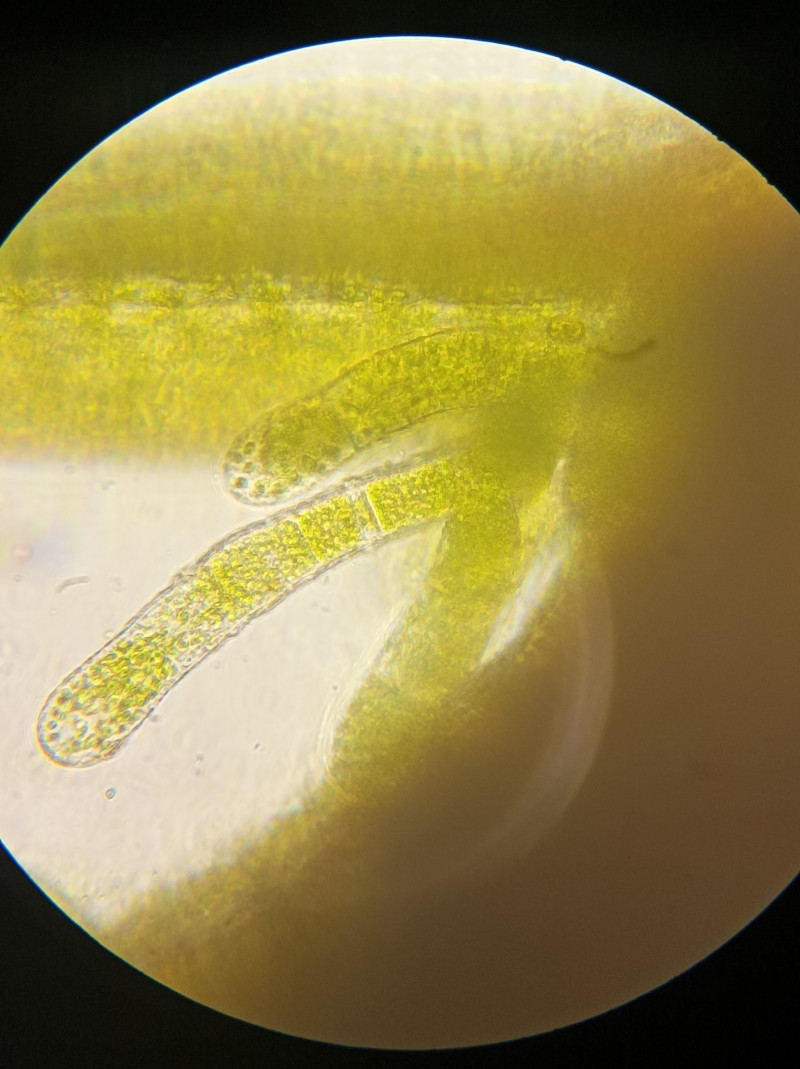
axillary gemmae detail, Eldon Hill Quarry
A form with concave, rounded leaves and abundant axillary gemmae known as B. subelegans is now regarded as a form of B. pallens.
axillary gemmae detail, Eldon Hill Quarry
Bryum pseudotriquetrum

Bar Brook, Eastern Moors
This widespread Bryum is a species of wet, habitats, irrespective of soil chemistry - it is a dominant species of springheads on the gritstone of northern Derbyshire and in woodlands but is also very common on wet ground in old limestone quarries. It is most widespread in the Dark Peak in Derbyshire, and is generally uncommon elsewhere in the county.
I've described this species in more detail in the Mosses of Ben Lawers section of the site.
I've described this species in more detail in the Mosses of Ben Lawers section of the site.
Bryum argenteum

Coombs Dale
One of the commonest 'weedy' Bryum species, B.argenteum is nonetheless an attractive plant when growing well. No other Bryum species has such silvery leaves with a distinct hair point. It can be found in a wide range of man-made or natural habitats, always where soil has been disturbed.
Bryum gemmiferum
 below Mam Tor, Castleton
This distinctive little Bryum is uncommon in Derbyshire and has a tendency to turn up in unpredictable places. It grows as scattered, upright stems on damp, gritty, calcareous, disturbed ground.
Its most distinctive feature is the presence of yellow-orange tiny bulbils in the leaf axils. These are much, much smaller than those of Bryum dichotomum and resemble grains of sugar under a hand lens.
Its most distinctive feature is the presence of yellow-orange tiny bulbils in the leaf axils. These are much, much smaller than those of Bryum dichotomum and resemble grains of sugar under a hand lens.
Bryum rubens

Elton Common
A very common Bryum of disturbed habitats and bare soil, this species is named for its bright red tubers, which are easily seen when soil is washed off its brown, papillose rhizoids. Some of its tubers can also be seen above ground - a characteristic feature of this species.

Cressbrook Dale NNR
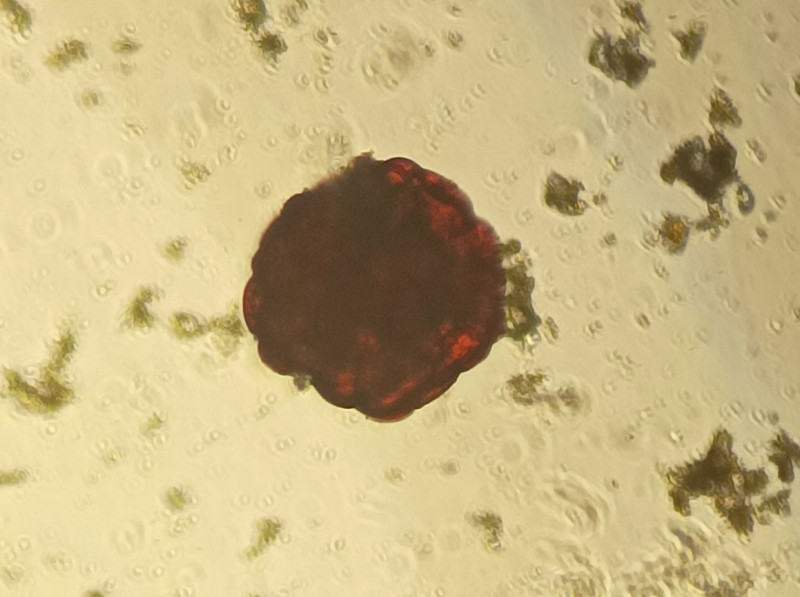
tuber detail
Cressbrook Dale NNR
tuber detail
Bryum elegans

Chrome Hill
A very rare moss in Derbyshire, this species is known from a few limestone outcrops in the White Peak. It grows as very compact, pale green patches of cylindrical shoots. Each stem characteristically hold their concave leaves tightly against the main axis. In this respect the moss somewhat resembles Anomobryum julaceum, but that species lacks bordered leaves with hair points.
Bryum riparium

Alport Valley
A very rare moss in Derbyshire, was only recently discovered by Tom Blockeel near Glossop in 2023. A second was recently found in the Alport Valley, where it occurs as a single small patch on a wet shale outcrop above the River Alport.
Bryum riparium is a tuber-bearing species - these have a diagnostic flat, serrated shape when seen under a microscope.
Bryum riparium is a tuber-bearing species - these have a diagnostic flat, serrated shape when seen under a microscope.
Rhodobryum roseum


Lathkill Dale NNR
This beautiful species is sadly a very rare sight in Derbyshire. It is plant of undisturbed calcareous grassland and once seen is easily recognised - the terminal rosette of leaves being highly distinctive, if difficult to describe in words!
R.roseum is known from scattered sites in the White Peak, with the best populations being in Lathkill Dale.
R.roseum is known from scattered sites in the White Peak, with the best populations being in Lathkill Dale.