


Thuidium tamariscinum

Cressbrook Dale NNR
This very common moss is a common species of damp habitats, both in shaded woodland and more exposed sites. It is variable in size, and not fussy about the soil it grows on.
Small specimens need to be checked carefully for T. assimile, T. recognitum (see below) and T.delicatulum, the last of which has not recently been recorded in Derbyshire.
Small specimens need to be checked carefully for T. assimile, T. recognitum (see below) and T.delicatulum, the last of which has not recently been recorded in Derbyshire.
Thuidium assimile
 Calver Quarry
Gang Mine NR, Cromford

microscope view of branch leaf apex, showing 'crown' of papillae on terminal cell
This smaller cousin of T. tamariscinum is a strict calcicole and is locally common in limestone grassland, especially in the Cromford-Wirksworth area.
The key characters of this species are microscopic and specimens can be strongly suspected in the field, but not confirmed. Under a microscope, two characters are present in T. assimile: the apical cells of the branch leaves have two papillae, giving the cells a 2-pronged appearance, and the stem leaves have a row of elongate apical cells, although these are sometimes broken-off. Checking a few leaves will usually reveal them. The widespread T. tamariscinum can be small and does occur on limestone soils, but never has these two characters.

apex of stem leaf
The key characters of this species are microscopic and specimens can be strongly suspected in the field, but not confirmed. Under a microscope, two characters are present in T. assimile: the apical cells of the branch leaves have two papillae, giving the cells a 2-pronged appearance, and the stem leaves have a row of elongate apical cells, although these are sometimes broken-off. Checking a few leaves will usually reveal them. The widespread T. tamariscinum can be small and does occur on limestone soils, but never has these two characters.
apex of stem leaf
Thuidium recognitum

High Dale, near Priestcliffe
This attractive species is extremely rare in Derbyshire, where it grows in cool, wooded limestone gorges and on open, damp rock ledges in grassland. Occasionally, it also grows with T.assimile on old mine spoil. The population in Via Gellia is very small. Here it grows with a rich assemblage of other calcicoles, such as Rhytidiadelphus triquetrus, Loeskeobryum brevisrostre and Seligeria donniana.
T. recognitum needs microscopical analysis to confirm its identity - it shares the apical papillae of T. assimile (see above), but the papillae on the paraphyllia are against the cell walls, rather than in the middle. The cells above the nerve on the stem leaves are also elongate, unlike in T. assimile.
Interestingly, the first record of this species in Britain was from Derbyshire, in the Matlock bath area.
T. recognitum needs microscopical analysis to confirm its identity - it shares the apical papillae of T. assimile (see above), but the papillae on the paraphyllia are against the cell walls, rather than in the middle. The cells above the nerve on the stem leaves are also elongate, unlike in T. assimile.
Interestingly, the first record of this species in Britain was from Derbyshire, in the Matlock bath area.
Palustriella commutata

Dunsley Springs, Via Gellia
This species is described in the Bryophytes of other areas of northern England section of the site.
It is by far the most common Palustriella in Derbyshire, where it grows as a common indicator of moderately base-enriched water around springheads, flushes and damp rocks.
Most populations are in the Dark Peak on base-rich gritstone - the White Peak is mostly too dry to support populations of this moisture-demanding species.
It is by far the most common Palustriella in Derbyshire, where it grows as a common indicator of moderately base-enriched water around springheads, flushes and damp rocks.
Most populations are in the Dark Peak on base-rich gritstone - the White Peak is mostly too dry to support populations of this moisture-demanding species.
Palustriella falcata

Westend Valley, High Peak
This species is described in the Bryophytes of other areas of northern England section of the site.
In Derbyshire, it is much rarer than P. commutata and is almost entirely confined to base-rich flushes in the Dark Peak. The only known site in the White Peak is in Monks Dale.
In Derbyshire, it is much rarer than P. commutata and is almost entirely confined to base-rich flushes in the Dark Peak. The only known site in the White Peak is in Monks Dale.
Cratoneuron filicinum

Mill Dale, Ladybower

Westend Valley, High Peak
This moisture-loving moss is very common throughout Britain and often one of the first mosses seen in permanently damp pastures and flushes. It favours calcareous habitats and in Derbyshire has its main distribution in limestone areas. Populations in the High Peak are usually associated with areas of base-rich seepage.
Cratoneuron is variable but usually can be recognised in the field by its pale shoot tips and rigid leaves with fine apices. Microscopically, the leaves have decurrent auricles that are broad enough to almost reach to base of the nerve.

Cratoneuron is variable but usually can be recognised in the field by its pale shoot tips and rigid leaves with fine apices. Microscopically, the leaves have decurrent auricles that are broad enough to almost reach to base of the nerve.
Amblystegium serpens

Deep Dale
By far the commonest member of a family of superficially-similar pleurocarps, A. serpens is very much a habitat generalist and can be seen across Derbyshire (and Britain). Microscopical analysis is needed to differentiate it from its less common cousins, especially when growing on basic rock. A. serpens is distinguished by having a well-defined nerve that reaches at least halfway up the leaf, but always ends well below the apex. Its leaves are not decurrent and do not narrow markedly at their base.

Serpoleskea confervoides (syn. Amblystegium confervoides)

Deep Dale, Ashford-in-the-Water
Resembling a very slender A. serpens, this uncommon species is a specialist of damp, shaded limestone. It is very similar to Platydictya jungermannioides (see below), but never bears gemmae in the leaf axils. Unlike A. serpens, its tiny leaves lack a nerve.
Leptodictyum riparium
Image coming soon!
Text coming soon!
Conardia compacta


Markland Grips NR
This very small moss is a specialist of bare limestone in the mouth of caves and below overhanging crags where competition is minimised. It is extremely rare in Derbyshire and known from only three sites.
It is described in the Mosses of other areas of northern England section of the site.
It is described in the Mosses of other areas of northern England section of the site.
Campylium stellatum

Mill Dale, Ladybower

Westend Valley, High Peak
This attractive pleurocarp occurs sparingly in Derbyshire, normally in areas of base-enriched gritstone in the High Peak where it is a characteristic species of flushes. It is largely absent from limestone areas of Derbyshire because the habitats there are too dry.
Identifying C. stellatum is relatively easy in the field, given its characteristic star-like arrangement of leaves around the stems and golden yellow-orange colour. The rarer C. protensum (see below) is similar, but is smaller, more slender and grows as prostrate, regularly-branched shoots rather than upright patches.

Identifying C. stellatum is relatively easy in the field, given its characteristic star-like arrangement of leaves around the stems and golden yellow-orange colour. The rarer C. protensum (see below) is similar, but is smaller, more slender and grows as prostrate, regularly-branched shoots rather than upright patches.
Campylium protensum

Conies Dale
Formerly regarded as a variety of C. stellatum (above), this relatively scarce species is not especially frequent in Derbyshire.
Identification often requires microscopic analysis, especially when growing in habitats other than flushes, due to its similarity with Campylium chrysophyllum (see below), more than with C. stellatum, although C. chrysophyllum has leaves with a nerve which can usually be seen with a lens in the field.

Ginny Spring, Whitwell Wood NR
Identification often requires microscopic analysis, especially when growing in habitats other than flushes, due to its similarity with Campylium chrysophyllum (see below), more than with C. stellatum, although C. chrysophyllum has leaves with a nerve which can usually be seen with a lens in the field.
Ginny Spring, Whitwell Wood NR
Campylium chrysophyllum

Via Gellia
This attractive species is a moss of dry, open, calcaeous habitats. It is especially common as a colonist of old limestone quarries, and also commonly occurs in dry limestone grassland. In the field, it resembles a small form of Campylium stellatum, albeit growing in a very different habitat.
Campylium protensum can grow in similar places, and close examination is needed to differentiate the two. C. chrysophyllum has a nerve that reaches at least half way up the leaf and smooth leaf margins. Its leaf cells are also usually much shorter.
Campylium protensum can grow in similar places, and close examination is needed to differentiate the two. C. chrysophyllum has a nerve that reaches at least half way up the leaf and smooth leaf margins. Its leaf cells are also usually much shorter.
Campylophyllopsis calcarea


Cliffside Wood, Crich
This rare woodland species is known from a few scattered sites on the Magnesian Limestone in the east of the county. There older records from the White Peak but these have all proved to be errors. The only known site away from the Magnesian Limestone is at Crich, where it was discovered on several limestone blocks in steep woodland.
Although very small, C. calcarea has a characteristic appearance in the field, growing a fairly dense, sprawling mats which typically have abundant capsules, unlike other Campylium-related species. Microscopically, the leaves have very long, narrow acumens (the upper part of the leaf) and small, but distinct auricles at their bases. There is often no nerve, or at most a very short, double one.

alar cells forming small auricle
Although very small, C. calcarea has a characteristic appearance in the field, growing a fairly dense, sprawling mats which typically have abundant capsules, unlike other Campylium-related species. Microscopically, the leaves have very long, narrow acumens (the upper part of the leaf) and small, but distinct auricles at their bases. There is often no nerve, or at most a very short, double one.
alar cells forming small auricle
Drepanocladus aduncus

Ladybower Reservoir
The species is one of several pleurocarps that colonise bare, damp ground on reservoir margins. It can be identified by the small auricles that extend only slightly down the stems and untoothed leaf margins.
Sarmentypnum exannulatum


Westend Valley, High Peak
Similar to D. aduncus (above), this species can be found in flushes and boggy areas in the High Peak of Derbyshire.
It differs in having denticulate leaf margins, a nerve that reaches the leaf apex and auricles that are non-decurrent.
It differs in having denticulate leaf margins, a nerve that reaches the leaf apex and auricles that are non-decurrent.
Warnstorfia fluitans


Hipper Sick, Eastern Moors
The Pennines are a British stronghold for this unassuming pleurocarp of acidic, boggy places.
W. fluitans occurs on the margins of boggy moorland pools, typically growing with Sphagnum species.
In the field, it resembles an upright Hypnum species growing in a habitat that is far too wet for Hypnum! It can be identified by its leaves, which possess a long nerve, and the leaf bases, which barely have auricles.
W. fluitans occurs on the margins of boggy moorland pools, typically growing with Sphagnum species.
In the field, it resembles an upright Hypnum species growing in a habitat that is far too wet for Hypnum! It can be identified by its leaves, which possess a long nerve, and the leaf bases, which barely have auricles.
Calliergon cordifolium

Ladybower Reservoir
The spreading leaves with rounded tips immediately make this moss look like 'something different' when it is encountered, as does the pale yellowish-green colour. C. cordifolium is a plant of wet, acidic sites.
Superficially, it somewhat resembles Calliergonella cuspidata, but that species has overlapping, not spreading, leaves and the leaves lack a nerve.
Superficially, it somewhat resembles Calliergonella cuspidata, but that species has overlapping, not spreading, leaves and the leaves lack a nerve.
Calliergon giganteum

Highshaw Clough, Derwent Moors
Text coming soon.
Straminergon stramineum


Westend Valley, High Peak
Given its very distinctive thread-like appearance, Straminergon is easy to recognise. It is a moss of permanently wet, acidic places, such as marshes and flushes. It can be a large species, and often attracts attention, given its size and bright golden-green colour.
Scorpidium cossonii

Highshaw Clough, Derwent Moors
This species of base-rich flushes is rare in Derbyshire, with nearly all known sites associated with base-rich flushes in the High Peak.
It is described in more detail in the Bryophytes of Cumbria & Teesdale section of the site.
It is described in more detail in the Bryophytes of Cumbria & Teesdale section of the site.
Scorpidium revolvens

Mill Dale, Ladybower

This species is described in the Mosses of Ben Lawers section of the site. It is relatively scarce in Derbyshire, and restricted to flushes on the gritstone moors where there is at least some base enrichment.
Sanionia uncinata

Padley Gorge

This common, attractive moss occurs in a variety of habitats in Derbyshire. It can be found in moist turf, around tree bases in swampy ground and as an epiphyte in humid woodland. Wherever it occurs, the strongly curved leaves with long, fine apices are distinctive, along with its regularly pinnate branching.
Hygrohypnella ochracea (syn. Hygrohypnum ochraceum)

Goyt's Clough
This water-loving species is characteristic of fast-flowing streams in upland Britain and is locally frequent in the High Peak, where it forms this mats of orange-brown, curved stems on inundated acidic rocks.
Microscopically, H. ochracea has leaves with fragile, hyaline, decurrent auricles and a relatively well-developed, forked nerve.
Microscopically, H. ochracea has leaves with fragile, hyaline, decurrent auricles and a relatively well-developed, forked nerve.
Hygrohypnum luridum
Image coming soon!
Text coming soon!
Isothecium alopecuroides
Image coming soon!
A woodland moss, this species occurs relatively widely in Derbyshire. It can be distinguished from other Isothecium species by its obtuse leaves with very shortly-pointed tips. It occurs on trees and shaded, damp rocks.
Isothecium holtii


Bar Brook, Eastern Moors
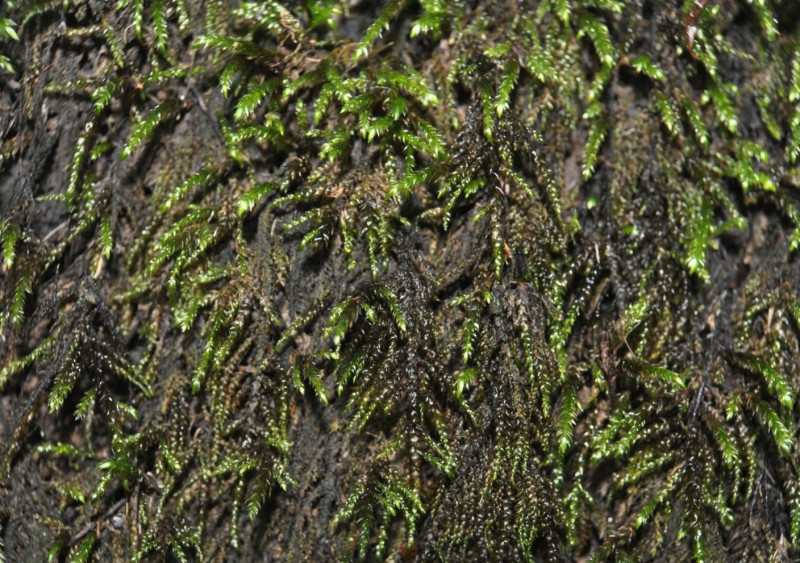
A more robust cousin of I. myosuroides, this handsome species is a specialist of humid rocks in gorges, where it can enjoy shelter and constant spray and high humidity. Ithas a characteristic orange brown lower part to the branches, and microscopically is seen to have shorter stem leaves with less-pronounced pointed apices.
Unusually, I. holtii is known from a single site in Derbyshire, despite it occurring there in some abundance in a relatively unremarkable habitat that is found along many streams in the High Peak.
Unusually, I. holtii is known from a single site in Derbyshire, despite it occurring there in some abundance in a relatively unremarkable habitat that is found along many streams in the High Peak.
Isothecium myosuroides

Westend Valley, High Peak
This pale greyish-green moss forms wispy tufts and patches on trees or around the base of acidic rocks with a distinctive dingy pale green colour. Its leaves are ovate, with long, gently-tapering apices and denticulate margins. The bases have distinctive patches of opaque alar cells.
Homalothecium sericeum

Via Gellia

Coombs Dale SSSI
A common moss of many habitats in Derbyshire, H. sericeum occurs both as an epiphyte and on rocks. The short, crowded branches which form dense patches are distinctive. Microscopically, the leaf bases are strongly-toothed - much more so than H. lutescens (see below).

Coombs Dale SSSI
Coombs Dale SSSI
Homalothecium lutescens


High Edge
Unlike H.sericeum (above), this species occurs primarily on limestone rocks in Derbyshire and has a much more upright appearance.because its branches are longer and less curved. Microscopically, the basal cells are porose and the basal margins are toothed, but not as strongly as in H. sericeum.
Brachythecium albicans

Bradwell Moor

Odin Mine, Castleton
This distinctively small, pale, stringy-looking Brachythecium is found in open, sunny sites on calcareous soils (or leached soil over limestone outcrops), where competition from more robust plants remains low. Typical sites are in short grassland turf, especially on bare soil patches and as a pioneer species in old limestone quarries.
B. albicans is perhaps the easiest of Derbyshire's Brachytheciums to identiy in the field, as no other species shares its pale colour and stringy appearance. Under a lens, the leaves are strongly pleated and closely overlap.

Calver Quarry
B. albicans is perhaps the easiest of Derbyshire's Brachytheciums to identiy in the field, as no other species shares its pale colour and stringy appearance. Under a lens, the leaves are strongly pleated and closely overlap.
Calver Quarry
Sciuro-hypnum populeum

above Pin Dale, Castleton
This rather nondescript species forms typically silky patches on acidic rock in Derbyshire, often in rather ordinary habitats. It resembles Brachytheciastrum velutinum, which is extremely rare here.
Microscopically, S. populeum has leaves in which the nerve reaches almost to the apex and untoothed, plane margins near their base. Fruiting material has the setae only papillose near the top, unlike B. velutinum.
Microscopically, S. populeum has leaves in which the nerve reaches almost to the apex and untoothed, plane margins near their base. Fruiting material has the setae only papillose near the top, unlike B. velutinum.
Brachythecium rivulare

Beeley Brook, Eastern Moors
This robust Brachythecium is a typical species of wet, wooded ravines and moorland, where it grows on flushed banks and in and by streams. It is common in suitable habitat in many parts of Derbyshire.
It is very similar to B.rutabulum, and a hand lens or microscope are needed to confirm it - B.rivulare has more shortly-pointed leaves, which are usually overlapping (imbricate) when dry. Microscopically, its leaves have distinct auricles composed of distinctly-enlarged alar cells (B.rutabulum does not have enlarged alar cells).
It is very similar to B.rutabulum, and a hand lens or microscope are needed to confirm it - B.rivulare has more shortly-pointed leaves, which are usually overlapping (imbricate) when dry. Microscopically, its leaves have distinct auricles composed of distinctly-enlarged alar cells (B.rutabulum does not have enlarged alar cells).
Brachythecium rutabulum
Image coming soon!
By far the commonest Brachythecium in Derbyshire, this ubiquitous species occurs widely on trees, damp soil and even damp tarmac. Its typically yellow-green colour and robust habit make it easy to spot, although care is needed to distinguish it from B. rivulare (see above). It is often abundantly fertile, with capsules maturing in winter and spring.
Sciuro-hypnum plumosum
Image coming soon!
Text coming soon!
Brachythecium velutinum
image coming soon
above Pin Dale, Castleton
above Pin Dale, Castleton
B. velutinum is a species that thrived in the years of atmospheric pollution, as it acidified tree bark. In recent times, it has declined.
This silky-looking, slender, deep green moss can be recognised by its leaves, which have denticulate margins, lack auricles and taper gradually to the apex. The nerve extends no further than 2/3 of the way up the leaf.
This silky-looking, slender, deep green moss can be recognised by its leaves, which have denticulate margins, lack auricles and taper gradually to the apex. The nerve extends no further than 2/3 of the way up the leaf.
Pseudoscleropodium purum


Coombs Dale SSSI
A very common moss of open grassland, P. purum is nonetheless an attractive species and can grow luxuriantly in damp meadows.
In the field it can be recognised by its 'wormlike' appearance and yellowish colour. Under a hand lens, a very useful feature is the 'crown-like' appearance of the shoot tip, caused by recurved apices on the leaves - this instantly separates it from the very rare Entodon concinnus (see below).
In the field it can be recognised by its 'wormlike' appearance and yellowish colour. Under a hand lens, a very useful feature is the 'crown-like' appearance of the shoot tip, caused by recurved apices on the leaves - this instantly separates it from the very rare Entodon concinnus (see below).
Scleropodium cespitans


Cressbrook Dale NNR

riverside form, by River Dove
A speciality of the limestone dales of the Peak District, this plant was formerly considered a separate species, Brachythecium appleyardiae, but has since been synonymised with the more widespread S. cespitans, a plant of riverbanks (see third photo).
The typical habitat of this moss in Derbyshire is at the base of sheltered limestone crags, where it can form extensive patches.
The typical habitat of this moss in Derbyshire is at the base of sheltered limestone crags, where it can form extensive patches.
Cirriphyllum piliferum

Flag Dale
This species and C. crassinervium (see below) are fairly common pleurocarps of limestone woodland. Both favour moist, shaded or sheltered situations.
C. piliferum, as its name suggests, has a long, fine hair-point to its leaves. These leaves are also strongly concave, with a nerve that end well below the apex.
C. piliferum, as its name suggests, has a long, fine hair-point to its leaves. These leaves are also strongly concave, with a nerve that end well below the apex.
Cirriphyllum crassinervium

above Speedwell Cavern, Castleton
Cirriphyllum crassinervium occupies similar habitats to C. piliferum, but has a markedly different appearance - it grows as dense, rather than lax patches, and its stems bear numerous short, usually straight branches, quite unlike the longer, spreading branches of C. piliferum. Under a hand lens, the difference in leaf shape is also clear, with those of C. crassinervium having short apices without hair points.
Rhynchostegium confertum

Westend Valley, High Peak

above Matlock Bath
A common moss of sheltered, damp habitats, this species occurs on base-rich rocks and bark of mature trees. The abundant capsules on short setae are mature in winter and often draw attention to the species.
Microscopically, the ovate leaves are seen to have denticulate margins and a nerve which ends well below the leaf apex.
Microscopically, the ovate leaves are seen to have denticulate margins and a nerve which ends well below the leaf apex.
Rynchostegium riparioides (syn. Platyhypnidium riparioides)

below Mam Tor, Castleton
This fairly robust moss is often common and conspicuous on rocks splashed by running streams. It is not fussy about water chemistry, and although very common in acidic streams in the Dark Peak, it also grows over limestone.
Rhynchostegium alopecuroides
Image coming soon!
Fair Brook
Fair Brook
Text coming soon!
Eurhynchium striatum

epiphytic colony,

limestone grassland colony, Bonsall Moor
Primarily a moss of calcareous woodland, E. striatum is a handsome species that is often found as an epiphyte but is also equally at home growing on limestone. It is widespread in limestone regions of Derbyshire and is often a dominant bryophyte in damp woodland.
Under a microscope, it has distinctively short, broad triangular leaves with denticulate margins.
Under a microscope, it has distinctively short, broad triangular leaves with denticulate margins.
Plasteurhynchium striatulum

Matlock Bath

Cow Dale
Another moss of damp, sheltered, limestone woodland, this species is rarer than its close cousin, E. striatum, with which it often occurs. In the field, P. striatulum has a certain 'look' to it, which makes it somewhat easier to spot. It is a smaller species than E. striatum, with a less regular branching habit, giving it a slightly scruffier appearance.
Microscopically, it is a very distinctive species, with the leaf bases having a band of thickened, round cells that reach the nerve.
Microscopically, it is a very distinctive species, with the leaf bases having a band of thickened, round cells that reach the nerve.
Kindbergia praelonga

Bar Brook, Eastern Moors
A very common moss throughout Britain, Kindbergia is an easily recognised species, typical of damp woodland. While variable, its typical appearance is as slender, pale shoots with strikingly regular, pinnate branches. As long as the habitat is persistently damp, Kindbergia can grow on any substrate and is some habitats it is one of the most prominent mosses.
Oxyrrhynchium hians

Padley Gorge
This variable species is very common in acidic woodland in Derbyshire. I've described the species in the Bryophytes of other areas of northern England section of the site.
Microeurhynchium pumilum (syn. Rhynchostegella pumila)

Deep Dale DWT Reserve
This tiny species is common on shaded limestone crags in Derbyshire, where it grows as dark green patches and wefts.
Superficially, it resembles an Amblystegium, but microscopically it is very different - this species can be recognised by its denticulate leaf apices, long nerve and short leaf cells. The leaves lack the long, drawn-out apex of Amblystegium species.
Superficially, it resembles an Amblystegium, but microscopically it is very different - this species can be recognised by its denticulate leaf apices, long nerve and short leaf cells. The leaves lack the long, drawn-out apex of Amblystegium species.
Rhynchostegiella tenella


This patch-forming species is a characteristic moss of sheltered, dry limestone crags in the Peak District, here in Derbyshire. On poor crags, it may be one of the only species present, especially under dry, shady overhangs. Its typical appearance is as low-growing, felty, yellowish-green mats.
Microscopically, R. tenella has long leaves and the capsules have smooth setae. Microeurhynchium pumilum (R. pumila) also occurs on limestone crags, but is a duller green and has much shorter leaves and cells.

Cressbrook Dale NNR
Microscopically, R. tenella has long leaves and the capsules have smooth setae. Microeurhynchium pumilum (R. pumila) also occurs on limestone crags, but is a duller green and has much shorter leaves and cells.
Cressbrook Dale NNR
Rhynchostegiella teneriffae


Bentley Brook, Lumsdale, Matlock
Unlike the previous species, this moss is moisture-loving, and often grows on rocks in streams. Smith's Moss Flora states it has a preference for limestone, but in Derbyshire, this species is much more commonly found on acidic gritstone.
Microscopically, R. teneriffae is most similar to R. curviseta, differing in its longer cells and shorter seta. The latter species is only known from a single site in Derbyshire.
Microscopically, R. teneriffae is most similar to R. curviseta, differing in its longer cells and shorter seta. The latter species is only known from a single site in Derbyshire.
Entodon concinnus


Calver Quarry
This beautiful moss is a very rare sight in Derbyshire, where it almost exclusively favours regenerating grassland in old limestone quarry and lead-mining sites. Small forms of Pseudoscleropodium purum (see above) can resemble this species and occur in similar habitats but E. concinnus never has the 'crown' of reflexed leaf tips always visible in P. purum.
Microscopically, the two species are easily distinguised - Entodon leaves lack a nerve entirely.
Microscopically, the two species are easily distinguised - Entodon leaves lack a nerve entirely.
Orthothecium intricatum

Cressbrook Dale NNR

with Pedinophyllum interruptum, Chee Dale SSSI
Always a nice sight in derbyshire, O. intrictatum is a moss of damp, sheltered calcareous crags. No other pleurocarpous moss shares it combination of green and washed-out pink colours, which makes it instantly recognisable.
This species has a fairly widespread distribution in the limestone dales of the White Peak and is also found at scattered sites in the High Peak, on outcrops of base-rich gritstone.

in habitat, Cressbrook Dale NNR

Conies Dale
This species has a fairly widespread distribution in the limestone dales of the White Peak and is also found at scattered sites in the High Peak, on outcrops of base-rich gritstone.
in habitat, Cressbrook Dale NNR
Conies Dale
Platydictya jungermannioides


Monks Dale NNR
A rare moss in Derbyshire and Britain as a whole, P. jungermannioides is a very understated by highly distinctive species. Knowing its habitat is the key - it inhabits dripping tufa or limestone in sheltered habitats such as woodland or shaded crags. Here, it forms straggly green wefts over the rock and is often the only pleurocarp present.
Microscopically, it resembles other members of the Amblystegiaceae, but has more distant leaves with long, drawn-out apices. Crucially, it also produces highly characteristic wedge-shaped gemmae in the leaf axils.
In Derbyshire, Platydictya is currently known from a dozen or so sites, all but one in the White Peak (the other is at Ashover).
Microscopically, it resembles other members of the Amblystegiaceae, but has more distant leaves with long, drawn-out apices. Crucially, it also produces highly characteristic wedge-shaped gemmae in the leaf axils.
In Derbyshire, Platydictya is currently known from a dozen or so sites, all but one in the White Peak (the other is at Ashover).
Plagiothecium denticulatum
Image coming soon!
Text coming soon!
Plagiothecium nemorale

above Pin Dale, Castleton
Text coming soon!

Plagiothecium undulatum

Clark's Plantation, Eastern Moors
This elegant moss is typical of damp, acidic woodland, where it can form impressive hummocks with a characteristic ghostly pale green colour.
As the name suggests, the ovate leaves have an undulate surface with the short, double nerve typical of Plagiothecium.
As the name suggests, the ovate leaves have an undulate surface with the short, double nerve typical of Plagiothecium.
Pseudotaxiphyllum elegans
 Goyt Valley
 This attractive, often conspicuous moss is very common in damp woodland throughout Britain.
It is a plant of acidic habitats and forms characteristic shiny patches on soil and rotting wood. It also occurs in more open habitats such as woodland and acidic soil around the base of crags, but always where it remains damp and sheltered. It can resemble other, rarer, species but a combination of habitat and leaf characters will separate it - Pseudotaxiphyllum has a very short, double nerve, non-inflated, non-decurrent alar cells and usually bears many short filiform branchlets from the leaf axils, which readily break off and form a means of reproduction.
It is a plant of acidic habitats and forms characteristic shiny patches on soil and rotting wood. It also occurs in more open habitats such as woodland and acidic soil around the base of crags, but always where it remains damp and sheltered. It can resemble other, rarer, species but a combination of habitat and leaf characters will separate it - Pseudotaxiphyllum has a very short, double nerve, non-inflated, non-decurrent alar cells and usually bears many short filiform branchlets from the leaf axils, which readily break off and form a means of reproduction.
Taxiphyllum wissgrillii

Northern Dale, Matlock
This easily-overlooked species of calcareous woodland is described in the Bryophytes of other areas of northern England section of the site.
Calliergonella cuspidata

A very common moss of marshy ground, Calliergonella is an easy moss to find in Derbyshire and occurs in almost any damp habitat, from wet pasture, to flushed moorland slopes and stream margins. In Derbyshire, this species occurs in both base-rich and mildly acidic sites.
Ths moss is easily identified by its blunt-tipped leaves and branches, which end in a tapering, blunt point formed from overlapping, concave leaves. Colour ranges from yellow-green in open habitats to rich, bright green in shaded sites.
Ths moss is easily identified by its blunt-tipped leaves and branches, which end in a tapering, blunt point formed from overlapping, concave leaves. Colour ranges from yellow-green in open habitats to rich, bright green in shaded sites.
Pylaisia polyantha

Via Gellia

Chee Dale NNR
Derbyshire is something of a stronghold for this moss, which is rare in Britain. In the White Peak woodlands, it can be a very common and locally dominant epiphyte.
Superficially resembling a Hypnum, Pylaisia can be easily recognised by the dark setae and numerous fertile branches bearing abundant capsules, of which there are usually several generagtions present. When present, the capsule lids are straight and acute, rather than beaked. Microscopically, the exothecial cells are heavily thickened.
Superficially resembling a Hypnum, Pylaisia can be easily recognised by the dark setae and numerous fertile branches bearing abundant capsules, of which there are usually several generagtions present. When present, the capsule lids are straight and acute, rather than beaked. Microscopically, the exothecial cells are heavily thickened.
Hypnum cupressiforme
Image coming soon!
Text coming soon!
Hypnum cupressiforme var. lacunosum

Coombs Dale SSSI
This golden-brown variety of the widespread and variable H. cupressiforme is particularly characteristic of rocky limestone habitats and calcareous grassland. The stems are typically quite robust and have strongly falcate leaves.
Hypnum andoi


Goyt Valley
In the wetter, cooler northern and western parts of Derbyshire, this epiphytic Hypnum can be quite common. It needs to be searched for from autumn to mid-winter, when the characteristic rounded (mamillate) lids are still on the capsules. In the absence of these, it cannot be reliably distinguished from H. cupressiforme, although the latter species has generally longer pseudoparaphyllia and mid-leaf cells.
Hypnum jutlandicum

Kenslow sand pit
This brown Hypnum is extremely common on moorland, where it can be the only pleurocarp present. It is described in more detail in the Bryophytes of Cumbria & the Lake District section of the site.
Ctenidium molluscum

Coombs Dale SSSI

fruiting plants, Grindsbrook, Edale
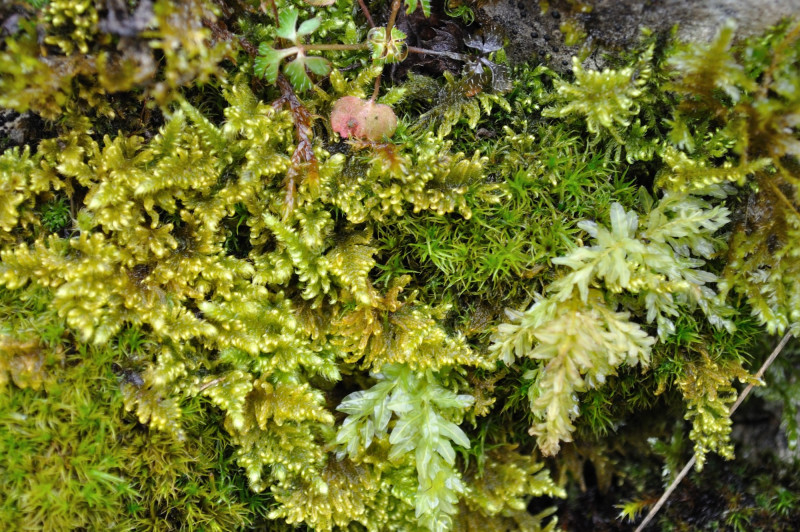
One of the classic mosses of limestone terrain in Derbyshire, Ctenidium is a beautiful plant, especially when growing luxuriantly. In Derbyshire, no other species is likely to be confused for it.
Capsules are fairly rare in Derbyshire, and tends to occur in plants in colder, wetter locations, such as those in the High Peak, where base-rich gritstone is occasionally found.
Capsules are fairly rare in Derbyshire, and tends to occur in plants in colder, wetter locations, such as those in the High Peak, where base-rich gritstone is occasionally found.
Hyocomium amoricum

Ashop Clough
This common and conspicuous moss of shaded, damp boulders in and alongside streams is easy to find in many areas of Derbyshire. The pale green shoots with darker bases form large, spreading patches and this species is often one of the dominant mosses in its favoured habitat.
Microscopically, Hyocomium is easy to recognise by its broad-based, toothed leaves which lack a nerve.
Microscopically, Hyocomium is easy to recognise by its broad-based, toothed leaves which lack a nerve.
Rhytidium rugosum

Chee Dale NNR


Monks Dale NNR (this and previous two images)
This rare moss is something of a Peak District speciality, where it grows in limestone scree at several sites. Where present, it can occur in remarkable abundance, but is absent from similar habitats in seemingly good sites.
R. rugosum somewhat resembles Hypnum cupressiforme var. lacunosum, which is often abundant in limestone scree, but on close inspection the leaves are clearly wrinkled (hence the name) and the whole plant has a coarse look not shared by Hypnum. The colour is a characteristic golden hue and the stems have irregular pinnate branching, with many stubby, pointed branches.


in habitat, Monks Dale NNR
R. rugosum somewhat resembles Hypnum cupressiforme var. lacunosum, which is often abundant in limestone scree, but on close inspection the leaves are clearly wrinkled (hence the name) and the whole plant has a coarse look not shared by Hypnum. The colour is a characteristic golden hue and the stems have irregular pinnate branching, with many stubby, pointed branches.
in habitat, Monks Dale NNR
Pleurozium schreberi

Coombs Dale SSSI
A common moss of stony, acidic meadows, heaths, moorland and woodland, P. schreberi is common in many parts of Derbyshire. It can be recognised by its bright red stems and neat pinnate stems. Microscopically, the leaves have rounded tips and a very short, double nerve. Despite Smith's Moss Flora stating the margins are entire, they are actually often toothed.

Hylocomiadelphus triquetrus (syn. Rhytidiadelphus triquetrus)

Cressbrook Dale NNR
One of my favourite mosses in Derbyshire, H. triquetrus is a plant of damp, calcareous woodland, scrub and cool, moist meadows. Its characteristically pale whitish-beige-green robust stems make it easy to recognise.
Rhytidiadelphus loreus

Grainfoot Clough, Derwent Valley
Very much a plant of non-calcareous terrain, R. loreus has a characteristic spiny appreance to its robust stems. It forms wefts and mats in damp woodland and sometimes occurs on sheltered rocks.
Rhytidiadelphus squarrosus


Coombs Dale SSSI
One of the commonest mosses in Britain, R. squarrosus inhabits any acidic or neutral open grassland and is often found in garden lawns. Its yellow-green colouration and strongly recurved leaves make it easy to recognise.
Loeskeobryum brevirostre

Chee Dale SSSI
This uncommon moss is characteristic of pristine, humid, calcareous woodland in Derbyshire, where it typically occurs with Rhytidiadelphus triquetrus and other damp-loving species. Here, it can form extensive patches at some sites. It has a rather scruffy, rough look to it, and is easily identified in these habitats by its coarsely-dentate leaves and reddish-brown stems (the superficially-similar Rhytidiadelphus loreus never occurs in calcareous habitats). Microscopically, the abundant paraphyllia are immediately diagnostic.
Capsules are rare in this species, but despite this, it is something of a colonist and has successfully spread its distribution to some former industrial sites in Derbyshire.
Capsules are rare in this species, but despite this, it is something of a colonist and has successfully spread its distribution to some former industrial sites in Derbyshire.
Hylocomium splendens

Coombs Dale SSSI
This common moss is described in the Mosses of Ben Lawers NNR section of the site.