


Aulacomnium palustre


Cumwhitton Moss SSSI
A conspicuous, bright yellow-green moss of wet heathland and acidic bogs, A. palustre is common across much of Britain where suitable habitat occurs. It is easy to identify, as the stems are densely covered in brown rhizoids.
Plagiopus oederianus

Glen Shee
This species is described in the Mosses of Derbyshire section of the site.
Plagiopus is widespread in the central and southern Highlands but much rarer north of the Great Glen.
Plagiopus is widespread in the central and southern Highlands but much rarer north of the Great Glen.
Bartramia pomiformis


Ben A'an SSSI, Trossachs
This species is described in the Mosses of Derbyshire section of the site.
B. pomiformis is found across almost all of Scotland in suitable habitat.
B. pomiformis is found across almost all of Scotland in suitable habitat.
Bartramia ithyphylla

Glas Choire, Glas Maol, Cairngorms
More of an upland species than B. pomiformis, this moss is similarly widespread in Scotland, especially north of the Central Belt.
B. ithyphylla is described in more detail in the Mosses of Derbyshire section of the site.
B. ithyphylla is described in more detail in the Mosses of Derbyshire section of the site.
Philonotis fontana


Coire nam Beith, Glencoe
This common species of upland flushes and springheads is described in the Mosses of Ben Lawers section of the site.
Philonotis seriata
Image coming soon!
This rare species is a specialist of cold, snowbound mountain summits, where it effectively replaces P. fontana. It shares the same requirement for wet, acidic habitats and the two species can be found growing close by each other.
Classically, P. seriata is characterised as having spirally-arranged leaves (hence the name), but I find this character hard to see, perhaps as I encounter the species so infrequently. Microscopically, the back of the nerve in P. seriata has strongly mamillose cells, a character never shared by P. fontana.
Nationally, P. seriata is almost entirely restricted to Scotland, with a single old record from North Wales.
Classically, P. seriata is characterised as having spirally-arranged leaves (hence the name), but I find this character hard to see, perhaps as I encounter the species so infrequently. Microscopically, the back of the nerve in P. seriata has strongly mamillose cells, a character never shared by P. fontana.
Nationally, P. seriata is almost entirely restricted to Scotland, with a single old record from North Wales.
Philonotis calcarea

Cairnwell SSSI, Glen Shee
As its name suggests, this is a moss of calcareous habitats, where it occupies a similar position to that of P.fontana in acidic places. The leaves of this attractive moss are usually distinctively curved to one side, quite unlike its close cousin and the leaves surrounding the male inflorescences are sharply-pointed, rather than rounded (as shown in the photo here).
P.calcarea is relatively frequent in suitable habitat in Scotland and is at its most frequent in the eastern Borders, Cairngorms and on machair in the Western Isles.
P.calcarea is relatively frequent in suitable habitat in Scotland and is at its most frequent in the eastern Borders, Cairngorms and on machair in the Western Isles.
Philonotis tomentella

Glen Shee, Cairngorms
Much scarcer than the other calcicolous member of the genus, P. calcarea, this moss is very much a montane specialist and nearly all recent British records of this species come from Scotland.
Superficially, this species resembles a straight-leaved, diminutive form of P. calcarea but microscopically the two are distinct. P. tomentella has shorter leaf cells and usually a longly-excurrent nerve.

Superficially, this species resembles a straight-leaved, diminutive form of P. calcarea but microscopically the two are distinct. P. tomentella has shorter leaf cells and usually a longly-excurrent nerve.
Breutelia chrysocoma

Glen Loin SSSI, Arrochar

Glencoe
This beautiful species is common in much of western Scotland, where it is found on heathy, flushed mountain slopes.
I've described it in more detail in the Mosses of Derbyshire section of the site.

I've described it in more detail in the Mosses of Derbyshire section of the site.
Amphidium mougeotii

Pollochro Wood SSSI, Loch Lomond

Ben A'an SSSI, Trossachs
A characteristic moss of damp, often slightly base-rich, siliceous rocks, A. mougeotii is common across much of Scotland in suitable habitat.
It has a characteristic dark green colour, with narrow, pointed leaves and typically grows as cushions filling cracks in boulders and outcrops.
Microscopically a useful feature is that the cells appear striated on the underside of the leaves due to lines of papillae.
It has a characteristic dark green colour, with narrow, pointed leaves and typically grows as cushions filling cracks in boulders and outcrops.
Microscopically a useful feature is that the cells appear striated on the underside of the leaves due to lines of papillae.
Zygodon conoideus

Ballachuan Hazelwood, Seil

Glen Nant NNR, Argyll
A common epiphyte, especially in western Britain, Z. conoideus becomes a familiar sight to anyone spending time inspecting epiphytes in decidous woodland.
Key features in identifying this species are its large leaf cells, large gemmae, distinct peristome and leaves that are not recirved when moist. Unlike Z. viridissimus,which often occurs in similar habitats, this species often bears abundant capsules on curved setae.

Key features in identifying this species are its large leaf cells, large gemmae, distinct peristome and leaves that are not recirved when moist. Unlike Z. viridissimus,which often occurs in similar habitats, this species often bears abundant capsules on curved setae.
Orthotrichum rupestre
 road to Sanna Bay, Ardnamurchan
As its name suggests, this is very much a species of rocks, and is almost never found as an epiphyte in Britain. It could be confused with the common O. cupulatum, but has hairy calyptrae and any old capsules are parallel-sided with superficial stomata.
O. rupestre is largely found in Scotland within the British Isles, with only scattered occurrences elsewhere.
O. rupestre is largely found in Scotland within the British Isles, with only scattered occurrences elsewhere.
Lewinskya affinis (syn. Orthotrichum affine)

Riechip Den, Perthshire
This very common, largely-epiphytic, species is found across Scotland apart from at higher elevations (above 600m or so) and in areas where tree cover is absent.
L. affinis is described in more detail in the Mosses of Derbyshire section of the site.
L. affinis is described in more detail in the Mosses of Derbyshire section of the site.
Ulota phyllantha


Ardnamurchan
Along the west coast of Scotland, this can be an abundant and conspicuous moss, both on trees and on rocks. The abundant brown gemmae are easily-seen, even when the plants are crisped and dry. Capsules are very rare, unlike the rest of the genus in Britain.
Nationally, U. phyllantha is a common species in lowland areas, although in inland Britain it is found predominantly as an epiphyte.
Nationally, U. phyllantha is a common species in lowland areas, although in inland Britain it is found predominantly as an epiphyte.
Ulota hutchinsiae
 Resipol ravine, Sunart
I apologise for the terrible, overexposed photo! This tiny patch is the only one I've seen so far, so it will have to do for now!
U. hutchinsiae is very much a plant of north-western Britain, with nearly all occurrences in Scotland. Unlike the other Ulota species, it is almost always found on rocks.
Apart from the habitat, key characters for identifying U. hutchinsiae are straight leaves with small cell lumens, along with the usual hairy calyptrae, typical of Ulota.
U. hutchinsiae is very much a plant of north-western Britain, with nearly all occurrences in Scotland. Unlike the other Ulota species, it is almost always found on rocks.
Apart from the habitat, key characters for identifying U. hutchinsiae are straight leaves with small cell lumens, along with the usual hairy calyptrae, typical of Ulota.
Ulota calvescens

Ballachuan Hazelwood, Seil
Text coming soon!
Ulota bruchii

Rumbling Bridge, Perthshire
Perhaps Britain's most widespread Ulota, U. bruchii is especially frequent in upland woods and in the oceanic west of Scotland.
The species is described in more detail in the Mosses of Derbyshire section of the site.

The species is described in more detail in the Mosses of Derbyshire section of the site.
Ulota drummondii

Glenmore Forest, Cairngorms
Scotland is the British stronghold for this montane Ulota, where it typically grows in upland woodland and sheltered ravines.
Characteristic features of this species are the white peristome teeth and the leaves, which do not crisp up when dry, unlike other epiphytic Ulotas.
Characteristic features of this species are the white peristome teeth and the leaves, which do not crisp up when dry, unlike other epiphytic Ulotas.
Hedwigia sp.

Traprain Law, East Lothian
Text coming soon!
Hookeria lucens

Glen Falloch Pinewood SSSI, Loch Lomond


Pollochro Wood SSSI, Loch Lomond
This common species is described in the Mosses of Derbyshire section of the site.
Hookeria is common in wetter areas of Scotland and can be seen across much of the country.

Image coming soon!
Coire nam Beith, Glencoe
Hookeria is common in wetter areas of Scotland and can be seen across much of the country.
Image coming soon!
Coire nam Beith, Glencoe
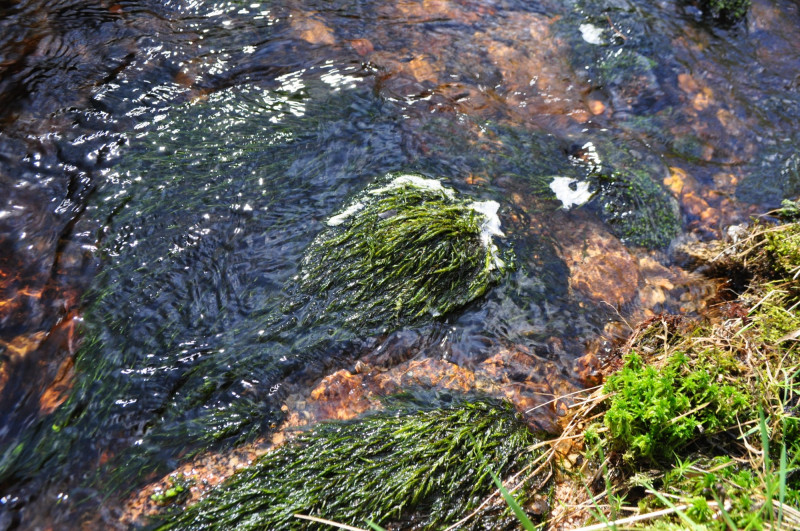
Fontinalis antipyretica

Ariundle Oakwood NNR, Sunart
Text coming soon!
Pterogonium gracile


Falls of Leny, Callander, Trossachs
This uncommon moss has its British strongholds in the west of Scotland. The plants photographed here were growing beside a waterfall in a shaded, humid woodland ravine.
The species is described in more detail in the Mosses of Derbyshire section of the site.
The species is described in more detail in the Mosses of Derbyshire section of the site.
Neckera crispa

Ben A'an SSSI, Trossachs


Resipol ravine, Sunart
This common species is described in the Mosses of Derbyshire section of the site.
In Scotland, N.crispa occurs mainly in the southern and western Highlands, with sparser populations in the Southern Uplands.

In Scotland, N.crispa occurs mainly in the southern and western Highlands, with sparser populations in the Southern Uplands.
Neckera complanata

Riechip Den, Perthshire
This common species is described in the Mosses of Derbyshire section of the site.
N. complanata shares a similar distribution in Scotland to that of N. crispa, although its tolerance of drier habitats means there are more records in the east of the country.
N. complanata shares a similar distribution in Scotland to that of N. crispa, although its tolerance of drier habitats means there are more records in the east of the country.
Neckera pumila


Glen Loin SSSI, Arrochar
As its name suggests, this species is indeed small and almost exclusively found as an epiphyte in Britain, where it has a strongly western distribution.
N. pumila has undulate leaves like N. crispa, but is much smaller and has smaller leaf cells.

N. pumila has undulate leaves like N. crispa, but is much smaller and has smaller leaf cells.
Palustriella commutata

Ben A'an SSSI, Trossachs
Common across Scotland in wet, base-enriched habitats, P. commutata is often abundant and conspicuous.
This species is described in more detail in the Bryophytes of other areas of northern England section of the site.
This species is described in more detail in the Bryophytes of other areas of northern England section of the site.
Campylium stellatum

below Coire Gabhail, Glencoe, Argyll
This species is described in the Mosses of Derbyshire section of the site.
C. stellatum is widespread across Scotland, where it grows in wet, base-enriched ground, often ascending to high altitudes.

Glen Shee
C. stellatum is widespread across Scotland, where it grows in wet, base-enriched ground, often ascending to high altitudes.
Glen Shee
Sarmentypnum sarmentosum


Morrone Birkwood SSSI, Braemar
This beautiful species of slightly base-rich flushes is described in the Mosses of Ben Lawers section of the site.
Sarmentypnum exannulatum

Cairnwell SSSI, Glen Shee
This species is described in the Mosses of Derbyshire section of the site.
S. exannulatum is recorded from sites across much of Scotland, where suitable habitat occurs (moderately acidic, sunny wetland margins and flushes).

in habitat, Lochnagar, Grampians
S. exannulatum is recorded from sites across much of Scotland, where suitable habitat occurs (moderately acidic, sunny wetland margins and flushes).
in habitat, Lochnagar, Grampians
Calliergon giganteum

Slaidhills Moss SSSI, Borders
Text coming soon!
Unusually for a somewhat montane moss, C. giganteum is less common in Scotland than in other areas of Britain. In the west it mainly grows in coastal sites, while it is more common in the east.
Unusually for a somewhat montane moss, C. giganteum is less common in Scotland than in other areas of Britain. In the west it mainly grows in coastal sites, while it is more common in the east.
Scorpidium scorpioides

Glen Shee

Pitarrig Meadow SSSI, Pitlochry
Text coming soon!
Scorpidium revolvens

Cairnwell SSSI, Glen Shee
This attractive, moisture-loving species is described in the Mosses of Ben Lawers section of the site.
S. revolvens is widespread in Scotland, mainly north of the central belt, but there are scattered records from across the Southern Uplands as well.
S. revolvens is widespread in Scotland, mainly north of the central belt, but there are scattered records from across the Southern Uplands as well.
Hamatocaulis vernicosus


Slaidhills Moss SSSI, Borders
A rare specialist of neutral fens and marshes, Hamatocaulis is always a special find. In Scotland, it is only known from widely-scattered sites at moderate altitudes, mostly in the south.
Hamatocaulis can be recognised by a combination of upright, hooked stems (hence the genus name) and leaves with obvious orange-red bases.

in habitat
Hamatocaulis can be recognised by a combination of upright, hooked stems (hence the genus name) and leaves with obvious orange-red bases.
in habitat
Hygrohypnum eugyrium


Resipol ravine, Sunart
Text coming soon!
Isothecium myosuroides


Ben A'an SSSI, Trossachs

Glen Falloch Pinewood SSSI, Loch Lomond
This common woodland species is described in the Mosses of Derbyshire section of the site.
I. myosuroides is a common species in Scotland, found across nearly the whole country.

I. myosuroides is a common species in Scotland, found across nearly the whole country.
Brachythecium rivulare
 Resipol ravine, Sunart
This common species is described in the Mosses of Derbyshire section of the site.
In Scotland, B. rivulare occurs across nearly the whole country, apart from areas of the northern Highlands. It ascends to high altitudes in suitable habitat.
In Scotland, B. rivulare occurs across nearly the whole country, apart from areas of the northern Highlands. It ascends to high altitudes in suitable habitat.
Orthothecium rufescens


Glen Shee


Hypnum cupressforme/lacunosum
image coming soon!
Text coming soon!
Ptilium crista-castrensis


Glen Nant NNR, Argyll
Text coming soon!

in habitat, Glen Nant NNR


Hidden Valley, Glencoe
in habitat, Glen Nant NNR
Hidden Valley, Glencoe
Hyocomium amoricum

Craighoyle Wood SSSI, Cowal
This common species of wet, acidic rocks beside flowing water is described in the Mosses of Derbyshire section of the site.

below Hidden Valley, Glencoe
below Hidden Valley, Glencoe
Rhytidiadelphus loreus

Glen Loin SSSI, Argyll

Falls of Leny, Callander, Trossachs
Text coming soon!
Hylocomiadelphus triquetrus (syn. Rhytidiadelpus triquetrus)

Tentsmuir NNR, Fife
This widespread species is described in the Mosses of Derbyshire section of the site.
In Scotland, this handsome moss is widespread, where it also occurs in acidic sites, unlike in much of Britain.
In Scotland, this handsome moss is widespread, where it also occurs in acidic sites, unlike in much of Britain.
Hylocomium splendens
 Sonachan Hazelwood, Ardnamurchan
This common species is described in the Mosses of Ben Lawers section of the site.
In Scotland, this moss has been recorded from almost every 10km in the country, and is often a common and dominant species of open morrland slopes.
In Scotland, this moss has been recorded from almost every 10km in the country, and is often a common and dominant species of open morrland slopes.
Ctenidium molluscum

Ailnack Gorge, Cairngorms
This species is described in the Mosses of Derbyshire section of the site.
C. molluscum is widespread in Scotland.

Rumbling Bridge, Strathbraan, Perthshire
C. molluscum is widespread in Scotland.
Rumbling Bridge, Strathbraan, Perthshire
Calliergonella cuspidata

Falls of Leny, Callander, Trossachs
This common species is described in the Mosses of Derbyshire section of the site.
Calliergonella has been recorded from just about every 10km in Scotland and is often a common and abundant moss.

Calliergonella has been recorded from just about every 10km in Scotland and is often a common and abundant moss.