


Drinker (Euthrix potatoria)


Dwarf Cream Wave (Idaea fuscovenosa)

Text coming soon!
Blue-bordered Carpet (Plemyria rubiginata ssp.rubiginata)

The beautiful, icy blue-grey trailing edge to the forewings easily identifies this very attractive moth. The rich brown blotches (actually remnants of a highly-reduced central band) on a pure white background are also unique.
The Blue-bordered Carpet has a wide distribution in Britain but is not especially common. It is especially associated with damp or wet lowland, scrubby habitats, hence its residence in the fen at Dry Sandford Pit NR.
The Blue-bordered Carpet has a wide distribution in Britain but is not especially common. It is especially associated with damp or wet lowland, scrubby habitats, hence its residence in the fen at Dry Sandford Pit NR.
Early Thorn (Selenia dentaria)

Named for the very early flight period of the first generation each year (from February onwards), the Early Thorn looks superficially similar to other members of the family but has one key distinguishing feature - it always rests with its wings held vertically above its body, like many butterflies. No other Thorn does this.
The Early Thorn is a common species throughout much of Britain.
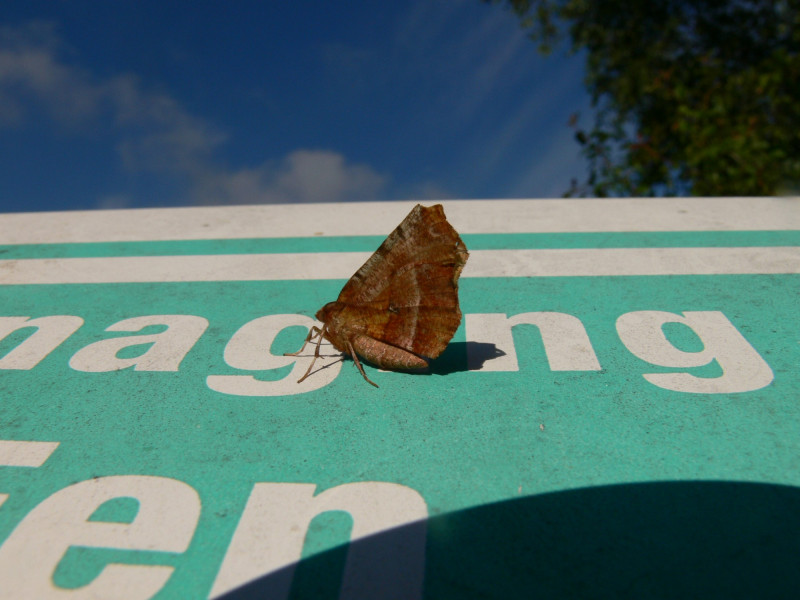
The Early Thorn is a common species throughout much of Britain.
Scalloped Oak (Crocallis elinguaria)


Common Wave (Cabera pusaria)

Text coming soon!
Privet Hawkmoth (Sphinx ligustri)


My favourite of Britain's resident hawkmoths, the Privet Hawkmoth is a spectacular and unmistakable creature, with a bold, pink and black striped body and perfectly-camouflaged bark-like wings.
The Privet Hawkmoth is the largest of the resident hawkmoths, almost twice the size of an Elephant Hawkmoth. Sadly, I don't get to see them in my home county of Derbyshire, with it being just to the north of their range, which covers southern England, Wales and East Anglia.
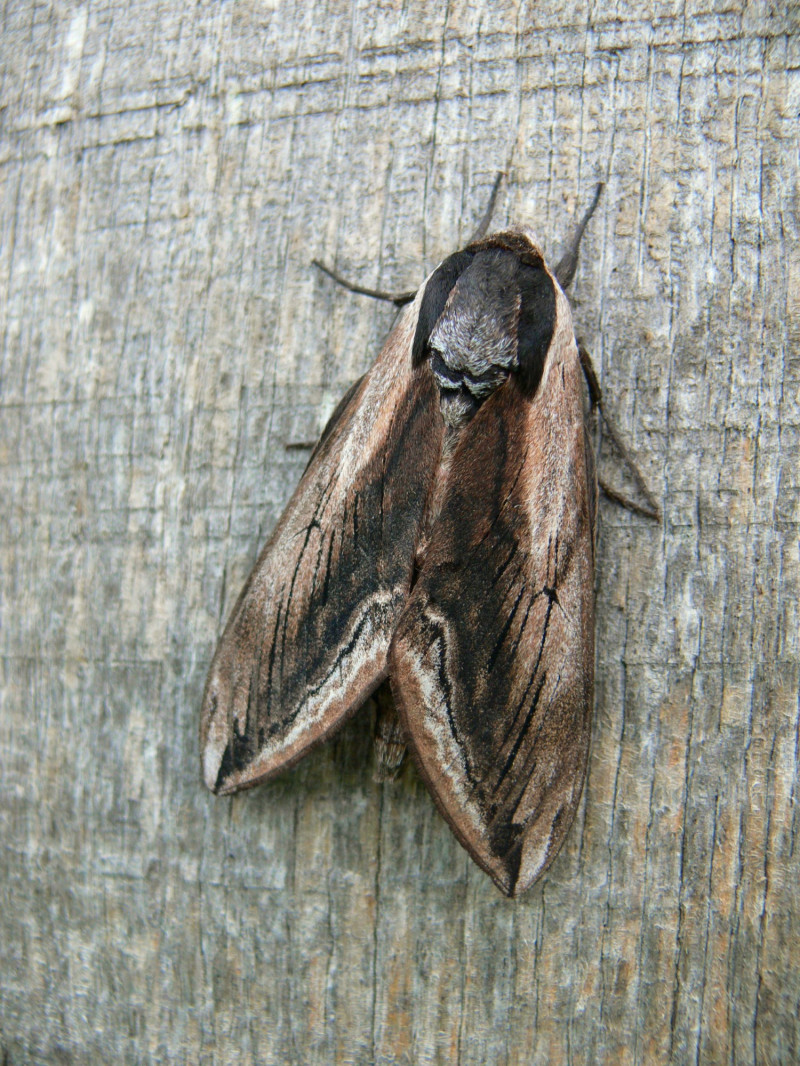

The Privet Hawkmoth is the largest of the resident hawkmoths, almost twice the size of an Elephant Hawkmoth. Sadly, I don't get to see them in my home county of Derbyshire, with it being just to the north of their range, which covers southern England, Wales and East Anglia.
Eyed Hawkmoth (Smerinthus ocellata)

This moth is described in the Moths of other parts of Dorset section of the site.
Pale Prominent (Pterostoma palpina)

This common species is described in the Moths of Wicken Fen NNR section of the site.
Rosy Footman (Miltochrista miniata)

The pinkish-orange wings with fine back patterns make this moth unmistakable. It is fairly common in southern counties of England but much more local further north. Woodland and mature, shrubby habitats are favoured.
Like other members of the Lithosiinae, its larvae feed on lichens, rather than vascular plants.
Like other members of the Lithosiinae, its larvae feed on lichens, rather than vascular plants.
Muslin Footman (Nudaria mundana)

Named for its diaphanous wings, this little moth is a lovely, delicate species is relatively uncommon in southern England, especially in central and eastern areas. It is a moth of open, wooded and stony habitats.
The transparent wings and somewhat indistinct V-marks on them distinguish this moth from other footmen.
The transparent wings and somewhat indistinct V-marks on them distinguish this moth from other footmen.
Dingy Footman (Eilema griseola)


The Dingy Footman has a very distinctive lozenge-shaped profile when at rest, quite different from other members of the genus in Britain. The unfortunate common name comes from its greyish-beige colour, although it is a an attractive, delicate species, with characteristically silky wings when fresh, as seen here.
Double Square-spot (Xestia triangulum)

This moth is described in the Moths of Derbyshire section of the site.
Clay (Mythimna ferrago)

This common moth is described in the Moths of Derbyshire section of the site.
Smoky Wainscot (Mythimna impura)

The Smoky Wainscot is described in the Moths of Wicken Fen NNR section of the site.
Dun-bar (Cosmia trapezia)


Text coming soon!
Dark Arches (Apamea monoglypha)

This very common moth is described in the Moths of Derbyshire section of the site.
Treble Lines (Charanyca trigrammica)

The common name of this moth aptly describes its key identifying feature - the three fine, dark cross lines on a plain sandy background make it easy to recognise, even on worn individuals like this one.
The Treble Lines is common in the southern half of England and Wales, becoming more local further north.
The Treble Lines is common in the southern half of England and Wales, becoming more local further north.
Beautiful Hook-tip (Laspeyria flexula)

Despite its common name, this noctuid is unrelated to the other 'hook-tips', which are part of the family Drepanidae. It is, by and large, a moth of southern England and Wales and occurs in open wooded habitats, where its larvae feed on lichens.
No other British species resemble this moth; the Scalloped Hook-tip has a similar trailing edge to the wings but has a different patterning.
No other British species resemble this moth; the Scalloped Hook-tip has a similar trailing edge to the wings but has a different patterning.
Mother of Pearl (Patania ruralis)

This common moth is described in the Moths of Derbyshire section of the site.
Ringed China-mark (Parapoynx stratiotata)


The Ringed China-mark is a wetland moth and its caterpillars are aquatic, feeding on pondweed and other plants. It is one of the most easily-identified micro-moths, although it is not especially small. The black ring on each forewing makes the attractive Crambid moth unmistakable.
The Ringed China-mark is mainly a species of southern Britain but is very widespread globally, found across Europe, as far east as China and as far south as North Africa.
The Ringed China-mark is mainly a species of southern Britain but is very widespread globally, found across Europe, as far east as China and as far south as North Africa.