


Little Corella (Cacatua sanguinea ssp.gymnopis)


Adelaide, SA
The Little Corella is not an especially little bird, but certainly smaller than some of its cousins like the Sulphur-Crested Cockatoo (see below). This species has a scattered distribution in Australia and is notably absent from the wet eastern seaboard and cooler areas of Victoria and Tasmania.
Ssp.gymnopis is the eastern subspecies, found west of the Great Dividng Range across inland Australia almost as far west as the Western Australian border. Other populations are centred on the Kimberley region, Cape York and the Indian Ocean coast of Western Australia.
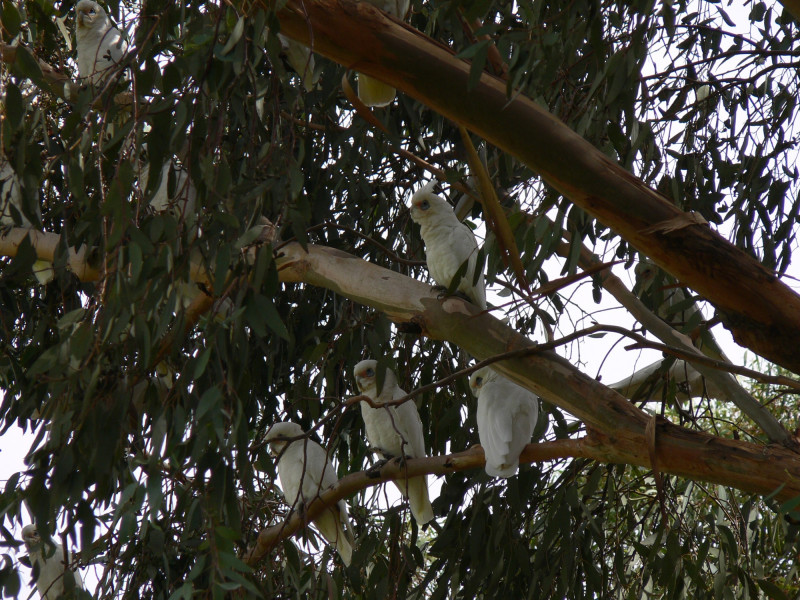
The Little Corella is largely white with a band of red between the eye and bill. The skin around the eye is blue-grey.
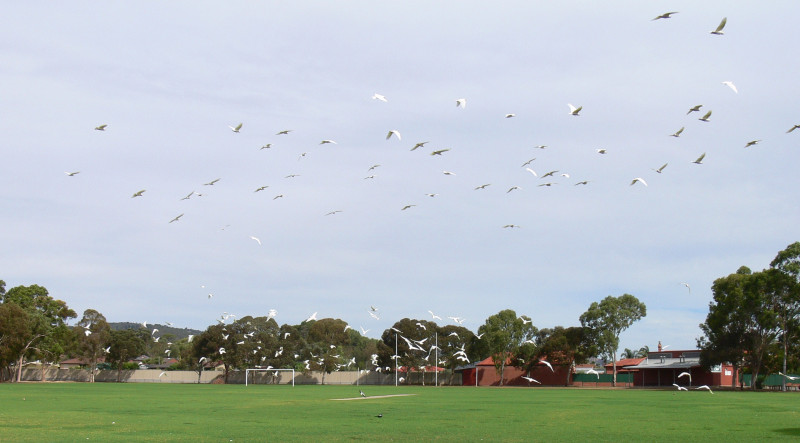
Ssp.gymnopis is the eastern subspecies, found west of the Great Dividng Range across inland Australia almost as far west as the Western Australian border. Other populations are centred on the Kimberley region, Cape York and the Indian Ocean coast of Western Australia.
The Little Corella is largely white with a band of red between the eye and bill. The skin around the eye is blue-grey.
Sulphur-crested Cockatoo (Cacatua galerita)

Adelaide, SA

near Lorne, Victoria
One of Australia's best-known parrots, the Sulphur-crested Cockatoo is a charismatic, large bird, common throughout the country's south-east and entends further north, across the tropics. It also occurs in New Guinea.
The Sulphur-Crested Cockatoo is instantly-recognisable as the only white Australian parrot with a yellow crest. Like other cockatoos, it uses this crest to communicate and indicate mood, etc.
Like other large parrots, this species has a reputation for being very long-lived.

The Sulphur-Crested Cockatoo is instantly-recognisable as the only white Australian parrot with a yellow crest. Like other cockatoos, it uses this crest to communicate and indicate mood, etc.
Like other large parrots, this species has a reputation for being very long-lived.
Galah (Eolophus roseicapilla)


Telowie Gorge CP, Flinders Ranges, SA
The Galah is Australia's most widespread parrot and can be seen just about nywhere except the south coast of Western Australia, the wet west of Tasmania and the wet tropics of Queensland.
In appearance, it is unmistakable with its combination of pink and grey plumage. Galahs often gather in large flocks, especially in inland areas where they can become a serious pest of wheat farms.
In appearance, it is unmistakable with its combination of pink and grey plumage. Galahs often gather in large flocks, especially in inland areas where they can become a serious pest of wheat farms.
Rainbow Lorikeet (Trichoglossus hamematodus)


Morialta CP, Adelaide Hills, SA
A familiar, noisy and gregarious bird of suburban eastern Ausralia, the Rainbow Lorikeet is probably one of the most easily-seen Australian parrots. Its range is very large, extending from the Eyre Peninsula in South Australia all the way around the eastern side of the continent and across the north in the Western Australia.
The scientific name of the Rainbow Lorikeet is derived from its brush-like tongue, which helps it lap up nectar from eucalypt flowers.
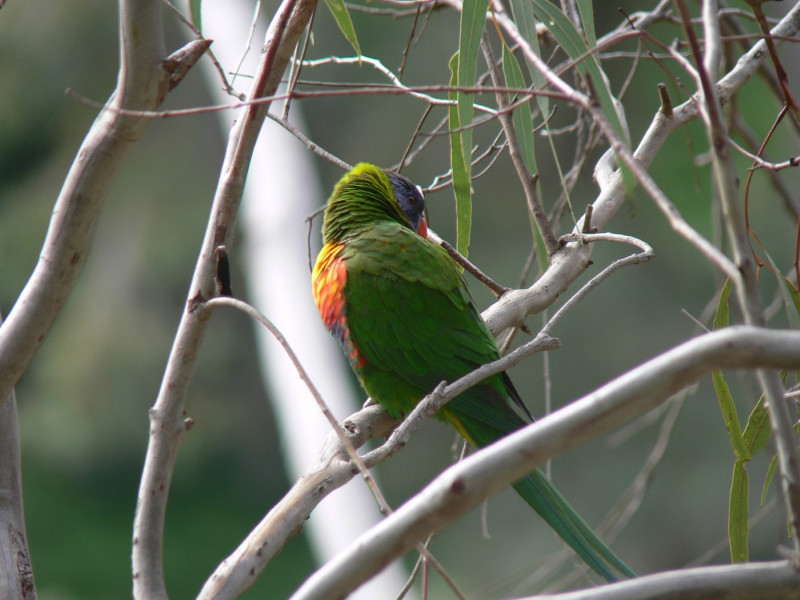
The scientific name of the Rainbow Lorikeet is derived from its brush-like tongue, which helps it lap up nectar from eucalypt flowers.
Musk Lorikeet (Glossopsitta concinna)


Montacute, Adelaide Hills, SA
A colourful, small parrot of southeastern Australia, the Musk Lorikeet is an attractive bird that can be locally common where flowering eucalypts are abundant. When I lived in the Adelaide Hills, these parrots used to visit the orchards at the back of my house to eat the ripening fruit. In these situations, their bright green colours provided surprisingly good camouflage.
Apart from its overall green colour, the Musk Lorikeet has distinguishing red blotches behind its eyes and between the eyes and beak. It also has a blue cap.

Apart from its overall green colour, the Musk Lorikeet has distinguishing red blotches behind its eyes and between the eyes and beak. It also has a blue cap.
Adelaide Rosella (Platycercus elegans ssp.adelaidae)

Scott Creek CP, Adelaide Hills, SA
This local race of the Crimson Rosella was formerly regarded as a separate species but is now accepted as an orange subspecies of the Crimson Rosella.
The Adelaide Rosella is largely orange, but retains the blue chin, wings and tails of the Crimson Rosella, as well as the black mottled markings on the wing feathers. It is locally common around Adelaide, where the 'normal' form of the Crimson Rosella also occurs.
The Adelaide Rosella is largely orange, but retains the blue chin, wings and tails of the Crimson Rosella, as well as the black mottled markings on the wing feathers. It is locally common around Adelaide, where the 'normal' form of the Crimson Rosella also occurs.
Port Lincoln Parrot (Barnardius zonarius)


Wilpena Pound, Flinders Ranges NP, SA
The Port Lincoln Parrot is a distinctive geographical race of the widespread Australian Ringneck which forms the bulk of the central and western range of the species. It is found west of a line roughly centred on Port Augusta in South Australia, although the individuals shown here were slightly to the east.
The plumage of the Port Lincoln Parrot is an attactive mix of green and blues, with a yellow ring around the back of the neck and a black cap. The belly is a beautiful yellow.
When I stayed at Wilpena, the parrots would congregate around watered plant pots on the patio to drink the overflow. Here, they could be approached quite closely and it was easy to appreciate their truly beautiful plumage.

The plumage of the Port Lincoln Parrot is an attactive mix of green and blues, with a yellow ring around the back of the neck and a black cap. The belly is a beautiful yellow.
When I stayed at Wilpena, the parrots would congregate around watered plant pots on the patio to drink the overflow. Here, they could be approached quite closely and it was easy to appreciate their truly beautiful plumage.
Mallee Ringneck (Barnardius zonarius)

Brookfield CP, Murray region, SA
This is the eastern geographical race of the Australian Ringneck, characterised by its pale head. It still has the yellow ring on the back of its neck but the shoulders have a prominent blue grey plumage, rather than the pure green of the western races.
As its name suggests, the Mallee Ringneck is fond of mallee woodland and other semi-arid habitats - it is not a bird of wetter forests. Its range extends from the Flinders Ranges in SA eastwards to the inland side of the Great Dividing Range.
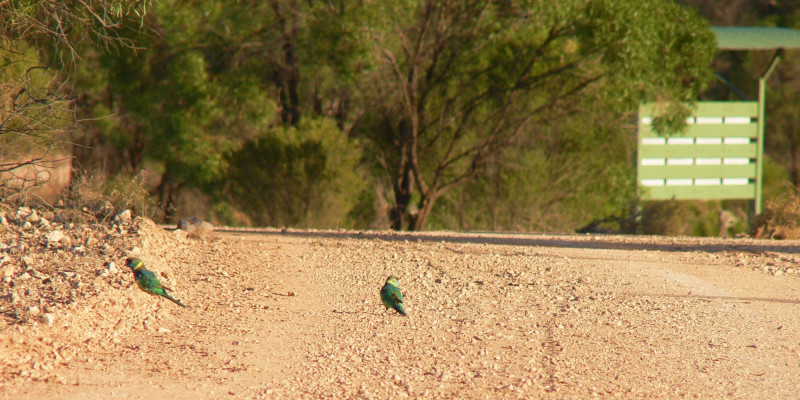
As its name suggests, the Mallee Ringneck is fond of mallee woodland and other semi-arid habitats - it is not a bird of wetter forests. Its range extends from the Flinders Ranges in SA eastwards to the inland side of the Great Dividing Range.
Red-rumped Parrot (Psephotus haemotonotus ssp.haematonotus)

Victor Harbor, SA


Moorook GR, Murray region, SA
This beautiful, fairly small parrot is common across mainland south-eastern Australia, extending from the Flinders Ranges in SA to eastern seaboard on the NSW / Queensland border. Throughout their range, they are strongly associated with water, and inland populations rely on billabongs and pastoral dams.
The Red-rumped Parrot is aptly-named, although only the males have this distinctive plumage. Females are a rather uniform olive-green with paler underparts. They are quite similar to their close cousin, the Mulga Parrot, but males are more blue and both sexes lack the red cap of that species.
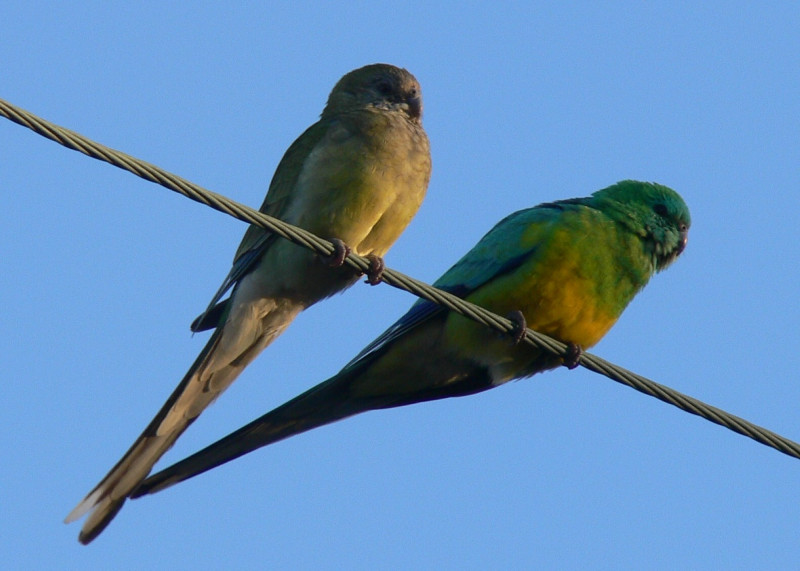
The Red-rumped Parrot is aptly-named, although only the males have this distinctive plumage. Females are a rather uniform olive-green with paler underparts. They are quite similar to their close cousin, the Mulga Parrot, but males are more blue and both sexes lack the red cap of that species.
Mulga Parrot (Psephotus varius)

Wilpena Pound, Flinders Ranges NP, SA

Brookfield CP, Murray region, SA
Mulga Parrots are residents of semi-arid and truly arid woodland, where they can be common. They are fond of Mulga habitats but are also widespread in open mallee woodland.
Like most other parrots, males and female are differently-coloured. Males are richly adorned in shades of turquoise, blue and green with yellow and red on their heads and wings. Females are the usual olive-green.
Mulga Parrots are not seen in flocks, but often seen in pairs or small family groups. Typically, they feed on seeds on open ground beneath trees, to which they retreat when danger approaches.
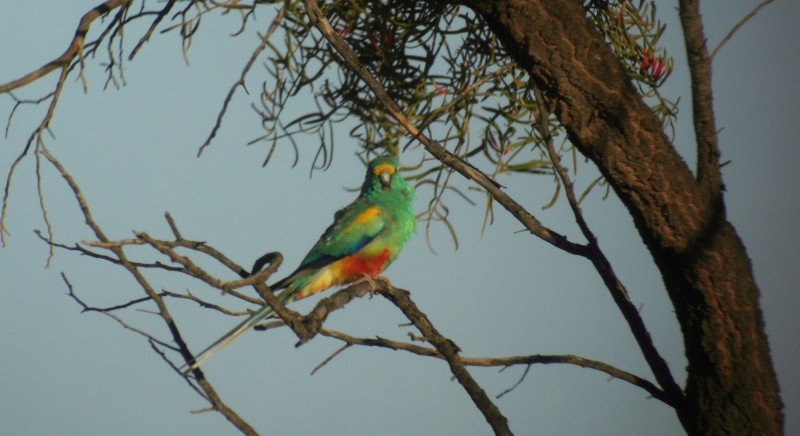
Like most other parrots, males and female are differently-coloured. Males are richly adorned in shades of turquoise, blue and green with yellow and red on their heads and wings. Females are the usual olive-green.
Mulga Parrots are not seen in flocks, but often seen in pairs or small family groups. Typically, they feed on seeds on open ground beneath trees, to which they retreat when danger approaches.
Rock Parrot (Neophema petrophila)

Lincoln NP, Eyre Peninsula, SA
The Rock Parrot is a rather dull-coloured parrot, but one that is perfectly camouflaged and adapted to survive in its rocky, coastal habitat.
Unusually among Australian Parrots, this species rarely ventures more than a few hundred metres from the sea. Here, they feed on various plants that grow in the heathy vegetation that covers the cliff-tops.
The Rock Parrot has two distinct populations in Australia, separated by the vast Nullarbor Plain - the Western Australian population ranges from Shark Bay to the Esperance area. The eastern population occurs in South Australia, and ranges from the Eyre Peninsula to Ceduna. Research has shown that these parrots often prefer to feed on the mainland coast but roost on offshore islands.
Unusually among Australian Parrots, this species rarely ventures more than a few hundred metres from the sea. Here, they feed on various plants that grow in the heathy vegetation that covers the cliff-tops.
The Rock Parrot has two distinct populations in Australia, separated by the vast Nullarbor Plain - the Western Australian population ranges from Shark Bay to the Esperance area. The eastern population occurs in South Australia, and ranges from the Eyre Peninsula to Ceduna. Research has shown that these parrots often prefer to feed on the mainland coast but roost on offshore islands.
Long-billed Corella


Text coming soon!